At Monticello, a new Edith Hern Fossett portrait emerges
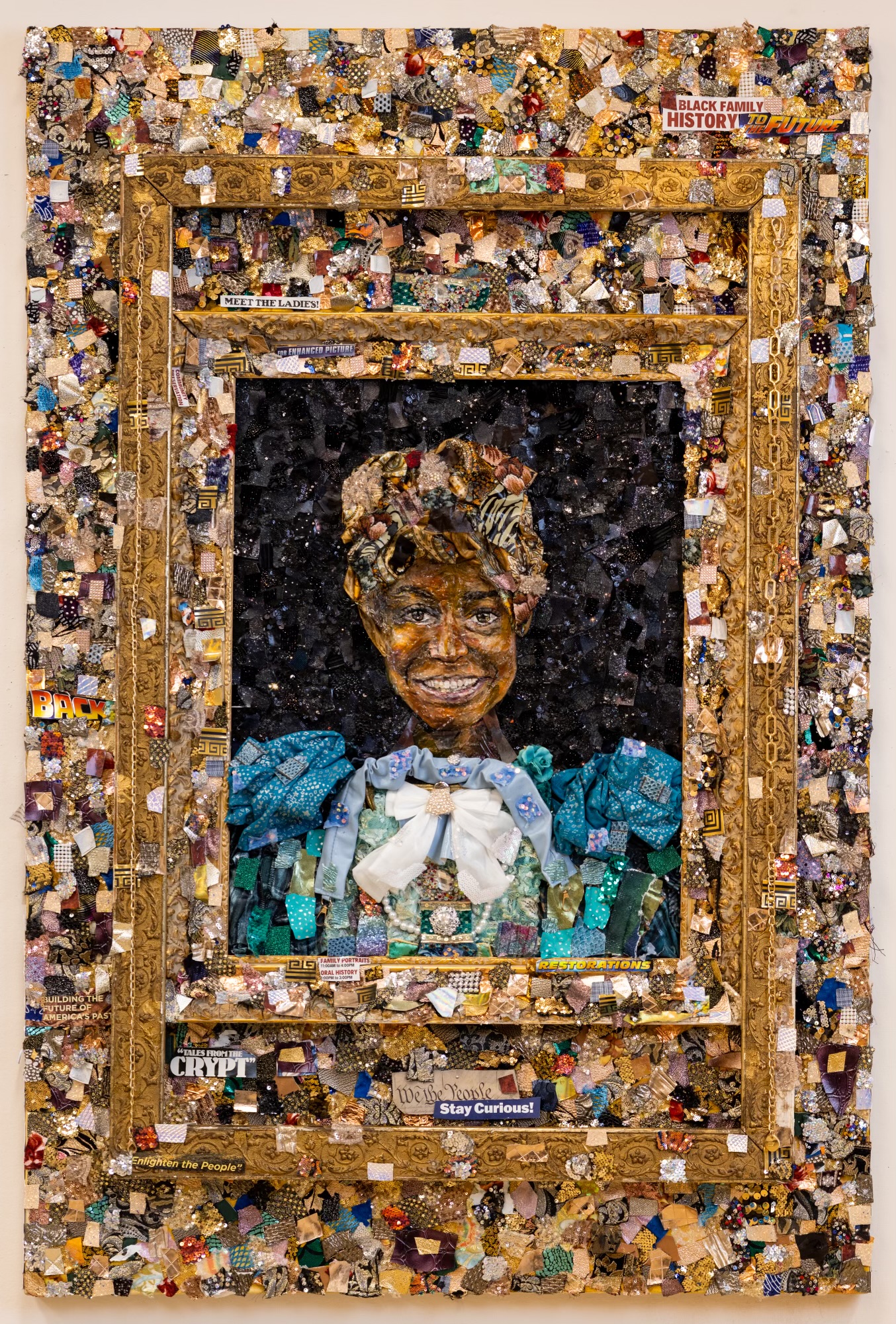

Though inanimate, the portrait “Who Is Edith Hern Fossett?” emits a warmth of its own.
Strokes of a meticulous artist’s hand form a toothy smile. An intricate pattern of sequined fabrics, paper clippings, and gold link chain provide a satisfying visual overload. The happiness captured in her grin spreads to her twinkling walnut eyes, meeting the viewer’s own with amusement.
Edith Hern Fossett is one of the most documented enslaved women to come from Monticello, where former President Thomas Jefferson called home and enslaved hundreds of human beings. Despite this, nothing in Fossett’s own words survives. No descriptions of her outside of her labor exist.
“Who is Edith Hern Fossett?” tries to fill in these gaps in her narrative.
A copy of the portrait will be included this spring in Monticello’s Griffin Discovery Room, a hands-on learning area aimed at helping younger visitors explore how history is created. Jabari Jefferson, a D.C.-based, mixed media artist who made “Who Is Edith Hern Fossett?”, and Auriana Woods, director of the Getting Word African American History Department at Monticello, will hold a public unveiling and discussion of the portrait this spring, too.
Enslaved people were rarely captured in portraiture and photography. And the few depictions that survive are often one-dimensional, hollow, and feed into racist ideas of Black people as subservient human beings. This dearth of representation poses a problem for museums hoping to tell more inclusive stories about American history, especially as Americans turn to historic sites for insight ahead of the nation’s 250th. Nevertheless, Monticello scholars — and descendants of the plantation’s enslaved community — agree this absence presents an opportunity to imagine enslaved people’s lives, such as that of Fossett, in a fresh, nuanced way.
Portraits like this “humanize [enslaved people’s] experiences and what they contributed to Monticello,” said Stephanie Craft Perry, a fourth great-granddaughter of Fossett. “Enslaved people were not anonymous or interchangeable.”
Edith Hern Fossett lived a remarkable life marked by both joy and sorrow. She was born in 1787, the daughter of enslaved carpenter David Hern and Isabel, a lady’s maid and farm laborer. At just 15, she learned French cooking under chef Honoré Julien at what became the White House, and in 1809 brought those skills back to Monticello during Jefferson’s retirement years.
When she returned to the plantation, Fossett reunited with a growing family. She had already married enslaved blacksmith Joseph Fossett, with whom she had 10 children. At age 39, Hern Fossett would see her family split after Jefferson’s death in 1826. Her husband Joseph was one of five individuals freed in Jefferson’s will, but Edith and their children remained enslaved. It would take years of capital, courage, and resolve by Edith, Joseph, and both free and enslaved loved ones to put the pieces of their fragmented family back together.
Fossett spent the last decades of her life as a free woman in Cincinnati, and died in 1854 at age 67. Though two of her children’s fates remain unknown, Fossett lived to see the majority of her children free and thriving in the Buckeye State.
“My grandmother always used to tell me, ‘You come from great people,’” said Greg Knight, a fourth great-grandson of Fossett.
Fossett’s life journey, which can be gleaned from a mix of artifacts, oral histories, and historical research, appealed to a committee assigned to select four Monticello residents — free or enslaved — to highlight in the historic site’s Griffin Discovery Room. Woods said the group wanted to spotlight a member of the enslaved community who historically had not received the same attention as more well-known individuals, such as Sally or James Hemings.
“[Fossett and her family] left a very significant legacy,” Woods said. With the plethora of historical information available, “her story was one waiting to be told.”
The committee settled on Thomas Jefferson, his granddaughter Cornelia Jefferson Randolph, enslaved blacksmith Isaac Granger Jefferson, and, of course, Fossett. Of the four historical figures, Fossett was the only one without an image.
They floated ideas on how to represent her, said Jenna Owens, a Getting Word oral historian. There could be a silhouette. A picture of a descendant? Some of her cookware?
But “[Fossett] wasn’t just a cook,” Owens said. “That diminishes her to her labor.”
The Getting Word Advisory Committee, mostly comprised of descendants of Monticello’s enslaved community, decided an artistic interpretation would best honor Fossett’s legacy. And if the descendants wanted art, no one else was better suited than Jabari Jefferson.
Jefferson — no relation to Thomas Jefferson — already had a personal and working relationship with Monticello. A descendant of Wormley Hughes, an enslaved gardener and stableman, Jefferson knew his family history from an early age. And in 2022, he created “A Moment of Silence,” a mixed art piece commemorating the Burial Ground for Enslaved People at Monticello.
Jefferson said he consulted surviving images of enslaved people to inform his painting, and was struck by the “lack of identity and joy” plastered across each figure. He wanted his portrait of Fossett to be different — so he settled on a smile.
“I was going for humanity,” Jefferson said. “Compared to most in her position, I think she had a lot of highs and a lot of happy moments.”
After the public unveiling, the physical “Who Is Edith Hern Fossett?” will be displayed in the upstairs gallery hall of Monticello’s David M. Rubenstein Visitor Center. A digital reproduction has been installed in the Griffin Discovery Room, which is tailored to the scores of families and 40,000 students that visit Monticello each year.
Rachel Baum, the Hunter J. Smith director of education and visitor programs at Monticello, explained the room is designed for exploring archaeology, restoration, collections, archiving, and oral history. Combining these disciplines forms “Meet Four People of Monticello,” a mini-exhibit where the Fossett portrait will lie.
The portrait is accompanied by a sugar nipper, a historic kitchen item Fossett might’ve used for preparing desserts; a gingerbread cookie recipe believed to be derived from Fossett’s own recipe; and an oral history interview with James Clark, Fossett’s third great-grandson.
“As [museum] interpreters, it’s hard for us to evoke someone’s soul,” Baum said. “We can tell their story, we can use their words, and we can try to give a sense of who they were from the evidence that we have.”
Incorporating art like Fossett’s portrait, Baum added, can go beyond a museum interpreter’s bounds. And it poses an open question to the viewer to glean their own lessons.
For Perry, Fossett’s fourth great-granddaughter, the portrait emphasizes just how much about her pioneering ancestor is still unknown.
“The fact that we know so much about our family history, and that there’s still more to learn — it can be daunting,” she said.
Knight, Fossett’s fourth great-grandson, finds solace in the portrait’s placement — a hands-on activity center where visitors of all ages can engage in an honest history.
“We need to keep passing our stories down,” Knight said. “We don’t want our community’s stories to get lost in time.”
Tiana Woodard is a research and oral historian for the Getting Word African History Department at Monticello, which has commissioned “Who is Edith Hern Fossett?” for the renovated Griffin Discovery Room.

The National Student Clearinghouse Research Center released its 14th annual High School Benchmarks report on September 17, 2026, tracking where...

If you’re overwhelmed by education debt, you may be asking, “Can I file bankruptcy on student loans?” The answer is...

A dividend is a cash payment a company sends to shareholders, quarterly for most U.S. stocks. Reinvested dividends account for...