What My Summer Internship at Aspen Taught Me About Leading Through Uncertainty

Program & Communications Intern, Aspen Institute Business & Society Program
By the time you are a college senior, everyone seems to ask the same question: “So, what’s next?” We spend so much time talking about “finding our path,” as if the destination already exists, and all that’s left is figuring out how to get there. We map out careers, pick classes, choose jobs, schedule coffee chats, and convince ourselves that every decision is another stop on that route. I used to think that was exactly how careers worked, and it’s the mindset I brought with me when I applied to the Aspen Institute Business and Society Program and began my summer as a Program and Communications Intern.
When I accepted this summer internship, I viewed it as another step to get closer to the career I hoped to build. I envisioned helping governments, companies, and communities develop solutions that protect the natural environment while creating long-term economic and social resilience. I was drawn to the Business & Society Program because I wanted to explore the intersection of business, sustainability, and societal impacts. With the public sector facing increasing scrutiny and political uncertainty, many of the decisions that will shape the future of human society are suddenly shifting from government to companies willing to lead. As this shift continues, I realized that understanding how organizations navigate uncertainty may matter just as much as the problems they are trying to solve, which would end up changing the way I think about my future career.
How Do I Find the Right Path?
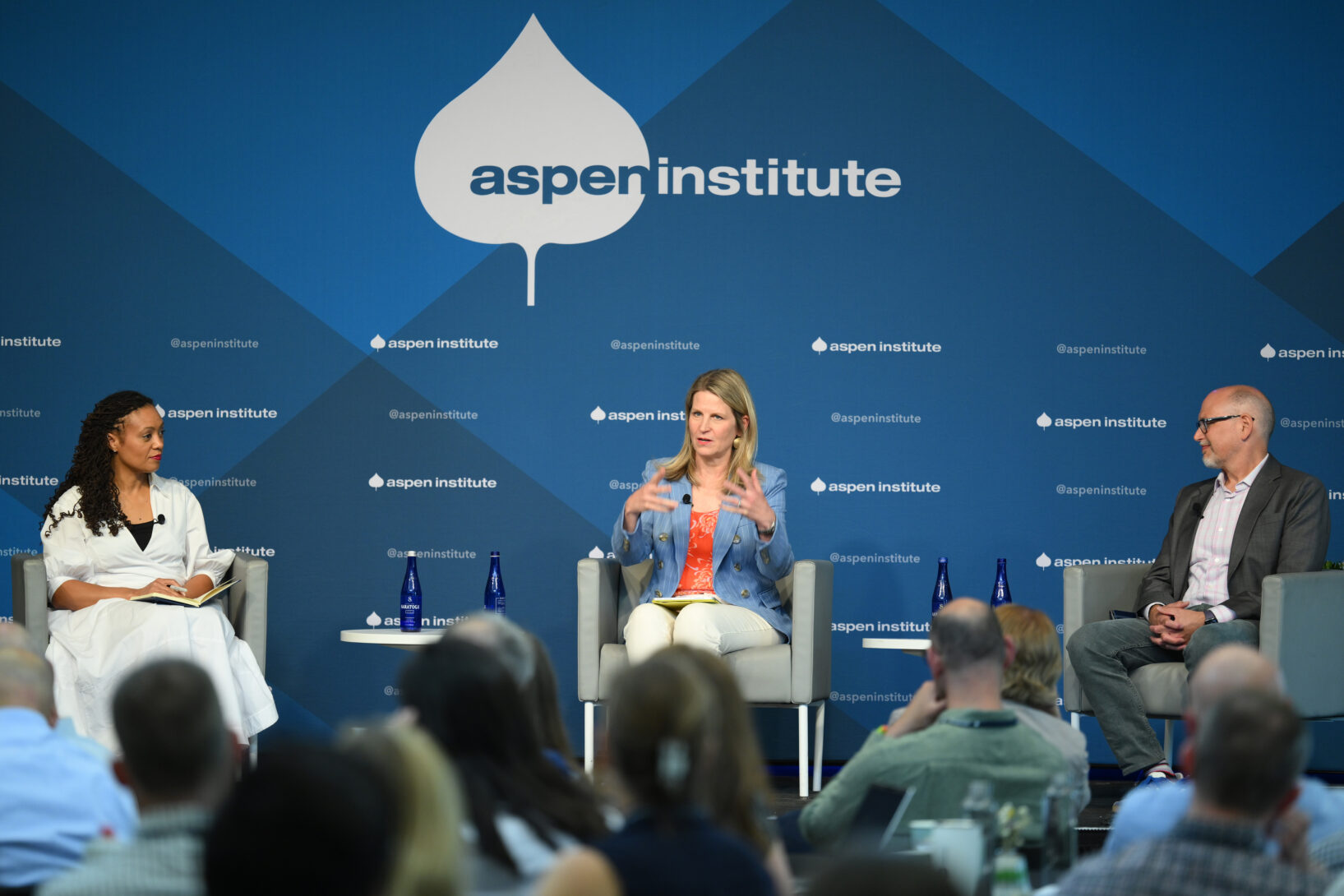
Each year, the Aspen Institute Business & Society Summit convenes nearly 200 senior executives, board members, investors, and thought leaders for three days of dialogue, working sessions, and idea exchange at the frontier of business practice. Over the last nine weeks, my work has focused on logistics, communications, Airtable CRM organization, LinkedIn campaigns, and media coordination in support of the Summit. Together, these responsibilities taught me that communications work is about much more than messaging or marketing. At its core, it seeks to build relationships and create opportunities for meaningful conversations. Thoughtful organization creates the conditions for impactful conversations to happen. Behind every conversation at the Summit were months of planning, spreadsheets, scheduling, and countless small logistical details. Because I had the opportunity to help bring those conversations together, I also had the privilege of listening to them unfold.
Of all the conversations I listened to at the Summit, one in particular completely reframed how I think about my future. During a podcast interview discussing how leaders should approach AI, Dr. Linda Hill, the Wallace Brett Donham Professor of Business Administration at Harvard Business School and Faculty Chair of the Leadership Initiative, introduced a concept that I keep coming back to: pathfinding versus wayfinding.
Pathfinding assumes you’ve already determined the destination and simply need to choose the best route to reach it. Wayfinding is different. Because the destination itself has not yet been created, there is no route waiting to be discovered. It requires moving forward without knowing exactly where you are going, creating both the destination and the path as you go. As corporations build new systems amid rapid technological change, they are not choosing between existing paths, but creating entirely new ones, which isn’t just true for AI, but for people, too. I had been approaching my own career as a pathfinder when what I really needed was to become a wayfinder.
Running Towards Problems
Once I started viewing the Summit through this lens, I realized that many of the people I admire most, the leaders shaping business, technology, and sustainability, don’t actually know where the road ahead leads. We are living in a moment of profound uncertainty. No one seems to know exactly what this technology will become, how work will change, or what the next decade will look like. Yet what struck me most was that this uncertainty wasn’t stopping anyone from moving forward. The leaders in the room recognized that, even though no one had all the answers, they were collectively determined to keep leading anyway. One piece of advice I heard repeatedly throughout the Summit was that people should build their careers by running toward the world’s biggest problems. Looking around the room, I realized that was exactly what so many of these leaders were doing. Surrounded by this sentiment, I stopped worrying so much about having my own future figured out.
This new way of thinking will inform how I seek to build an early career with a positive climate impact. Throughout my education in Marine Studies, I was trained to think about climate action in terms of scientific data and policy frameworks — not yet a business strategy. At the Summit, I heard sustainability leaders no longer frame climate action as a moral responsibility, but a risk mitigation strategy that’s essential for long-term future prosperity and resilience. That perspective extends beyond the Summit itself and was echoed in recent Summit coverage in TIME, Fortune, and the Harvard Business Review, in which several participants described how to communicate the business value of sustainability investments. It showed me that companies can be a lever for change, and it’s why I want to understand both the environmental science and human systems that drive how that change happens.
What Will Guide Me Next?
Through the conversations I heard, the people I met, and the team I had the privilege of working alongside these last nine weeks, I came away with a clearer picture of the kind of career I hope to build. I have learned that those who can bridge the technical world with an understanding of how business, government, and institutions actually create change are often the ones able to solve hard problems. That is the kind of work I hope to do. I want to continue working at the intersection of people and the environment alongside people who are pointed at the same mission I am.
I do not know exactly where my career will lead me, and for the first time, I am okay with that. The people I am inspired by are not guided by certainty, but by a mission. Instead of searching for a perfectly mapped path, I want to focus on developing the values, curiosity, and sense of purpose that will serve as my compass wherever I go. This internship didn’t give me a map for my future. It gave me the confidence to use my inner compass to find my own way forward.
Want more insights like these? Sign up to receive thought leadership and updates from the Business & Society Program each month!
var _ctct_m = “bd512d0aaa0692b8f942a0754b25c12b”;
The post What My Summer Internship at Aspen Taught Me About Leading Through Uncertainty appeared first on Aspen Institute.
Blog Posts Archives UnfavoriteFavorite October 26, 2026 Financial Security Program Kira Tebbe Senior Manager, Benefits Transformation Initiative Tim Shaw Director,...

As more advisors move toward fee-based, planning-driven relationships with clients, a familiar blind spot persists across many books of business:...

Applying for a loan is stressful enough without worrying that a lender may not be treating you fairly. Some lending...