Credit Card Minimum Payment Explained
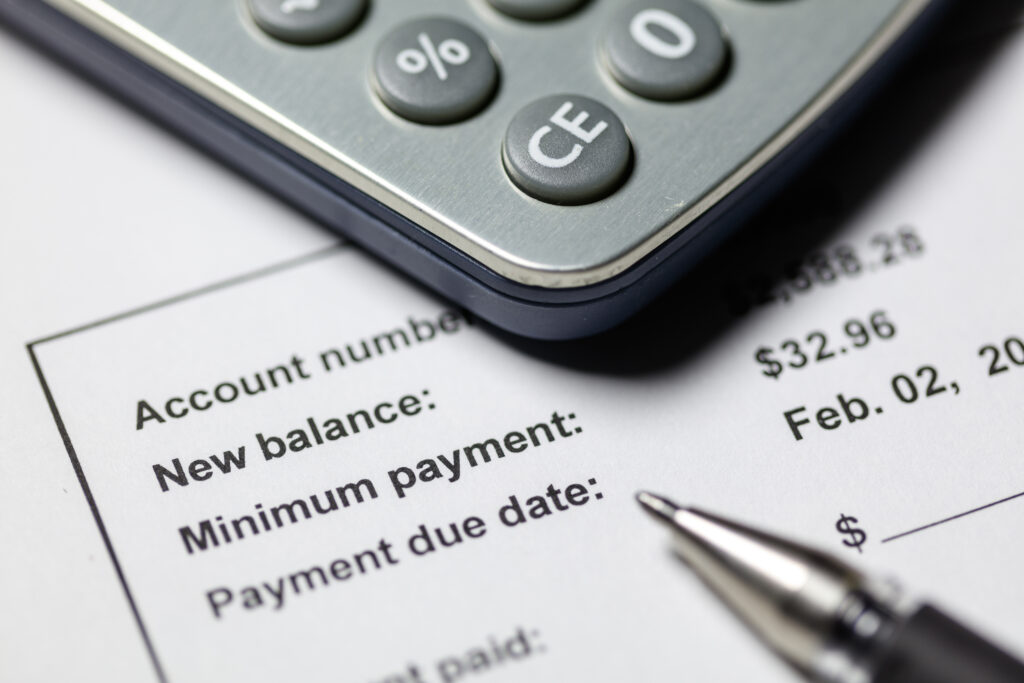

Your credit card minimum payment is the smallest amount you need to pay by the due date to keep your account current. You’ll find this number on every monthly statement, and it changes based on your balance, interest, and fees.
When money is tight, paying just the minimum can work as a short-term safety net. It helps you avoid late fees and keeps your account from falling behind. Over time, though, sticking with minimum payments usually means carrying your balance longer and paying more in interest.
Understanding how your minimum payment works puts you in a better position to make decisions about your debt.
Your credit card minimum payment is the smallest amount you need to pay by the due date to keep your account current. Think of it as the floor, not a target. Paying this amount tells your card issuer that you’re meeting the basic terms of your agreement.
Your statement balance is the total you owed at the end of your last billing cycle. If you pay this amount in full by the due date, you generally won’t owe interest on those purchases.
Your current balance may be higher than the statement balance because it includes any new charges, payments, or fees since the last statement closed. This number updates as you use the card.
You can find your minimum payment in two easy places. First, look at your monthly billing statement, either the paper copy or the PDF version. The minimum due and the payment due date are typically listed near the top.
Second, log in to your online account or mobile app. Most issuers display the minimum amount right on the dashboard alongside your balance and due date.
Keep in mind that the minimum can change from month to month. As your balance, interest, and any fees shift, so does the amount your issuer requires.
Paying at least the minimum by your credit card payment due date generally keeps your account in good standing. This helps you avoid late fees, which can add to your balance and make repayment harder.
Missing the minimum can trigger a fee right away. If the missed payment goes past 30 days, it may also appear on your credit report. So even in months when money is tight, covering at least the minimum can help you avoid those consequences.
One important thing to remember is that paying the minimum keeps your account current, but it doesn’t stop interest from building on the remaining balance. That distinction matters when you’re thinking about how quickly you want to pay down what you owe.
Credit card issuers don’t all use the same formula to figure out your minimum payment. The method depends on your card agreement, and the amount can shift from month to month based on your balance, interest charges, and any fees. Most issuers use one of three common approaches.
Here’s a quick comparison of how minimum credit card payments are calculated on a $3,000 balance:
| Calculation Method | How It Works | Approximate Minimum on a $3,000 Balance |
|---|---|---|
| Percentage of the balance | 2% to 4% of the total balance | $60 to $120 |
| Percentage plus interest and fees | 1% of principal + interest + fees | Around $55 to $75 (varies with APR) |
| Flat dollar minimum | Set floor amount when balance is low | $25 to $40 (applies to small balances) |
If your balance is very small, say under $25 or $40, depending on the issuer, the full remaining balance may be due.
Many issuers calculate the minimum payment as a flat percentage of your outstanding balance, typically somewhere between 2% and 4%. On a $5,000 balance at 2%, your minimum would be $100. On the same balance at 4%, it would be $200.
One thing to watch with this method: as your balance goes down, so does your minimum. That can actually slow down your credit card debt repayment. Each month, you’re required to pay less, which means less money goes toward the debt. A balance that might take a few years to pay off with steady payments could stretch much longer when the required amount keeps shrinking.
Some issuers use a different formula. They take a smaller percentage of your principal, often around 1%, and then add on any credit card interest charges and fees from that billing cycle.
This method can make the minimum payment look manageable. A closer look often reveals that much of the payment is covering interest. For example, if your 1% principal portion is $30 and your monthly interest charge is $45, your $75 minimum payment only chips away $30 from the balance. The rest goes toward interest. Over time, that slow progress can raise the total cost of carrying the balance.
When your balance drops below a certain threshold, many issuers switch to a flat dollar minimum. This floor is commonly set between $25 and $40, though the exact amount varies by card.
If your remaining balance is $200 and your issuer’s floor is $35, that $35 becomes your minimum regardless of what the percentage formula would have produced. If your balance falls below that floor, say you only owe $18, the issuer will typically require the full $18 as your next payment.
In most cases, your account stays current, and you avoid late fees. However, the remaining balance continues to accrue interest. That means repayment can take much longer and cost more overall.
Most credit card issuers calculate interest using a daily periodic rate. That means interest builds on your balance every single day. When you pay only the minimum, a large chunk of that payment goes toward the interest that has already piled up. Only a small portion actually reduces what you owe.
This creates a cycle that can feel like running in place. As your balance slowly drops, a percentage-based minimum payment drops too. So each month, you’re paying a little less, which means even less goes toward the principal. The payoff timeline stretches further out.
Sometimes, yes. If money is tight and you’re choosing between paying the minimum or missing the payment entirely, the minimum is usually the better short-term option. A missed payment can trigger late fees, and if the account goes 30 or more days past due, it could show up on your credit report.
Making only minimum payments month after month can work against you over time, though. Because interest continues to build on the remaining balance, a larger share of each payment goes toward interest. The result is a balance that shrinks slowly and costs more than the original purchases.
Think of the minimum payment as a safety net for difficult months, not a payoff plan. Relying on it regularly means you’ll carry the balance longer and pay more in interest before the debt is gone. When your budget allows, putting extra toward the balance can make a real difference in how quickly you move forward.
Paying more than the minimum each month can make a real difference in how fast your balance drops and how much you pay in interest overall. When you send only the minimum, a large portion of that payment often goes toward interest charges. The remaining amount, sometimes just a small slice, actually reduces what you owe. Adding even a little extra pushes more money toward the principal balance itself.
That shift matters over time. As your principal shrinks faster, the interest calculated on it each month decreases. This creates a cycle where more of every future payment works in your favor. The result can be a shorter payoff timeline and less money spent on interest.
You don’t need to double your payment to see a difference. An extra $20 or $50 a month on top of the minimum can add up over the course of a year. Some people round up their payment to the nearest $50 or $100 as a simple way to pay a little more without overthinking it.
Another approach is to put small windfalls toward the balance. If you get a refund, a rebate, or a few extra dollars from picking up a shift, directing that money to your card keeps your credit card debt repayment on track.
The minimum keeps your account current, and paying more when you can helps you make progress on the debt. Even modest, consistent extra payments can change how long the balance sticks around and how much it ultimately costs you.
One of the simplest ways to avoid late fees is to set up autopay for your credit cards. Most issuers let you schedule automatic payments through your online account, so you never have to worry about forgetting a due date.
When you set up autopay, you typically get to choose how much is paid each month. The most common options are:
Even with autopay turned on, checking your monthly statement is still a good habit. Your statement shows the payment due date, the minimum amount due, and any interest charges that were added during the billing period. Reviewing it takes just a few minutes and helps you catch errors, spot unfamiliar charges, and understand how much of your payment goes toward your balance.
Credit card issuers are generally required to send your statement at least 21 days before the due date. That window gives you time to review the details and adjust your payment if you want to pay more than the autopay amount you originally set.
If you realize you might miss a payment, reach out to your card issuer as soon as possible. Many issuers have options they can walk you through, and calling before you fall behind gives you a better chance of learning what those options are. You may be able to request a different due date, ask about temporary hardship programs, or see if the issuer can waive or reduce a fee. None of these outcomes is guaranteed.
What you want to avoid is simply ignoring the bill. When a payment is missed, the issuer will typically charge a late fee and continue adding interest to your balance. That means the amount you owe can grow quickly, even if you were close to making the payment on time.
Even if the situation feels stressful, taking one small step, like making a phone call or reviewing your account online, can help you understand where things stand. The sooner you act, the more options you may learn about.
Your credit card minimum payment is designed to keep your account current, not to pay off debt quickly. Understanding that difference can change how you approach your monthly payments.
When you can afford to pay more than the minimum, even a little extra each month, you put more money toward your actual balance. Over time, that can shorten your payoff timeline and reduce your overall payments.

Texas public schools lost about 76,000 students in the 2025-26 school year, the first enrollment decline outside the Covid-19 pandemic...

If you’re considering a home equity loan and wondering whether you can deduct the interest on your taxes, the answer...

Articles Single-family rentals (SFR) now house 41% of the U.S. renter population, according to Rentometer Mid-Year...