UpSkill America, and Economic Opportunities Program
Haley Glover
Director, UpSkill America
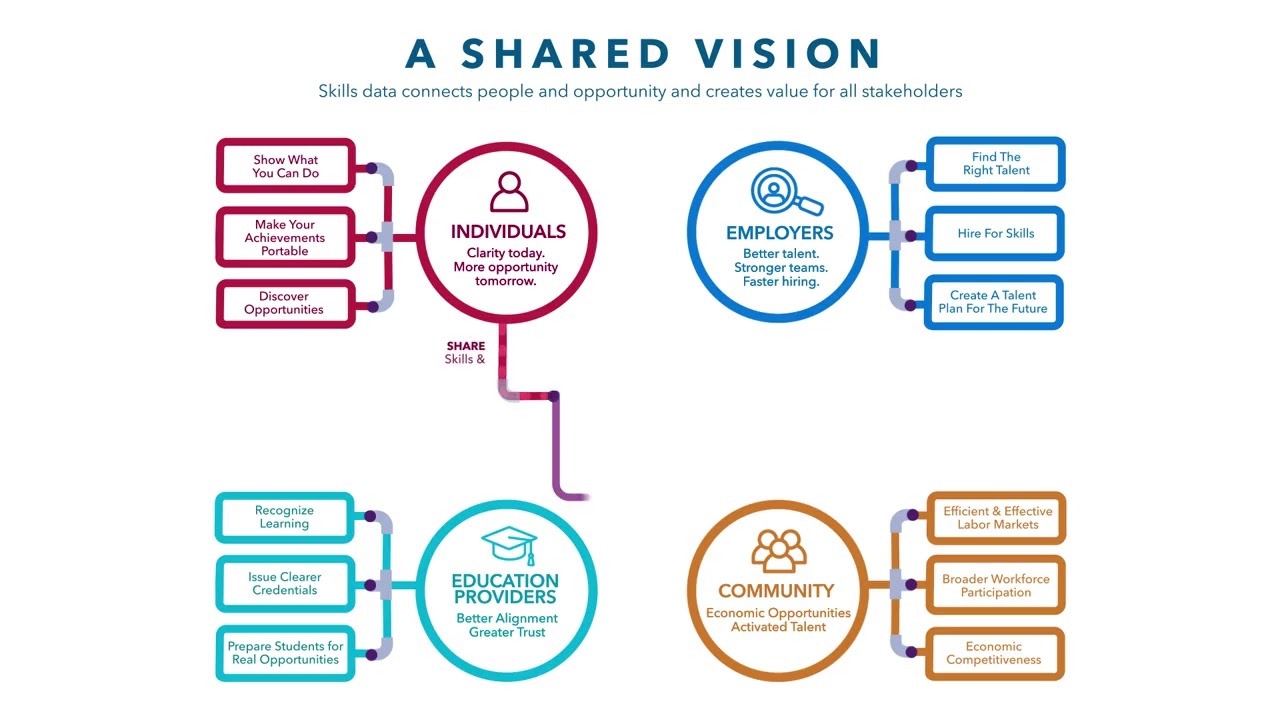
In May 2026, UpSkill America and our partners at Alvarez & Marsal released From Silos to Systems: Building the Skills Ecosystem America Needs. Drawing on more than 40 interviews with stakeholders across the skills ecosystem, it laid out a shared vision. Today, we’re introducing a new visual to go with it.
The vision is straightforward:
A fully realized skills-based data ecosystem creates real value for everyone who participates in it, including producers like higher education institutions and training providers, and consumers like individuals and employers. At its core, skills and credentials data should move as freely as people do across jobs, institutions, and stages of life, connecting learning and work in ways that benefit individuals, employers, and communities alike.
That shared vision has resonated. Since the paper’s release, we’ve seen broad agreement with the narrative and have received little critical feedback. This isn’t surprising, as the vision came directly from system stakeholders. The original visual that accompanied the narrative was another story! Its gears and loops were too abstract. It didn’t show the stakeholders or how they interact, or the value each stakeholder group stands to gain.
So, we took another go. The original conveyed that supply and demand data must work together, and the new version shows who is behind that data, what each group contributes, and what each gets back.
The new visual makes four ideas explicit.
Everyone gives and everyone gets. No group is only a producer or only a consumer of skills data. This is a core finding in our research: every actor can contribute to a well functioning skills ecosystem and benefit from what it produces.
People’s records travel with them. Today, individual effort is often the only way data moves, downloading and re-uploading credentials and re-entering the same information at every step. In a connected skills ecosystem, skills and achievements follow individuals, with their consent, across jobs, institutions, and states.
Employers and communities are contributors, not just end users. Employers supply talent needs, and communities supply labor market information and feedback. Our research identifies these demand signals as a key, and often missing, component of functioning talent marketplaces.
“Portable. Trusted. Interoperable.” The hub of this new visual refers to the shared standards, trust frameworks, and coordination that the shared vision rely on, not any single product or platform. These factors are the infrastructure that makes everything else work.
We designed this visual to show how skills data can move among sectors and stakeholders to create real value for everyone. We also built it for the leaders doing the hard work of building talent marketplaces, to give them a clearer way to explain the value of that work and drive adoption.
We welcome your feedback. Please share your thoughts directly, or via our survey: https://www.research.net/r/Silos2Systems.
Take the survey
About UpSkill America
UpSkill America, an initiative of the Economic Opportunities Program, supports employers and workforce organizations to expand and improve high-quality educational and career advancement opportunities for America’s front-line workers.
About the Economic Opportunities Program
The Aspen Institute Economic Opportunities Program advances strategies, policies, and ideas to help low- and moderate-income people thrive in a changing economy.
Join Our Mailing List
To receive occasional emails about our work — including new publications, commentary, events, fellowships, and more — join our mailing list.
Subscribe
Connect on Social Media
For news and updates every day, connect with us on the social media platform of your choice.
Bluesky
Facebook
Instagram
LinkedIn
Threads
X
YouTube
More from UpSkill America
Blog Posts
Visualizing the Skills Ecosystem
This publication examines how fragmented skills, credentialing, and workforce data systems limit the potential of skills-based hiring and advancement, and outlines a shared vision for building the interoperable infrastructure needed to create a connected skills ecosystem that benefits workers, employers, educators, and governments.
Haley Glover
Publications
Foundational Skills: National Survey Findings
This publication examines how fragmented skills, credentialing, and workforce data systems limit the potential of skills-based hiring and advancement, and outlines a shared vision for building the interoperable infrastructure needed to create a connected skills ecosystem that benefits workers, employers, educators, and governments.
Haley Glover
Publications
Room for Growth: A Survey of Upskilling Approaches — 2026 Analysis
This publication examines how fragmented skills, credentialing, and workforce data systems limit the potential of skills-based hiring and advancement, and outlines a shared vision for building the interoperable infrastructure needed to create a connected skills ecosystem that benefits workers, employers, educators, and governments.
Haley Glover
Publications
Employer-Friendly Practices: A Guide for Higher Education
This resource is designed to help colleges and universities become more employer-friendly and build the kind of institutional capacity that sustains and grows partnerships while simultaneously better serving working learners.
Publications
MillerKnoll: Developing Operations Leaders from Within and Beyond — A Case Study in Structured Talent Development
Bridge, Propel, and Career Academy are built on a practical philosophy: that MillerKnoll has great talent already inside the organization. Finding that talent, developing it, and aligning it to the right opportunities is key to its success. T
Haley Glover
Publications
A Typology of State-Supported Work-Connected Learning Programs
States invest in work-connected learning through dozens of distinct funding streams, grant programs, and agency initiatives, often developed independently over time by different administrations and agencies pursuing different goals.
Haley Glover
Blog Posts
The Workforce of the Future Starts with Adult Basic Education
To create a future-ready workforce system, we must move beyond outdated credentials and analog processes to one that is skills-first, transparent, data-driven, and aligned with the evolving needs of workers, educators, and employers.
Haley Glover
Sharon Bonney
Publications
Foundational Skills: Early Insights from Employers and Providers
This publication examines how fragmented skills, credentialing, and workforce data systems limit the potential of skills-based hiring and advancement, and outlines a shared vision for building the interoperable infrastructure needed to create a connected skills ecosystem that benefits workers, employers, educators, and governments.
Chelsea Miller
About This Post
People/Authors
Haley Glover
Series
Programs
UpSkill America
Economic Opportunities Program
Tags
Upskilling
Upskilling resources
Topics
Economic Opportunity
Impact Areas
Economic Opportunity
Content Categories
Blog Posts
Disclaimer: This story is auto-aggregated by a computer program and has not been created or edited by wisewalletwizard. Publisher: Source link
This publication examines how fragmented skills, credentialing, and workforce data systems limit the potential of skills-based hiring and advancement, and...