Ownership During the AI Revolution
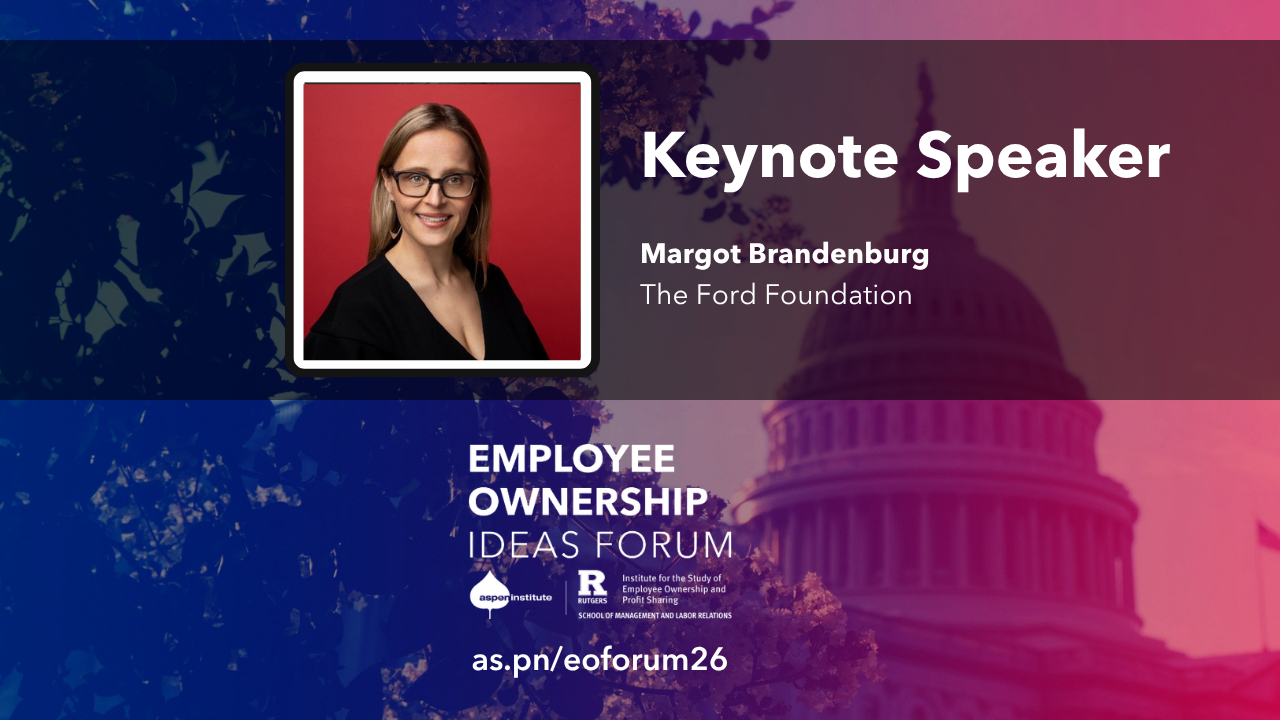

Artificial intelligence and automation promise to unleash a wave of productivity and economic growth — but without deliberate action, the gains will flow overwhelmingly to those who already own capital, deepening inequality and further disconnecting society from the value it helps create. This session explores how reimagining ownership — from broad-based worker equity to public-interest frameworks — can ensure that the AI-powered economy generates a true “social dividend” rather than a private windfall. Panelists will examine the risks of AI growth without consideration of ownership and social impact, how some organizations are already prioritizing shared value and governance, and what policy shifts could institutionalize this approach.
This video comes from the 2026 Employee Ownership Ideas Forum, which took place on June 2-3, 2026, in Washington DC and online.
For more videos from the Forum, visit our event page or subscribe to our YouTube channel.
And subscribe to our podcast to listen on the go.
[00:00:05] Maureen Conway: For this session, we are live streaming, and we have additional guests joining us in the livestream and a few in our audience. For those of you I haven’t introduced myself to yet, I’m Maureen Conway. I’m a vice president at the Aspen Institute, executive director of our Economic Opportunities Program, and it is my great pleasure to welcome you to Ownership During the AI Revolution.
Just a note to the livestream audience, we do hope to get to Q&A at the end of the session, and we love to hear from our livestream audience, so please drop your questions, comments in the chat. We’ll get to as many as we can, but we very much hope to hear from you. This session is our closing session for the forum. For those of you who are here with us in person, please do stay and join us for the reception immediately following this up on the rooftop. We’re looking forward to chatting with you more then.
This conversation is an opportunity to think about how this work connects to some of the broader issues that we’ve been discussing, honestly, already in the forum about really some of the challenges of our time. In particular, how will artificial intelligence reshape work? Who will benefit from the wealth and productivity it creates? How do we assure that our economy continues to provide meaningful opportunities for people to participate, contribute, and thrive?
Over the past two days, we’ve explored employee ownership from many different angles, as a business strategy, a wealth-building tool, a succession solution, and a way to strengthen communities and create good jobs. Underlying all of those conversations has been a larger question, how do we build an economy in which prosperity is broadly shared?
As I mentioned at the opening of the forum, employee ownership is one potential answer to that question. It is one of the tools available to us as we navigate technological change and seek to ensure that innovation strengthens opportunity rather than concentrating it. I can’t think of a better way to conclude our time together than by exploring this relationship between ownership and the future of work in an age of AI.
We’re fortunate to be joined today by an extraordinary group of thinkers and leaders for that conversation, some of whom may be joining slightly late but are en route and will be here. In the interest of time, I will introduce them now, just with the names and faces introduction, and invite them to come up on stage. Come up on stage. That was your cue. I encourage you to read their full biographies on our website.
Joining us today, let’s see, so to my far right, your left, is Richard Freeman, Herbert Ascherman Chair in Economics, Harvard University. Next to Richard is Deric Cheng, Director of Research, Windfall Trust. Next to Deric is Zoe Cullen, Michael B. Kim, Associate Professor of Business Administration at Harvard Business School. Anthony Cimino, Head of Federal Affairs, Anthropic is en route. I am going to turn it over to my fabulous colleague, our moderator today, Liba Wenig Rubenstein, Director, Future of Work Initiative at the Economic Opportunities Program. Liba, I turn it over to you.
[00:03:48] Liba Wenig Rubenstein: Thank you so much, Maureen. Thank you all for being here. I want to just reiterate that this is a sort of hybrid structure where some folks are joining us for the first time, either virtually or in person. Some of you have been here for a very rich two days of conversation.
As Maureen did, I just want to start with some going back to first principles because I think that’s the right starting point for a conversation like this regardless. Why do we care about employee ownership? Why are we just talking about it and bringing stakeholders together over the last two days? Why do ESOPs and co-ops and profit sharing matter to folks in this room?
It’s not just the tax treatment or the succession planning mechanics. Underneath it all, I believe, and I think we’ve talked about this over the last few days, it’s the belief that the people who contribute to the creation of value should share in that value, that ownership can and should shape voice, and voice can and should shape outcomes, and that a more broadly-owned economy is a more stable, more legitimate, and more democratic one.
As we learned yesterday, the grandfather of the ESOP, Louis Kelso, built his whole project on a version of that argument that the problem with capitalism is not necessarily capitalism. It was that not enough people got to participate in it as owners. That argument is definitely seeing some new life 50 years later. We had a Republican state legislator from Iowa yesterday declaring to this audience that shared ownership is the future of capitalism. As Melissa Hoover pointed out earlier today, employee ownership seems to hold a real material answer to some of the questions of our political and economic moment.
Now, if AI transforms the economy the way that some very serious people believe it will, if it is genuinely a productivity revolution on the scale of electrification or industrialization, then we must ask honestly what it looks like to pursue those same values and outcomes in a very different economic and work context. One where the nature of firms is changing and where the capital that matters most may not be the factory or the office building, but a model trained on human knowledge owned, as of now, by a handful of companies, where the gains may be enormous, and the question of who captures them is entirely open.
Anthony, come on down. Perfect timing.
[00:06:54] Anthony Cimino: Sorry about that.
[00:06:55] Liba: That’s what this session is for. While this is a heady and broad topic, we’re going to try to heed Siobhan Sutton’s entreaty this morning to be as obsessed about solving real-world problems for real people as we are about innovation. I am absolutely thrilled that we have this brilliant panel of researchers and practitioners to help us think this through.
Without further ado, I would like to ask each of you, what does the employee ownership tradition bequeath the AI conversation? What are the ideas and the mechanisms and the proof points from the field that you find yourself reaching for when you think about distributing AI’s gains more broadly? Anthony, welcome. I’m going to start with you, in part because you have been on this stage before in a previous role, and you understand firsthand what the employee ownership field is trying to achieve.
[00:08:06] Anthony: First off, apologize for being late and apologize to my fellow panelists. Thank you for having me. This is something that I’ve actually cared very deeply about for a long time. As you mentioned, I’ve been here on the stage before and worked in a very similar capacity in a previous job where it was focused on broadening ownership.
I think starting from that premise is really core to this broader discussion because when we think about broadening ownership, I think about it in three key categories that are very core. From a performance perspective of a company, it helps them attract and retain the best talent. We see them engaged, we see them productive, and we see these firms outperforming their peer groups. There is an absolute incentive from a commercial and capitalistic perspective for firms to do this.
I think what matters more to me is how you think about what that means for the employees and how you think about what that means for the community. For employees, ownership gives them access to uncapped upside and the ability to participate in the profits. When you look at the last four or so decades, there’s been a lot of research that shows that for all but the highest earners, wages have remained stagnant. That’s why it’s key that you get more people access to ownership and that upside.
That also then leads to that third bucket there of that sense of community, that sense of belonging, that sense of engagement. I think that that kind of broader employee ownership construct is even more important now as we see technology and specifically things like AI, create greater productivity and greater asset appreciation, but not always in ways that allows more workers that are built around wages to participate. We really need to assess this moment in time and start talking about what that needs to look like from a policy and a practical shift. Let me stop there.
[00:10:01] Liba: Thank you. Richard, you have been arguing for over a decade that who owns the robots rules the world. We are still talking about this question. How has that prediction held up? Talk about the relationship between employee ownership and the robot revolution.
[00:10:25] Richard Freeman: It still holds. I’ve tried to become a robot to rule the world, but I remain a human, for better or worse. I would just take as a comment of how it stands today was Senator Sanders from Vermont just called for a huge stake of workers as owners, but there’s a big difference between the kind of employee ownership that we discussed in general and what the AI does with this.
AI is going to be increasing the share going to capital. It is capital. The labor share is down seven points from what it was, I don’t know, 15, 20 years ago. We are the lowest labor share country among the advanced countries. China is close to us in this, and we’re the most unequal in wealth by any metric you would want to take. We are a problem.
AI suddenly brings more capital, and the danger is that will add to this further inequality. AI is not the same as normal kind of capital. Let’s say, oil. Norway can own shares of the oil companies. Some companies produce AI, some companies produce key chips that go into AI, and some companies and all of us use AI. Now, AI has taken some things from us and property.
The credit are paying a certain amount of money after a court suit to writers and people whom they use to train their machine. Actually, their machine and all the other machines are trained on everybody’s input. It’s things that we do and say on the internet and elsewhere that they’re using. We have to really rethink it over very differently than we have other forms of capital.
[00:12:42] Liba: I’m going to skip to Zoe on that one because I think this question of how we handle the fact that the value is created from all of our collective information and data is very relevant to your work. Again, back to the question, what does this conversation of employee ownership bequeath the AI conversation from where you stand?
[00:13:10] Zoe Cullen: Thank you very much for that lead-up. The way I think about this is that most of the world’s human expertise has yet to be codified. This is a forward-looking problem. By default, much of this human expertise is owned by employees. The question is, under what terms is it going to be transferred going forward? In addition to our interest in what’s going to happen in these court cases about what has been transferred in the past. I think we’re in a really unique position where employees could have quite a bit of bargaining power over what happens to the knowledge they could supply.
I think many of the companies that have stagnated in their adoption of AI have yet to figure out the right contracts with their employees. This is a contracting problem in my view.
[00:14:14] Liba: Thanks, Zoe. Deric, you’ve joined us for the first time this year. You’re deep in the AI policy and scenario conversation every day. What are you hearing and seeing from being here in this employee ownership conversation that you feel like rhymes with what you work on?
[00:14:39] Deric Cheng: Thanks, Liba. I’d love to build on what Anthony was talking about, which is that I see very similar strong incentives for individual corporations to engage with the employee ownership conversation because, in the end, it retains talent. We still are going to need, clearly, talent and taste, even in an AI-driven world. That employee ownership is a very powerful way to incentivize retaining and acquiring the best talent.
I think when you start to see, maybe as we’re starting to see with software engineering, the top 10% or 20% of software engineers performing 5 or 10 times better, but then maybe middling outcomes for the entry-level workers or mid-level workers, then you really need to compete so hard for that top 10% or 20%. I think employee ownership helps with that.
The challenge that we’re seeing at Windfall and that we’re very concerned about is when you look at this from a macroeconomic lens, if you see the same trends across economies where only 10% of corporations or 10% of workers are capturing the lion’s share of new economic growth, that does start to look very concerning. Because it doesn’t matter how great employee ownership is working, it might only still distribute ownership within that top 10% or 20% of workers.
The real concern here is if you have more superstar firms, if you have more concentration of profits, what are the mechanisms that we can structurally ensure that the majority of Americans, the majority of people are retaining and acquiring benefits from this?
[00:16:31] Liba: Great. Let’s talk a little bit about the evidence that we have to build on for this uncertain future. Back to you, Richard. You have spent decades studying firms that have employee ownership and profit-sharing mechanisms that you categorize as shared capitalism in the Kelso tradition, I think. When those firms go through technological disruption, we’ve certainly seen automation and digitization before, maybe at a different scale, do we have any evidence that workers with an ownership stake fare any differently than workers without one? Do we have any data that shows whether ownership is, in fact, protective in these transitions?
[00:17:23] Richard: The answer is, yes, we do. We have very good data for the disruption of the Great Recession, which is by Doug Kruse and the co-author, whose name I now blank, even though I know her very well. We have evidence for the COVID period that the firms did better in responding quicker with work-from-home things, et cetera. Now, that doesn’t mean necessarily that it’s going to spread to the current situation.
I’d say almost every economic measure that we’ve looked at, the workers-owned firms do a bit better. It’s not massively better or if every firm in the country would change, but it’s enough better to be worth it for all of us to encourage the expansion of these firms.
[00:18:37] Zoe: Is the reason for this, in your opinion, aligning incentives or something else?
[00:18:45] Richard: I think it is aligning incentives is the major mechanism, and it involves both– The employee ownership firms tend to have more 401(k) plans. While you’re owning as an ESOP, your dangers are much less than people who are critical of the ESOPs say. They are more likely to have profit-sharing plans, and they have more mechanisms for the workers to speak out.
The only other real mechanism we have in the country are trade unions, and the trade unions can be good at speaking out and expressing workers’ views. They can bargain for these things, but they don’t have the same ownership arrangement. The ownership arrangement makes it easier, I think, to reach agreement because, one sense, if you’re an owner and you’re a worker, you’re reaching agreement with yourself. In the other case, there’s always going to be some divergence.
[00:20:01] Liba: Zoe, since you jumped in, I want to go to you next because I think your recent research found something that might surprise folks in this room. Can you describe what happens when workers realize that their expertise is being used to train AI systems? Then maybe a little bit about the research on the difference between individual and collective responses.
[00:20:26] Zoe: Sure. My view is that we’re in a very unusual period of time where people are gradually gaining awareness that the process of doing work is not just what it used to be, the work itself, but in addition, a stream of data about the work process, which can be, in many cases, even more valuable than the direct labor.
Now, the share of workers who fully understand and grasp this is low, and the share who have consented to this process is even lower. These are the very training data that make for high-quality AI, especially when you talk about applications within firms that have proprietary work processes, proprietary knowledge that is not easily incorporated into the foundational models from the get-go.
The question is, in my view, as people gain awareness, how will they respond? Now, you can look at this in a narrow way experimentally, just playing videos and informing people about the link between what they do and how well the AI can do what they do. What you’ll see for a range of reasons is that most employees do and believe that they can withhold a lot of the high-quality documentation around what they’re doing.
To give a sense of magnitude, many employees will say that about, on average, and this is again across the US economy, so I’m giving you high-level numbers here, about half of what they are doing is already in the documentation of their employer. If their employer were to do everything they could to fully surveil what they were doing, of course, they couldn’t mind read, but they can fully surveil, you can see that gap rise to between 70% and 80%. Meaning if a replacement worker were to try to do their job with only what was documented by the firm, plus all the surveillance data, they would do about 70% to 80% as well as they would.
Now, then you ask this question, what if you were to try to proactively withhold your data, avoiding surveillance, sandbagging, not providing the documentation, being an active member of the question of how well your replacement might perform, then you see that with a proactive worker, 40% of the knowledge that they have could be transferred to the worker. Meaning that they feel like they could be deleting emails, doing what they can to sort of sabotage the process, something that we saw happen in previous technological revolutions. They feel as though they are empowered to do something like that if called on or willing or choosing to.
To this question of what form do we expect a resistance movement to take, I don’t know the answer to that, but I do think it could be extreme. Now, you asked about the difference between individual versus collective action in this context. Of course, another reality is that most workers believe that they have a close substitute coworker in their firm. If they were to withhold their data, a close substitute worker might not, and it would be for naught. You can see very clearly how this is a collective action resistance, if there were to be resistance.
[00:24:33] Liba: You know what workers understand really well, how important their documentation and data is to training models are the unemployed ones in their industries who are being hired by the firms that are training the models. There’s been some really interesting reporting recently about whether it’s physical work that’s training robots or knowledge work, screenwriters and project managers and others who are not finding work in their fields who are engaging in these jobs that very quickly degrade whose purpose is to train models for other firms. I recommend looking that up if you haven’t followed that.
I think part of what your research points out is this question of alignment between the interests of the firm and the interests of employees, which is ultimately so much of what the employee ownership argument is about.
Anthony, from where you sit inside one of the most valuable AI companies in the world, this question of buy-in, literally and figuratively of the public, of workers, is a huge issue for the industry right now because the data is showing. Certainly, like the folks who are loud online are demonstrating and some of the political issues that are bubbling up show that folks are scared and they don’t necessarily see their interests as workers aligned with the interests of their firms or the larger industry when it comes to AI.
I think you could make the argument on the firm level or the societal level that if we want to get the positive outcomes and the productivity outcomes that we might see, that the most optimistic scenarios show, you actually need workers to be bought in in some way. How seriously is the industry taking this question and taking the question of distribution of value?
[00:27:04] Anthony: It’s a really fundamental question. I think one of the reasons why I wanted to work at Anthropic is I think we are trying to take this type of question on earnestly. I’m sure many folks have seen or read, but our CEO himself has basically said, those that are at the economic forefront of this AI boom should be willing to share and in many ways, give away this power. Hopefully, in the right ways that actually help more people, whether those are workers or citizens, benefit from this, not just from the technological prosperity, but from the economic impact as well.
I think to your core question, how is industry, how is Anthropic, how are they engaging on this? I think it’s a bit uneven still. I think a lot of people, even earnestly, are still trying to wrap their arms around it and some folks aren’t as focused on it. I think for us, this is a problem with a size and scale that does need earnest and really thoughtful engagement.
I think you’ll be hearing from us on a more formal proposals around what that looks like in the coming weeks, because we do want to figure out how we not only take this prosperity and figure out how we share it with governments, how we share it with citizens, how we share it with workers, but do so in a way that can also be adaptable for conditions that we can’t yet foresee.
I think you’ve seen from us, like we have an economic index out there, we’re trying to help people really wrap their arms around this and policymakers better understand it, but these are very quickly changing circumstances. In so many cases, how do we start with ground truth and recognize that the policy proposals we might have today will be additive, but in many cases, will need to adapt as circumstances change?
Hence, we’re trying to engage in these types of dialogues with leaders like everybody here and policymakers, but I think that’s going to be another key part of you’ll see more formal pieces from us, but we also want to recognize that this needs to be an ongoing and evolving debate around that, where we are talking about things like pre-distribution for capital accounts and other areas.
There’s a number of levers that are going to have to change and evolve as this technology becomes more pervasive, as more workers hopefully do get buy-in. It’s not by any means uniform, so what do we do on that? We don’t have the perfect solution, but we are very much engaged to try and figure out how we identify some of these challenges today, but also set the scaffolding and the framework to evolve with these challenges.
[00:29:45] Liba: That’s a perfect transition to Deric because at Windfall, you’re tracking the full range of scenarios and not just at the current capabilities of technology but at AGI level disruption. In those scenarios that you run, what does the distribution of AI’s gains look like in the scenarios that you think are most plausible? Who ends up owning what? What are some of the levers that change those outcomes?
[00:30:20] Deric: Thanks. I’ll talk about the scenario that we are most concerned about that we think is plausible, which is the one in which capitalistic incentives lead very strongly towards consolidation. I think we’ve seen through past technological waves with the internet or with crypto that you have a period of great destabilization and a lot of new opportunities. The idea that the gains might be very broadly distributed, but then oftentimes, you see quite a rapid consolidation these days within 5 to 10 years towards only a few organizations.
I think our real concern is not necessarily, say, just the frontier AI labs capturing the majority of the wealth, but rather the set of superstar firms that may arise as a result of the capabilities created by AI that will likely dominate in each of the sectors that they are most focused in. I’m thinking maybe like 30 to 50 corporations in the US having the majority of new economic growth because they are most able to solve, say, the compute challenges or the regulatory challenges in their specific field.
Then the real challenge with that is historically, in the US, we’ve had the largest corporations with hundreds of thousands or millions of people. Corporations like General Motors or Walmart. This day and age, we’re starting to see the strongest corporations be the tech corporations with maybe 10,000 to 100,000 people. With the idea that AI can highly leverage human capital and make humans much more effective, you could start to see these superstar firms have even significantly fewer, like 100, to 1,000 to 10,000 on the larger end.
When you start to take all these assumptions, and they are assumptions, of course, these are still speculation, and there’s certainly no concrete evidence around this. When you start to think about all of these assumptions stacked on top of each other, you start to see an economy that centers more and more around a small set of humans capturing a large set of the economic potential of the US. When you extrapolate that to the rest of the world, you also see a lot of profit inflows to the US, which is a concern for, I think, every other developed nation.
The idea that this is possible and perhaps even likely is really the thing that we’re most concerned about, and that I think we should be ready for it, even if it’s not necessarily guaranteed to happen.
[00:33:01] Liba: In that scenario, just to put a finer point on it, what happens to the small and medium-sized firms that we’ve been largely occupied with over the last couple of days here?
[00:33:18] Deric: I guess, I don’t see necessary displacement in the traditional sense of people being fired from their jobs. I think the concern here is around what happens when Anthropic or OpenAI are able to compete with every SaaS corporation and build the same types of tools that they have at many times the speed? Would they have the incentive to deliver these tools to the existing SaaS corporations, or would they build them themselves?
Again, I’m talking deeply about capitalistic incentives here because I do know that the leading frontier labs are very, very thoughtful and aware of these sorts of considerations. My concerns are that the economic systems that we create and have created for ourselves lead to increasing consolidation and lead to the disempowerment of these small and medium businesses.
[00:34:14] Liba: The startup guru Eric Ries just published a book called Incorruptible about all of the incentives that direct well-intentioned firms to undermine their values as they grow and be successful. One of the antidotes to that is different governance structures. I don’t know if he talks much about employee ownership per se, but it is a good transition to talk, Anthony, about the way that Anthropic is structured.
Again, this is unique to an individual firm, but you are a public benefit corporation with a long-term benefit trust that has the ability to override investors to protect the company’s mission. Employees have shares, which, of course, is not unusual in tech. Do you see that structure actually constraining the company’s behavior in the kind of scenario that Deric’s talking about or aligning the company’s behavior in meaningful ways? What does it solve and not solve, and what might we learn from that, that we should extrapolate more broadly?
[00:35:32] Anthony: I have to learn a little bit more about the assertions there, but I think, for me, it very much aligns with what we’re talking about here today of employee ownership here. It also has been a real foundational reason as to why many people want to go work at a place like Anthropic because it is so focused on the long-term vision of the company and how we can help society make this transition to AI safely. That becomes not only aligned insofar as the ownership structure and the long-term vision, but then trickles down in the day-to-day.
To be frank, it’s also not just about structure. The tone and leadership from the top is incredibly consistent about where we are focused, what we want to be tethered to from a principled perspective. I do think these types of things can be very additive, but I do think that they also need to be complemented by the cultural practices at an organization. As we all know, so much of that is instilled from the top.
It’s not a perfect answer to the question. Again, I’d have to want to spend more time figuring out how we’d contrast or figure out the alignment with some of what you just discussed, which I think is actually a real thread we should pull on, not just today but going forward. As to the Anthropic structure, I actually think it serves a lot of the purposes we talk as an employee who wanted to work here and is also a shareholder in that sense.
[00:36:57] Liba: Right. I guess part of the question is, given that not all workers can work at Anthropic, [chuckles] can Anthropic, because of its structure and its leadership, resist some of the competitive circumstances that are in place, that may be in place in some of these scenarios? Perhaps, what are ways to take some of the values that are so deeply embedded in the way Anthropic is structured and led and bring those to the industry?
[00:37:38] Anthony: I think the question you’re getting at is, it’s really even broader than Anthropic, to your point. We actually see this between public and private markets quite a bit. Eric Ries, who not only is a startup guru, tried to launch or has launched a long-term stock exchange. I’m getting that wrong. Trying to solve a very similar thing where, how do you as a company build with a mission alignment and for the long-term, versus trying to hit a quarterly number, which might lead to different economic incentives and trade-offs?
I think even in a capitalist notion, this is why people have really seen a lot of growth in private markets because they can see that investment in the long-term. I think that when we’ve thought about that in the employee ownership context in private markets, we can see a huge amount of benefit because they are able to take advantage of that growth. The issue, not to get into too many mechanics, becomes what’s the liquidity opportunities for them?
I take that winding road to say, it’s something more and more companies, and I think we as a market society, need to figure out, of like, how do you think about short versus long-term? How do you think about competitive and capitalist pressure versus a more principled approach? I think the structure Anthropic’s adopted help on that. I don’t know if it’s a panacea, and especially it’s a panacea for all companies, but I do think it’s important that we figure out if there are structural changes that can align.
Again, somebody who’s there because I want to be there, it is also about the culture that’s instilled there because if that culture’s not there, that structure doesn’t really get leveraged in the right ways.
[00:39:18] Liba: We’ve talked a lot about culture over the last couple of days as well, and we had a session yesterday about the challenges and opportunities of employee ownership in publicly-traded companies, which obviously, is a really different dynamic. Check that out if you haven’t seen it. Zoe, yes.
[00:39:34] Zoe: I was just going to ask a question about the culture. A topic that we keep coming back to is the alignment between the innovation goals and the employee’s motivation. I was wondering if you might just speak directly to whether you think the culture is successfully doing that such that the coders are, we hear anecdotes like people are being hired at large sums, intentionally be hired out of the job. [00:40:00] We want you to come, do this, be a big part of the innovation, and then this is not a forever job. That’s not the way to think about it. I don’t know that those anecdotes hold water, if that’s the way you think about it, but I am curious how the culture does or doesn’t align incentives around innovation within Anthropic.
[00:40:27] Anthony: I do think that the culture is very focused on how do we develop and innovate, but doing so in the safest way that we are still focused on and tethered to. I don’t know if this is the exact answer to your question, but I think as a result, the people that want to work here are mission aligned. Then I will say, and again, you’re like, wow, this guy’s really drank the Kool-Aid, and I have, but it has not disappointed.
I think if you came here, and I’m not on the engineering team, but with the expectation of this is what we’re trying to build and these are the types of principles we follow as we build, it is very much what you would expect from the outside operating on the inside. I think we’ve actually had that tested in some pretty massive ways around– Happy to talk about this at length. I don’t think to the point of this panel, but like our most recent model, Mythos, it was the first model with kind of real performative qualities that we decided not to, and the industry decided not to push out broadly because we wanted to make sure it was done safely.
I do think that, at a very external but core decision, really informs how everybody else understands to align with those trade-offs internally of we want to innovate, we want to really build the best performative products, but do so with the principles of safety and helping the broader societal impacts around it.
[00:41:50] Liba: Well, another example being the pushback to the DoD, DoW. One of the things that I’ve tracked closely is how galvanizing that was for tech employees, both of Anthropic who came out very vocally in support of your CEO’s position, but also across the whole industry, including companies that were not taking that stand. A lot of organizing among tech workers to, in a muscular way, stand up for a certain set of values that maybe not all of their leaders were taking. I think flexing their power in that way.
Zoe, we did a series on looking back at the last 10 years of Future of Work, which you should all check out, Back to the Future of Work. One of the anecdotes I keep coming back to is from a senior partner at McKinsey who says if you get any COO or CEO or CTO off the record, they’ll say that no investment that they’ve made in a new technological process that was designed to increase productivity has ever paid off the way that it papered out.
One of the implications being that one of the reasons for that is that workers are introduced to this technology when it’s all done, and the contract is paid, and the IT folks have figured out exactly how it’s going to roll out, and then everyone’s asked to use it. They’re like, oh, this doesn’t help solve any problems that I need solving. It’s pushed down their throats.
I think it speaks to this alignment of incentives question and also a structural question about at what point is the technology introduced and what’s the role of workers in doing that? I think that speaks to your research a lot. I’m curious, as you’ve thought about the difference between individual data ownership and collective, what are the mechanisms by which some kind of collective ownership or agency around data, what could that look like?
[00:44:24] Zoe: The language that’s being used is I’d love my employees to train their coworker. I’ve asked all my employees to train their coworker, and 1 out of 10 seem to be doing that. There’s this training, the coworker phase that I think is very important for a lot of knowledge industries. I work with one very large consulting firm who’s taken the leap to say, we’re going to use the language that we’re going to be more real with our employees.
We want you to train your coworker not to do the tedious tasks that you don’t want to do to save you time. We don’t want you to train your coworker so that you can be more special in the company and everyone has to come to you. We actually want you to train your coworker so that you can share your coworker with everyone so that they can also consult on healthcare benefits the way you do, and so that the coworker is actually truly innovative and can reduce headcount. It’s the best version, leverages more people, can be shared broadly, does what the employee’s best at. That is what they want to shoot for, but talking about it that way is challenging.
Firms that I think are on the frontier of getting to that stage, closing the gap between what Anthropic have said is like the potential from AI versus what’s actually being used currently, closing that gap could mean giving employees some control rights over those coworkers. What I think I’ve seen, and I hope continues to be successful, but it’s very early days, is companies say, we are going to formally give credit and attribution and career benefits to you and your coworker as an extension of you. If your coworker is extremely productive at making other people in the company do their jobs well, we’re going to be tracking that, and there are all these tools now to do so.
[00:46:30] Liba: When you say coworker, you mean an AI coworker.
[00:46:32] Zoe: I’m sorry, your AI coworker. [laughter] Oh, yes. I just took that for granted. Your AI coworker. Sorry, yes. There’s a real struggle in the company whether the coworker should have the same name or a different name. They don’t want the confusion of two Kellys. We want Kelly AI to have a different name. Anyway, so Kelly AI with a different name can now be used in the promotion formally.
If you stay at the company, you get credit through these formal promotion processes for the work your coworker is doing and that you’re doing. Also, if we don’t need you anymore because you’ve done such an amazing job, we are going to require your consent to continue using your AI coworker even after you leave. That means you have to have a conversation. You have to have a conversation.
[00:47:27] Richard: If I’m the owner of the company, I’m saying, no, that’s the capital that I bought and it’s helped you with your job, great. Now you can go if you want to leave. Go to some other company. You’ve had this great experience of working with the “AI co-author” and I just wouldn’t discuss that with you. That would be, it just strikes me as not real.
[00:47:57] Zoe: You get at something really interesting, right? The lawyers and the executives would prefer if there were some piece of the coworker that the worker could take with them. This is sort of a, we are training you to be really good at this process.
[00:48:11] Richard: They do. If you learn to use Claude really well at some company, you are incredibly more valuable than someone who doesn’t know how to use it very well.
[00:48:25] Zoe: We’re not talking about use here. We’re talking about giving your domain expertise to– I feel like use, adoption, agree, but oftentimes-
[00:48:36] Liba: It’s like a skill. That’s like a skill.
[00:48:38] Zoe: I think there’s a mistake oftentimes CEOs are making where they think what they’re asking from employees is for them to be good at using AI, technically good at AI. That’s actually secondary, in my experience, to employees being willing to organize their information, document their decision-making, and upload their domain expertise to AI. Actually, the technical bridge can be solved in many ways. One is giving employees skills to do it, but another is to facilitate that process. It’s the proprietary process and know-how that’s a key component of it. Yes, what you take with you when you’re good at using AI is distinct, one subset.
[00:49:25] Liba: I guess the question is, to your point, Richard, what’s the antidote if it’s unlikely for CEOs to actually willingly negotiate with individual employees around the input of their knowledge for the perpetual use of the company? What are the structures that might be an antidote to that power imbalance?
[00:49:58] Richard: Whenever an employee makes a great contribution to a company, it could have been previously patents or something, and the company owns the patent, and that’s that. When I go away, if I leave the company, my name will be on the patent, but I’m not getting maybe money from that. It depends on how the contract was written. I’m sometimes not allowed to take the knowledge to the next company. That’s been a big issue. That’s one thing we can clarify by just getting rid of a lot of these confident– you can’t work for nine months or two years because you picked up that great knowledge, working at one firm, going to the next. We don’t agree on this issue.
[00:50:51] Zoe: I want to hear your– I’m going to close my mouth. I wanted to hear your response. You think the employees gain enough experience to take it with them in a different way through their accreditation of having done such a thing?
[00:51:06] Richard: Yes. At least as of now, the AIs do need the human help, and they need you to guide the machine to do things, and that’s a great experience for you to take to the next time. You know you can’t trust the client or whatever company is to do some things. It hallucinates here. It does this there. Every one of the AIs warns you. It tells you, you better check because they’re not perfect, and then you learn how to pose the questions more perfectly. There’s a lot of experience I think workers get in using the AIs, and that’s what they’re getting out. I can’t see why a company– I have seen the following.
[00:52:05] Zoe: Do you agree that companies are struggling to really create highly innovative proprietary models, often built on the foundational models, but have their proprietary organizational know-how in a way that’s moving the needle?
[00:52:20] Richard: I don’t really know, to be honest.
[00:52:23] Liba: I think, ultimately, we’re talking about a scenario in which there might not be another similar job for the worker to take that skill to. In Deric’s, the concerning scenario where there’s great jobs for 10% of the workforce and not for the rest, the current logic doesn’t hold. That’s where, to your point, Anthony, this sort of structures and frameworks that we can start to implement now that can be flexible in a perfect world. I think that’s arguably where ownership structures provide some of that underlying mechanism that can scale to whatever the outcome is.
I think one of the themes of the last couple of days is that employee ownership is this rare beacon of some bipartisan agreement or support. We are already seeing questions of ownership and distribution and regulation of AI scrambling traditional party lines. Sam Altman is in DC today meeting with both the White House and Bernie Sanders. Anthropic is, I know intimately, coming up with a bit of a policy agenda.
OpenAI has put out a policy agenda that I think there were some things in there that maybe surprised folks about how progressive they were. There’s also plenty of healthy skepticism about the likelihood of any follow-through in this political environment. I guess this is a question for anyone who wants to take it. I’ll say specifically to Anthony and Deric, but anyone else is welcome to jump in. What’s your take on the possibility of shared ownership, both of firms and of the technology more broadly, attracting some sort of enduring and successful political coalition in this country?
[00:54:57] Deric: I’m feeling very optimistic, perhaps some unfounded optimism, that this is potentially an issue that can remain nonpartisan and that we can all stand behind the protection of labor’s bargaining power and the protection of the American worker as something that is fundamental to this period. I think that one thing we were talking about was which are the groups that we are starting to see get involved in this conversation.
A very interesting group that we have been working with is Catholics in terms of we hosted a scenario workshop with Notre Dame on the ideas of faith and dignity in AI. As we all know, Pope Leo just released an encyclical this last week on really the big questions around what it means to be human in a world in which many cognitive skills are being acquired by AI.
I think maybe one thought that I have is what I’ve been hearing over the past couple days, is not just a financial imperative for ESOPs, but really a moral imperative in that there is some structuring of the narrative in which we believe that this is the right thing to do societally for the human condition, for the human experience to give people collective ownership or to give people broader ownership in the means of success.
I’m starting to really reflect on that myself and trying to understand what this looks like, because in these more radical scenarios of AI taking or becoming a larger and larger proportion of the economy, the question of what is our moral imperative really start to come to the forefront. I don’t think we can function entirely just based on capitalistic incentives. I think we do have to think about what is right for the American public, what is right for the globe. That’s something that I think we’re all going to have to grapple with in the next decade.
[00:57:04] Liba: Anthony?
[00:57:06] Anthony: Perhaps unfounded as well, I too am optimistic. I do not think many of these things will happen without leadership and action. I think the underlying foundation and premise of your question was like we’re now seeing realignment in many political ways that I think actually create opportunity here. When you look at even the evolution of policy positions from the labs, I think Anthropic has uniquely been saying for some time we need to be building a policy infrastructure that shapes the trajectory of this technology and does so in a way that unlocks its promise but mitigates and addresses some of the systemic or problematic societal impacts.
Candidly, I think the companies felt alone for a long time in saying that. We’re no longer alone. These windows are shifting in the direction of society saying something needs to be done here. That needs to be done for the economic piece. It needs to be done for the technological piece. It needs to be done for national security piece. What I’m hopeful is that we can actually find alignment and that we can–
This is perhaps naive and almost embarrassing to publicly say, but can we build a different political expectation that we don’t just move from one event to another careening but actually building a policy mechanism that can evolve on a more gradual basis as this technology evolves? I will admit that is naive. I live and work in this world where it is very unlikely today. If we can actually work to identify ground truths on what is happening and work together to build coalition and alignment on some solutions that might not be perfect but help move the ball as we continue to evolve, I think that will be additive. As I mentioned, we’re seeing a lot of the political will and the policy interest shift in this direction, which I think is additive.
[00:59:11] Richard: How much of the activity that you have done is because you’re a benefit corporation that that gives you perhaps greater protection to do things in the social good? Whereas if I’m not a benefit corporation, I don’t have that leeway. A shareholder or somebody can say, hey, you’re not maximizing profits. You really are not doing it because you’re worried about the world. I don’t care about the world. That’s the way most companies in the US are set up.
[00:59:51] Anthony: I think one result of Anthropic is that those things don’t have to be disconnected. We have shown that you can still think in a long-term values-based manner and be a very successful commercial enterprise, and I think we as a society need to reflect upon that more and more. I do think that there are, to your point, structures that might enable more latitude on decision-making, but I wouldn’t say we get to do that because we’re a public benefit corporation. I’d say we do that, and that’s why our leadership wanted us to be a public benefit corporation. It by no means was divorced from the fact that you can be a successful commercial enterprise while still thinking through the societal impacts and really operating in a mission-aligned way.
[01:00:42] Liba: I have so many more questions, but I want to make sure that we get a chance to see what’s on folks’ mind in the room, so I think we might have time for one or two. Yes, over here.
[01:01:03] Participant: Thanks for that. I’m curious, just to bring it back to I think what a lot of us coming to discuss, employee ownership, one of the central goals and missions is wealth building. It’s wealth building for working-class people who rely on a paycheck. You and your company, possibly an IPO just happened, or that’s in discussion, Anthropic, you all are set potentially to make millions of dollars. The workers here are set, but for real working-class people, I feel like talking about employee ownership AI firms is talking about employee-owned weapons manufacturers. That’s actually how I feel. I’m genuinely curious, in what ways do you all think that AI could actually build wealth for the majority of the world? All I really hear is how it’s taking jobs, how it’s ruining the climate with data centers. That’s my question.
[01:02:14] Liba: Yes, and I think it’s a fair question also to put a finer point that I think when we talk about employee ownership in the context of AI, we’re not exclusively talking about employee ownership of AI firms, but also forms of ownership of the value created by AI. We’ve alluded to it, but haven’t necessarily talked about what those mechanisms actually are that are on the table.
I understand, Anthony, that Anthropic has not yet come out with its own policy agenda per se, but there are certainly things that are on the table. I know, Deric, in your scenarios, you talk a lot about what some of these mechanisms might be. I think it would be useful to put a finer point on that. Certainly, that is not a story that’s being sold very aggressively by almost anyone, but it is what you spend your time on, Deric. Yes, let’s get into that a little bit.
[01:03:15] Deric: Yes, definitely. I think that in the long run, one of the few solutions I can see is that I believe governments and society need to stop abdicating the equity and value creation of technological change to VCs and to private equity and to private firms. In some way, shape, or form, it must capture that value on behalf of citizens or the public. What that looks like can take many different forms. It can take many different narratives, as we’re starting to see on the Democratic side.
I’m personally very excited that the idea of sovereign wealth funds, as brought up by Bernie just two days ago, and honestly, as suggested by Trump about a year ago, is still a relatively nonpartisan issue. We’re seeing good examples of that in Norway. We’re seeing good examples of that in Alaska. I think that if I was to push for something in this conversation, it’s that we should broaden the conversation of ownership beyond just within-firm employee ownership to almost this idea of collective ownership and understand the role of governments and society in terms of changing and capturing this value for the good of society.
[applause]
[01:04:30] Liba: I guess because we have no more time, I think that’s a good transition to one of my final questions, which was really going to be about paint us the picture of the best possible outcome to your question. What are the scenarios that, if we get this right, if we can nail down some of these flexible policy mechanisms and governance mechanisms and shared distribution of the value that’s created, what is the world that the workers of the future get to live in that we should be working toward? What maybe one lever that you want to see that would help us get to that outcome? Anthony, I’ll start with you. [laughter] Sorry.
[01:05:31] Anthony: I was about to step up [unintelligible 01:05:31]
[01:05:33] Richard: It better come out good on Friday.
[laughter]
[01:05:38] Anthony: I don’t know if there’s one lever.
[01:05:41] Liba: I’m not saying there’s one. I’m just saying pick one to highlight.
[01:05:49] Anthony: I’m going to do this as quickly as I can because it’s not just going to be one. I think what we want to see is that the productivity and benefits of this can continue to be harnessed and amplified in a way that drives not only that wealth and abundance, but empowers and enables more people, whether they’re entrepreneurs or they’re employees, and gives them a stake, whether through their company or through increasingly things like governments and just citizenry, in that economic surplus. That we’ve got trust in institutions that we’re seeing this wealth and the impact flow down. Again, whether that’s from a commercial or government mechanisms.
That does so while still realizing so much of this value where we can compress research and discovery and drive forward advancements that are going to be key to societal impacts. It’s, again, for lack of a better perfect lever. In many cases, it will be not only the practices of AI companies and companies integrating this technology for their workforce, but policy frameworks that do contemplate a lot of that questions around collective ownership and really do try and create norms around employee ownership as well. That’s why policy engagement is so core to Anthropic’s mission of shaping that framework, because even the best actors can only do so much. In many cases, we need society to buy in and behave that way as well.
[01:07:26] Liba: Well, I look forward to seeing what the policies are that you guys actually throw your energy and resources behind. Richard?
[01:07:36] Richard: Well, I think it’s not just a question of Anthropic. This is a big capitalist economy with lots of places. The world that I would like to see is where workers have shares not only of their own company but have some stock ownership shares of other companies. That’s the sovereign idea. The problem I see with Senator Sanders’s comment is that those shares were going to be controlled by the federal government, which I’m sufficiently pro-capitalist not to want to see and pro-democracy not to want to see.
There’s got to be some institutional ways in which we either develop a new form of sovereign capital ownership. It can’t be a capital sovereign fund where it does not vote in the company. The company has got to have some public pressure put in through ownership of normal people who they want to see Anthropic succeed because they own some shares, but they also don’t want to see it doing something bad that hurts them and another guys. I would put my faith into that people have this control or influence, and I’m worried about having which some of your rivals have more of this kind of thing where, yes, everybody gets shares, but nobody really makes a decision except for a small number of people.
The panel we had earlier today about who’s on the board of trustees, how do they get elected? Here it has to be not just some workers in the company which will represent the company’s hopefully culture and well-being, but it’s got to be some people from outside the company not politically picked by a president or a thing. I’m not sure how you work that out. You have boards of trustees with some public members who have sovereign shares that they can cast so they have some weight inside the company decision-making. That would be my ideal way, but it’s got to be worked out in lots of details.
[01:10:14] Liba: Like, for example, a union. We don’t have to go there. Deric.
[01:10:25] Deric: For me, in the very long run, one thing I aspirationally can hope for, and I think that we have a once-in-a-lifetime opportunity to aim for, is almost the decoupling of economic security in my head and purpose, in that I personally have many friends and people in my life who are artists, who are creatives, who are working at nonprofits, who are volunteers, in education, who have decided in many ways to sacrifice their own economic gains in order to pursue something that they deeply care about and deeply feel to be valuable.
I think there’s good numbers around this where, say, 85% of executives feel like their work provides them meaning and purpose, but 85% of lower-to-mid-tier employees don’t feel that way. They feel that they get their purpose from elsewhere. I know this is maybe a little controversial because, one, we’re in the US, and, two, everyone here is probably working on things that they are very passionate about, but I do think that there are many people who never get the opportunity in society to pursue deeply what they care about because of the economic limitations or the scarcity that is created by our society. I very aspirationally hope, through some shape or form, that we are able to move closer to a society in which we can give those people those opportunities.
[applause]
[01:11:50] Liba: Thanks. Zoe?
[01:11:55] Zoe: I’ll pick up on unions for a moment. I would like to see something like the rise of knowledge guilds. I’d like them to be perhaps premised on what Hollywood screenwriters did and have been doing for 100 years now, which writers, staff writers, little people in the industry were able to figure out a way of coming together as an industry and to take over the process of a peer attribution.
Everyone sent in their scripts in the 1930s, and peers would figure out who did what, who deserves what credit. Building on that attribution system, they have found a way to reward people for their work every time a new wave of technology comes out. They negotiated separated rights. You want to use the material again, a new technology arrives, you renegotiate with the people who created the original source material because the rights return to them unless it was explicit in the work contract. When streaming came out, you had to renegotiate contracts with materials, footage from 100 years ago.
I think there’s a basis for knowledge guilds that could transfer a lot of wealth to people who, like staff writers, are just middle-class knowledge workers. I’m going to just pause on that topic because I think the other dream I have is that, just aligned with the other panelists here, is that people focus their energy towards using the technology to solve real-world problems. I think with enough directed attention at solving problems that we fundamentally care about as a people rather than saving labor costs, I think then we’re going to see this AI technology benefit everyone. It’s about the objective of the tools.
[01:14:11] Liba: That was a beautiful way to end. Thank you so much. I will give you that closing benefit. Maureen, thank you.
[01:14:22] Maureen: Thank you all so much.
[applause]
Thank you. This was an amazing conversation, a wonderful conversation to close two amazing days of conversation. I really just want to briefly close with some thanks. First of all, thanks to our amazing panel here. Anthony, Richard, I’m going to forget, Deric, Zoe, Liba, thank you all so much for this great conversation.
[applause]
I want to once again briefly thank my team, Matt, Merit, Tony, so many. I won’t name them all again. I named them all yesterday. There are many, many people. This was a big undertaking pulling this together. A really huge thanks to everybody in EOP because, honestly, everybody pitched in, our colleagues in our communications department, the folks at architects. Many thanks also to our colleagues at Rutgers, and particularly to Joseph Blasi, who’s probably still watching us and who is, I’m sure, very sad he can’t be here. Thanks to all of you for all of the hard work you’ve done pulling this together. Giving them all a huge thanks.
[applause]
I just want to say I’m leaving feeling inspired and hopeful because you really can’t solve a problem until you identify the problem. Just having all of you in the audience here, our online audience, having you all engaged, having wonderful speakers really articulate where are we in our economy, why is ownership so important, what are the policy ideas, the business practice ideas, what are the things that we can do to build more ownership and allow more people to lead lives of dignity and of their own choosing and have the agency, as Deric was describing so well, to do the work that they want to do in their lives.
It’s great to have all of your minds on this problem and thinking about how we really address it and build the society we want. Thank you all so much for being here, for being in these conversations. Please join us on the roof to continue. Thank you.
[applause]
[01:16:46] [END OF AUDIO]
The Employee Ownership Ideas Forum brings together leading policymakers, practitioners, experts, and the media for a robust discussion on how we can grow employee ownership for the shared benefit of American workers and businesses. It is hosted by the Aspen Institute Economic Opportunities Program and Rutgers Institute for the Study of Employee Ownership and Profit Sharing.
The purpose of the Institute for the Study of Employee Ownership and Profit Sharing is to study the various models that have emerged and will emerge of employee ownership shares and profit shares in the corporation and society of the United States and around the world.
The Aspen Institute Economic Opportunities Program advances strategies, policies, and ideas to help low- and moderate-income people thrive in a changing economy.
To receive occasional emails about our work — including new publications, commentary, events, fellowships, and more — join our mailing list.
For news and updates every day, connect with us on the social media platform of your choice.
The post Ownership During the AI Revolution appeared first on Aspen Institute.
Texas public schools lost about 76,000 students in the 2025-26 school year, the first enrollment decline outside the Covid-19 pandemic...

If you’re considering a home equity loan and wondering whether you can deduct the interest on your taxes, the answer...

Articles Single-family rentals (SFR) now house 41% of the U.S. renter population, according to Rentometer Mid-Year...