2026 Worker Perspectives | Executive Summary

—Participant with household income less than $50k annually
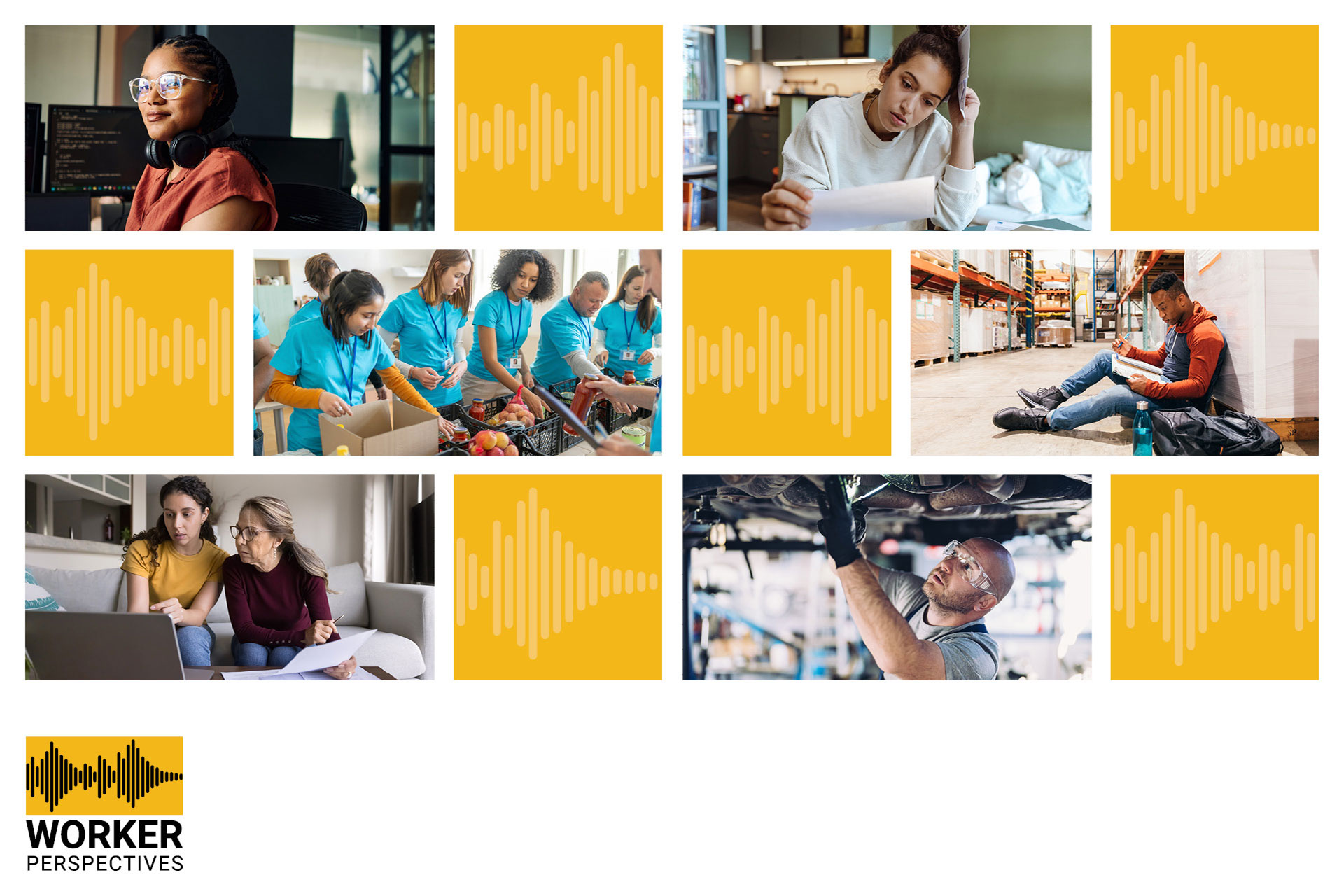
What does it mean to ‘tighten your belt’ when you’ve already run out of notches? In 2025, in an economic moment where unemployment was low by historical standards, job growth and job hiring had moderated (US Bureau of Labor Statistics 2026), and inflation remained elevated (Board of Governors 2026), the cost-of-living pressures have been felt unevenly across the economy. The affordability discussion and debates of a “K-shaped” economy, where different segments of the population experience fundamentally different economic recovery, have been widely discussed in national news recently (Stephens and Perry 2025). These narratives suggest that low- to moderate-income (LMI) households are experiencing economic discomfort and financial instability (Dalton et al. 2021).i It is with this economic context that the Federal Reserve renewed our Worker Perspectives research to see how LMI workers and job seekers have experienced these economic shifts in costs and employment, and how these perspectives influenced household decisions and labor market behaviors. Understanding these ground-level realities strengthens the Federal Reserve’s ability to monitor labor market dynamics tied to its dual mandate.
Collecting qualitative data from 63 workers and job seekers across the country with a household income of $85,000 or less,iithis research conducted 11 focus groups, two of which were conducted in Spanish (for more information on the methodology see Appendix B)iii, to capture lived experiences and direct perspectives from workers and job seekers. Through these conversations, the research aimed to learn how workers in LMI households are balancing income against persistent cost of living pressures and navigating employment opportunities in a moderated job market (Brave et al. 2026). Have they changed their consumption behavior to account for these issues? What is driving their employment decisions? And what is their confidence in the future of the economy or their employment opportunities?
“Sometimes I do fall behind just with basics like food and things of that nature…but now I work two jobs and I have a family of five. So, I do have to make things stretch throughout the month and things of that nature, but I do make enough to survive. However, it’s barely working.”
—Participant with household income between $50k-$60k annually
The conversations consistently carried a serious and somber tone, with workers and job seekers expressing ongoing and more recently acute concerns about rising costs, wages that are not keeping pace, and few opportunities for economic mobility. Participants spoke with rising urgency about economic struggles, noting that while they have historically been in some form of paycheck-to-paycheck financial circumstances, their situations have recently become more challenging to manage. The focus group discussions included stories of how participants’ daily lives have increasingly been filled with “distress” over the choices they have to make, references to more recent focus on “survival” as opposed to mobility, and managing “overwhelming financial stress”. These stressors forced most participants to focus on decisions that ensure their day-to-day survival and discussed how already strained budgets had to be stretched to make ends meet.
Due to their focus on getting from day-to-day, most were not able to pursue avenues for economic mobility. Most were in some form of job search but struggled to attain new employment; and those who were employed expressed a sense of thankfulness for the job they had. Compensation remained a consistent job quality priority for most, while flexibility, work-life balance, treatment, and career progress remained valued elements of job quality. Beyond this, participants expressed pessimism about the economy and job market as a force outside of their control, as opposed to the agency they needed to have about their own ability to manage through tough times. Yet, when thinking about their own situation participants spoke of the need to “stay positive” to help them navigate day to day economic uncertainty.
Circumstances for these participants tell a story that quantitative data alone cannot fully illustrate. Understanding the full economic story is important to see where, why, and for whom persistent strain could affect the broader system. The consequences of continued daily pressures and rising instability for LMI households have broader implications for the overall economy. Effects of these conditions for a substantial share of the national population may weaken workforce participation, reduce long-term purchasing power, heighten credit default risks, threaten housing stability, and exacerbate food insecurity, as it has for participants in this research.
The University of California’s Blue and Gold Opportunity Plan covers systemwide tuition and fees for California residents with family incomes...

Publications Archives UnfavoriteFavorite October 9, 2026 UpSkill America, and Economic Opportunities Program Haley Glover Senior Director, UpSkill America For many...
Texas public schools lost about 76,000 students in the 2025-26 school year, the first enrollment decline outside the Covid-19 pandemic...