Who Tells Charlottesville’s Story? Next-Generation Voices Shape Our Cultural Legacy

by Jessica Harris
Jessica Harris is based in Charlottesville, Virginia, and has written for Vinegar Hill Magazine for 3 years. She’s passionate about accessible arts education, community-based work, and, of course, 70s & 80s music.
There’s no lack of stories told about Charlottesville. For many reasons, the national spotlight has been on our community – in more ways than I can count.
But the stories told about Charlottesville haven’t been relegated only to news articles. Plays, music, films, and other creative arts have all captured various aspects of our community.
Performances like Suzan-Lori Parks’s recently released and critically acclaimed Sally & Tom display one of Charlottesville’s most noted stories of Sally Hemings and Thomas Jefferson on a national stage. We’ve had Priyanka Shetty retell and reinterpret the events of August 11 and 12, 2017. And numerous musicians and writers have shared our stories via original songs, popular books like My Monticello and Charlottesville and verse, like that of poet MaKysha Tolbert.
Despite Charlottesville’s wealth of creative expression, we don’t often feature the stories told by us and about us locally. And we haven’t amplified the nuanced or bold stories about our own legacies that often go undertold. Without a clear, cultural footprint driven by authentic storytelling, I wonder: What will the cultural memory of Charlottesville be in 5 years? 10? 50?
As a theatre artist and educator, I believe performing arts in particular can be used as a tool to transform communities and shape the way we remember. Performance is not just an avenue for expression, but a vessel into our collective memory and cultural heritage. In this time where arts and culture are being used as the first line of attack for political polarization – as evidenced by the current White House takeover and rename of the Kennedy Center for the Performing Arts – these homegrown, new, authentic stories are needed now more than ever. And if we don’t tell them, who will?
The answer to this question is to amplify youth’s creative voices.
While the next generation is certainly our future, it’s not just the passing of the baton that warrants our listening to young folk. Their perspectives, their understanding and their experiences are distinct, and challenge us to envision new possibilities. They remind us of where we have been and how far we have to go.
Enter Saturn Edwards.
For Saturn, a Charlottesville native, their interest in being an artist stems from wanting to ensure that authentic stories are centered. As an actor, a curator and a burgeoning playwright, they seek to tell stories from a bold lens and to ensure all narratives are rooted in authenticity.
As a child, Saturn came across a character description in a play they were reading.
“His name was something like ‘Marlin,’” Saturn recalled. “And his character description was ‘Black. Likes rapping.’ And I was like, okay, we gotta do better than this.”
Suffice to say, Saturn has committed to this effort.
Similar to the character, the stories we tell about Charlottesville deserve nuance and authenticity that represent crucial moments, quandaries and the legacies we want to leave behind.
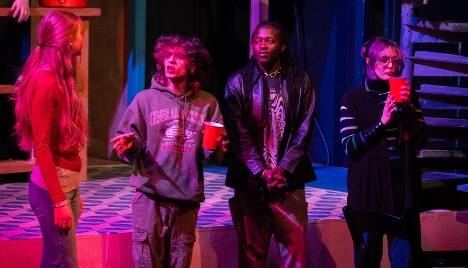
Saturn, 20, has lived in this community their entire life and addresses these challenges in their work. Most recently, they just finished writing a play called Floorboards. Set during the Harlem Renaissance, the play follows a Black queer community working on the fictional ship S.S. Dewberry and offers a lens into the ship’s working class, LGBTQ and racially diverse staff.
They were inspired to write this story because they feel “masculine black lesbian stories aren’t highlighted or told at all.” They’ve submitted the piece to a number of places for publication and staging, including the Trans History Project and other programs and theatres.
“The goal with floorboards is to tell a story about how Black people, how working people came together, especially through art, because art was the main way that queer people were able to express themselves,” Saturn said.
While not explicitly about Charlottesville, they utilized research on local narratives, places, and LGTBQ experiences to connect local stories to the play’s broader narratives and themes.
One prime example is the play’s callback to the Dewberry Hotel. Folks walking on the Downtown Mall will recognize this behemoth, empty building that has been home to the “Music Box” art exhibit for years. Saturn remembered the first time they saw the installation, they noticed someone had graffitied the words “not a local artist” on the art itself, as it was created by a guest artist. This moment stayed with them.
In Floorboards, they named the ship the “Dewberry” as an homage to the hotel, to “represent the potential that local spaces could harness when the community actually invests in them.” Saturn shared that it is important to grapple with the complexity of local disinvestment, as evidenced by the hotel’s lack of utilization and the subsequent artwork’s non-local focus.
Saturn says they are curious to learn more about this town they call home. For instance, they recently learned about Vinegar Hill’s Blue Diamond Cafe, and are inspired to learn more and tell stories of that place.
“I want to read more about black communities in my city,” Saturn shared.
Inspired by this history, they hope that Charlottesville embraces its Black cultural legacies more fiercely. Next up for them is pursuing a theatre and liberal arts degree in college. And in ten years, they hope to come back and “shake things up in Charlottesville.” Ideally, they hope to serve as an artistic director, shaping the narratives and stories that theatre-goers experience.
Individuals like Saturn inspire hope for the future of our community’s creative expression and preservation. Works like Saturn’s have the potential to open up Charlottesville’s stages, its pages and its galleries more widely to generations to come. Our legacies will be remembered through their eyes and ears, and we have the opportunity to uplift their stories now.

Only about 12% of college students pay full sticker price. The share paying the advertised rate has been shrinking for...

While marriage often involves merging finances, debt isn’t always a shared burden. If one partner faces overwhelming financial distress while the other remains...
Current Reports Arbor Realty Trust’s Top Markets for Multifamily Investment Report, developed in partnership with Chandan...