What Bloomberg CityLab Taught Me About Leading Before You Have the Answers
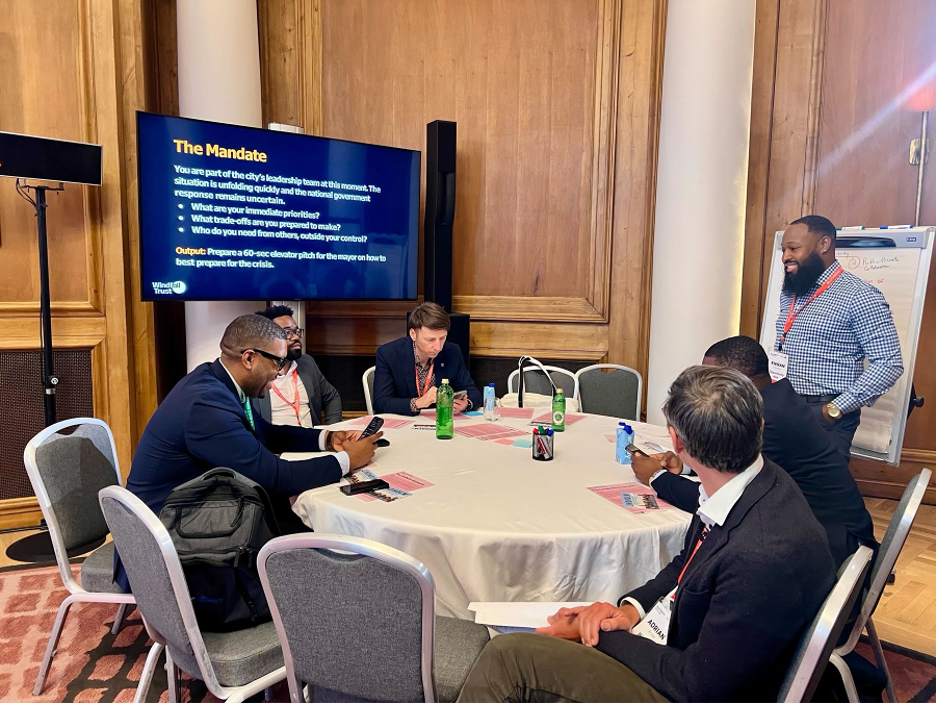

At Bloomberg CityLab 2026 in Madrid, I came prepared to lead a small group of attendees but instead left with an important reminder.
I was one of five scenario facilitators in a breakout session hosted by Windfall Trust, titled “How Would You Respond to an AI Interruption?”. I found myself seated alongside mayors, civic executives, and policy leaders from across the globe, all of whom had been handed a scenario of considerable weight: Lindholm, a fictional mid-sized European city of 650,000 people, its largest employer automating 20,000 jobs over the course of eighteen months, unemployment rising sharply, municipal revenues declining at precisely the moment social service demand was surging, and the national government’s response still uncertain. The instructions to CityLab attendees were simple: you are part of Lindholm’s leadership team, and you have sixty seconds to tell the Mayor how to respond.
What unfolded next was something I’ve recognized consistently at my table across years of facilitation work. Brilliant people did what brilliant groups do: reached for frameworks, debated parameters, and invited their favorite search engines and large language models to the table. With all the processing power present, my group chased the answer everyone could accept before anyone committed to a direction. In government, we’re often trained to lead with the answer rather than the question. Before my group developed a strategy, I intervened with a question: as the people charged with leading this city, what comes first — the economy, or the people within it?
I expected the table to keep circling. What happened next, was the opposite.
Mayor Paul Young of Memphis answered with a precision that only comes from someone who has made this choice in a real city, under real pressure. If stability is the goal, he argued, then people come first — because a community is only as stable as the people within it, and everything else you hope to build will collapse without them. Anything else is just a blueprint for chaos. Mayor Young’s argument was not a philosophical statement. It was a structural one.
On the foundation of “people first”, the group could finally build. Mayor Leonardo Williams of Durham added the lived complexity of leading a city through economic transition; an executive from Bloomberg Philanthropies’ African Leaders Initiative widened the frame to cities facing disruption with fewer resources and higher stakes; and a smart cities practitioner from Germany grounded it in operational reality. Together, my group built a working model on that single premise — incentive structures, philanthropic activation, workforce retraining, economic stabilization, and entrepreneurship pathways should be designed to absorb displaced talent before it disconnected from the labor market for good.
The lesson I carried home from that session is one that I believe has implications well beyond the walls of a conference breakout table: We are entering a period in which cities will be asked to respond to AI-driven disruption with a speed and an adaptive capacity that most governance structures were never designed to accommodate. The temptation, as with my group, will be to lead with strategy. To reach immediately for the frameworks, the technology platforms, the economic development incentives before the more fundamental question has been asked and answered. What Windfall Trust’s Lindholm scenario revealed, at a table of leaders who govern real cities is, strategy built on an unstated or unresolved value system produces frameworks that are technically defensible and humanly insufficient. While they may hold up in a presentation, they could fracture in practice.
It was clear to me the participants at my table did not need a better response plan. They needed the conditions — and perhaps the permission — to name their value system out loud before they began to build. Once they did, they moved the conversation from response based on urgency to leadership based on values.
This is what I will bring back to my work: a deeper commitment to the practice of values-first facilitation as a civic discipline and the ability to create the conditions in which leaders can surface the human question before the strategic one.
The super-intelligence era will keep producing Lindholm-like scenarios in real cities, with real consequences, and leaders who will have far less than sixty seconds to respond. The quality of those responses will depend less on the sophistication of the technology and more on value clarity of the values they identify. Madrid confirmed the thesis I have spent more than a decade building toward: that a human-first future is not the soft alternative to technological progress, but the structural precondition for it.
So the big question — “How Would You Respond to an AI Interruption?” There’s only one answer. You begin with the people. Everything else is a plan for what comes after.
Kieran N. Blanks, MBA is the Chief Product Officer and Venture Partner at Opportunity Hub (OHUB) and Founder of The Blankslate Group. An Aspen Institute Fellow and creator of the HITS Matrix and CALM Decision Operating Framework, he has spent over a decade applying human-centered design to frontier technology and shaping workforce and education policy nationwide. He writes and speaks at the intersection of exponential technology, civic leadership, and economic mobility.

Texas public schools lost about 76,000 students in the 2025-26 school year, the first enrollment decline outside the Covid-19 pandemic...

If you’re considering a home equity loan and wondering whether you can deduct the interest on your taxes, the answer...

Articles Single-family rentals (SFR) now house 41% of the U.S. renter population, according to Rentometer Mid-Year...