Vanguard Fully Paid Lending Program Review

Summary: Vanguard offers those with $500,000+ in assets a way to lend out those shares to earn additional income, called the Vanguard Fully Paid Lending Program. It’s an easy way to earn additional income if you hold shares in companies that investors want to short. Don’t expect to earn more but could provide additional income without much work and relatively little risk.
The Vanguard Fully Paid Lending Program lends out your shares of high demand companies and, when they are loaned out, you earn money monthly.
You know how you’ll hear about people “shorting” a company? That’s when they borrow shares of a company, sell them on the open market, wait (and hope) for the price of it to go down, then buy it back – pocketing the difference.
In that scenario, I would be the one lending out the shares to the investor shorting the company.
How does this work and is it worth it?
According to Vanguard, as long as you have at least $500,000 in assets at Vanguard and registered on the web, you qualify. The assets must also be in a Vanguard brokerage account and the brokerage account cannot be enrolled in a Vanguard-affiliated advisory service or be a margin account.
First, let’s talk about the basic risks associated with loans.
This loan is structured in a way that protects you. You lend the shares to Vanguard Brokerage and they handle lending it out to the actual borrower.
The borrower has to provide provide collateral of at least 102% of the daily market value of what they borrowed. The loans are over-collateralized, which is common, and 102% is reasonable. Some companies, like Sharegain, will average 105%.
If they default, Vanguard deals with it. They will collect.
If Vanguard Brokerage defaults, then you’d have to do it but in that case you’d be facing a much bigger problems.
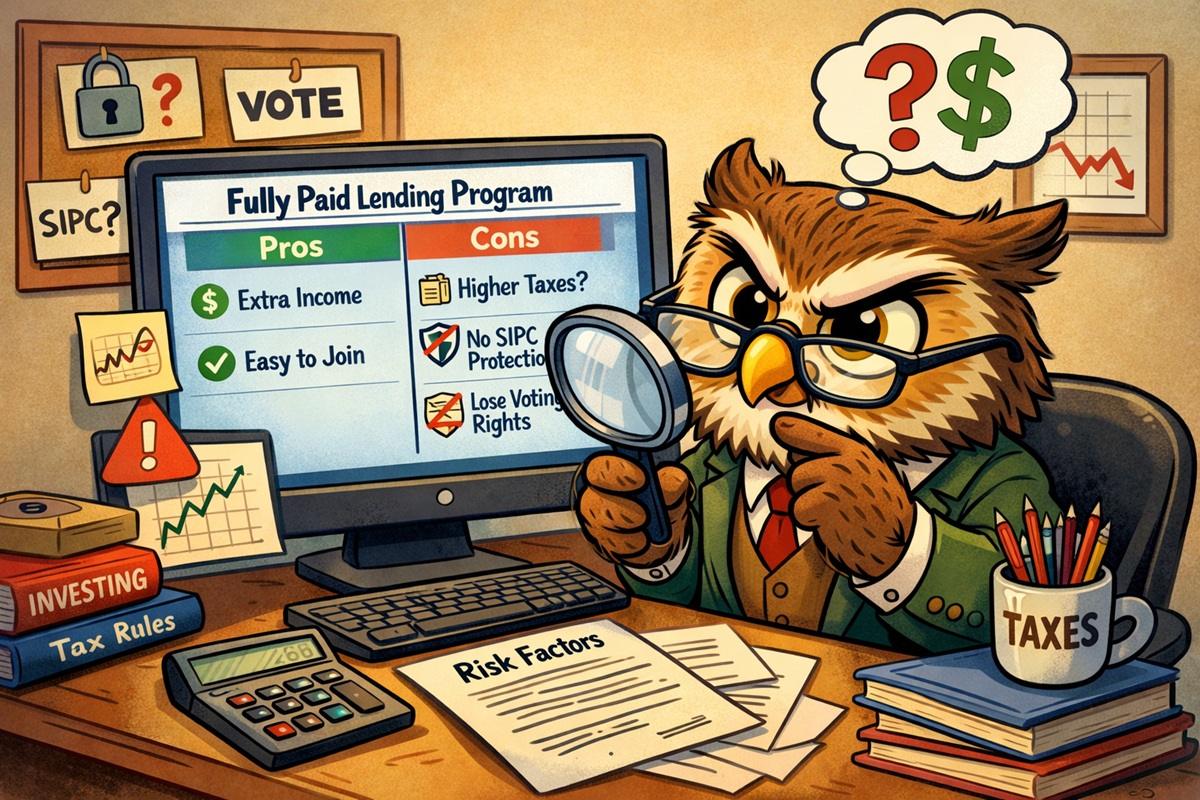
While the shares are on loan, you lose voting rights since you no longer have the shares.
SIPC, the Securities Investor Protection Corporation, is what protects you if a brokerage fails. It’s like FDIC for brokerages. You get $500,000 of protection with a $250,000 cash limit.
When you loan out your shares, they are no longer covered by SIPC. You’re protected by the collateral, as you would with any loan, but since you don’t have the shares you don’t have protection.
There are two main drawbacks to these schemes but Vanguard has an answer to them both:
Unlike other situations where you lend out your shares, since you are lending them to Vanguard and presumably the shares are pooled together, you can sell your share when they’re on loan. In this way, the most common drawback has been removed.
There are, however, tax implications but Vanguard deals with them.
If there is a dividend, you’ll receive a “substitute payment” but it’s not a dividend anymore. It’s just a cash payment, so it is taxed as ordinary income rather than the qualified dividend rate, which is usually much lower.
However, Vanguard will offer an additional credit reimbursement equal 26.98% of the substitute payment, which is good enough to offset most of those additional taxes for even the highest tax bracket.
In the end, you get the same tax treatment.
If you are lending out shares in a taxable account, your tax situation may become slightly more complicated because it’s not just dividends anymore.
If you lend out the shares in a tax advantaged account, such as a Roth which is tax free, there’s no difference.
Remember, the stocks that will get lent out are ones that at least one person (the borrower!) thinks will go down. That person may be wrong and there are plenty of people who think plenty of stocks will go down, so that alone isn’t an indicator of anything. But you are holding shares of a company someone thinks is worth less than it’s valued today.
Also, the person borrowing the stock is going to short sell it. That’s going to exert some downward pressure, however small, on the price; and you will be helping them.
You’re also helping short sellers, which some people fundamentally dislike.
I decided to opt in my Roth IRA at Vanguard into the program and after a few short questions, a DocuSign, my request was sent in and now I’m just waiting for the next steps. I chose that account because it holds stocks that may be high in demand and also because there are no tax implications.
It appears you have to elect to include each account into the program.
I’ll update this post as it progresses and if shares are lent out.
I don’t see any downside and given that joining the program is pretty easy, it’s “worth it.” You need to have over half a million in assets, so that excludes most, but you earn additional income on shares that are just sitting there.
If you’re going to hold a stock, you might as well lend it out if a short seller wants to sell it. You can sell it too if you want, Vanguard will find shares so the loan isn’t disrupted.
If you just have a bunch of index funds, which mostly describes my situation, you won’t get much interest because no one is shorting those.
Originally, I thought the only downside was that dividends are now taxed as ordinary income, but Vanguard offers an additional credit reimbursement that offsets the tax treatment.
I suspect that if you participate in this program, only a small subset of your shares will ever get lent out. You can earn a little extra income but it won’t be significant.
Have you looked at this program? Or similar ones?
A HELOC, or home equity line of credit, lets you borrow against the value of your home as needed. It...

Publications Archives UnfavoriteFavorite April 9, 2026 UpSkill America, and Economic Opportunities Program Chelsea Miller Associate Director For the working adult...

Can You Change Repayment Plans While Waiting For PSLF Buyback? This question is about PSLF Buyback. Nearly 100,000 student loan...