Turning America’s Anti-Scam Strategy Into Action
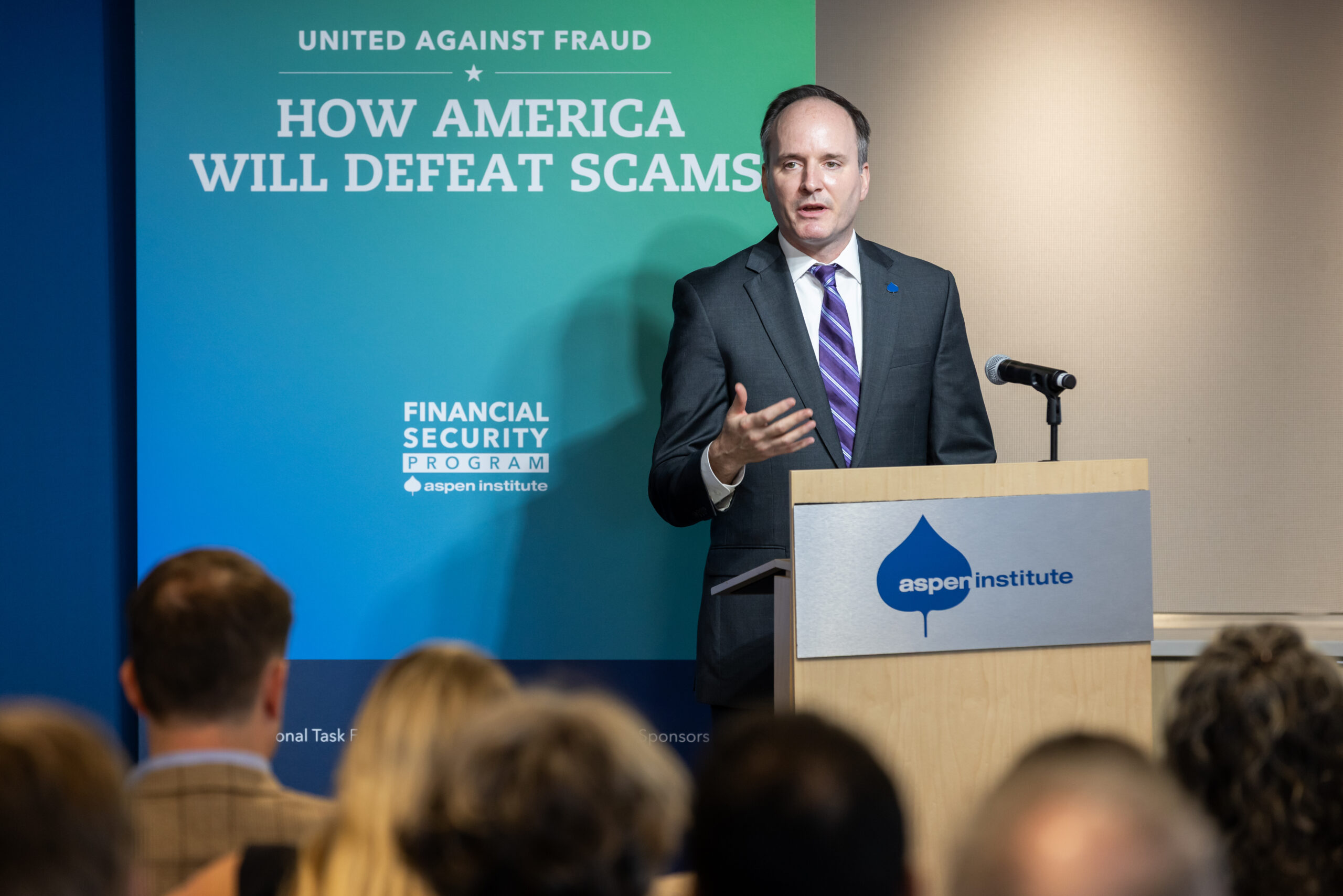

Fraud and scams have become one of the most urgent financial security threats facing American households today. Criminal networks, many of which are international, are stealing billions of dollars from people across the country, exploiting trusted systems of communication and commerce, and moving quickly across platforms, payment channels, financial institutions, retailers, and borders.
Over the past two years, the Aspen Institute Financial Security Program has worked with leaders across sectors to answer a critical question: How can the United States close the gaps that allow scammers to move from one system to another without being stopped?
A clear answer emerged: Scam prevention requires coordinated action across the entire ecosystem.
In 2024, Aspen FSP launched the National Task Force on Fraud and Scam Prevention to bring together the leaders and institutions closest to the scams problem. More than 80 institutions and 300 experts and leaders from government, law enforcement, financial services, technology platforms, telecommunications, retail, consumer advocacy, victim-serving organizations, and civil society contributed to that work.
Together, they helped develop United We Stand: A National Strategy to Prevent Scams, a blueprint for making scams harder to execute, less profitable, and easier to disrupt. The strategy called for bold federal leadership, stronger public-private collaboration, enhanced law enforcement capabilities, modernized legal frameworks, and better systems for measuring and preventing scam activity.
That strategy was an important milestone. The next step is implementation.
Today, Aspen FSP is launching the Scam Prevention Initiative, a new phase of work focused on turning shared strategy into coordinated action.
The Task Force created a common understanding of the scam lifecycle and the kind of response required, making it clear that scams rarely move through one sector alone. A single scam may begin with a fraudulent advertisement or social media message, continue through a phone call or text, impersonate a trusted company or government agency, and end with a payment through a bank, payment app, cryptocurrency platform, gift card, or other financial channel.
Scammers exploit the fact that scams move across many sectors—and the gaps that emerge when those sectors are not fully collaborating with one another.
Fortunately, many organizations are already working hard to prevent scams. Financial institutions are improving fraud detection and customer warnings. Technology platforms are removing fraudulent content and accounts. Retailers and payments companies are strengthening prevention tools. Law enforcement agencies are pursuing criminal networks. Consumer advocates and victim-serving organizations are helping people recover from devastating harm.
But when each part of the ecosystem acts mostly on its own, scammers move through the gaps.
The Scam Prevention Initiative is designed to close those gaps. Aspen FSP will work with leaders across sectors to align around shared priorities, strengthen prevention tools, improve how scams are measured and understood, and build the cooperation needed to reduce scam activity over time.
The Initiative launches at a moment of growing momentum.
Across the federal government and on Capitol Hill, policymakers and law enforcement leaders are paying closer attention to fraud and scams as a serious national priority. Companies across sectors are increasingly recognizing scam prevention as a shared responsibility—one that affects consumer trust, household financial security, and national resilience.
The challenge now is to translate heightened awareness into practical, sustained action. That means building clearer ways to understand how scams are changing, identifying which interventions are working, and strengthening information sharing among the sectors where scams originate, move, and cause harm. It also means helping policymakers and private-sector leaders develop solutions that are informed by evidence, and capable of working at scale.
Aspen FSP’s role is to serve as an independent convener and resource in that effort. Through the Scam Prevention Initiative, Aspen FSP will bring together leaders who can help advance solutions, strengthen prevention, and support a more coherent national response.
At the center of the Initiative is the Leadership Group on Scam Prevention, which brings together senior leaders from across the scam prevention ecosystem, including financial services, technology, retail, consumer advocacy, and payments.
Participating organizations include AARP, ABA, Amazon, Apple, Block, Capital One, Citizens Financial Group, Gen, Google, JPMorganChase, Match Group, Microsoft, PayPal, Target, Walmart, and Zelle.
The Leadership Group is designed to support focused collaboration and action. Its work will include helping public and private sector leaders align around shared priorities, better understand trends in scam activity, identify preventative and disruptive tools, and support partnerships that can deliver impact across sectors.
The structure reflects the evolution of Aspen FSP’s work. The Task Force was intentionally broad, designed to build shared understanding and develop a national strategy. The Leadership Group is more focused, with an emphasis on moving that strategy toward implementation.
The broader scam prevention ecosystem will remain essential to this work. To support continued engagement, the Scam Prevention Initiative will also include Solutions Forums—targeted working groups that bring together technical experts, law enforcement officials, consumer advocates, policymakers, industry practitioners, and other stakeholders to address specific operational, technology, and policy challenges.
These forums will move high-level agreement into practical problem-solving. Participants will define barriers, identify what is already working, surface implementation challenges, and develop recommendations or solution sets that can support stronger action by companies, policymakers, law enforcement, and others.
Over the next several years, the Scam Prevention Initiative will focus on four core areas of work.
First, Aspen FSP will work with partners to build a clearer picture of the scam landscape. One of the central challenges in scam prevention is that the country still lacks a consistent, shared understanding of the full scale of the problem, how scam tactics are changing, and which interventions are most effective. The Initiative will develop better ways to understand trends, compare insights across sectors, and support smarter public and private investment in prevention.
Second, the Initiative will convene leaders across industry, government, and civil society to align around shared priorities. Scammers benefit when sectors operate in silos. Stronger coordination can help organizations identify common challenges, learn from one another, and pursue prevention strategies that are more effective than isolated efforts alone.
Third, Aspen FSP will advance practical solutions and recommendations that make scams harder to carry out and easier to disrupt. This work may include improving information-sharing practices, strengthening tools for detecting and stopping scam activity, supporting better reporting and analysis, and identifying legal or operational barriers that prevent responsible actors from moving quickly.
Fourth, the Initiative will help sustain public and private sector attention on scam prevention as a national priority. Scams impose enormous costs on households, businesses, communities, and governments. Reducing that harm will require sustained leadership over time, not only during moments of crisis.
Fraud and scams are often described as consumer crimes. They are also a threat to household financial security, trust in the digital economy, and national resilience. In many cases, the money stolen from Americans funds transnational criminal networks that are difficult to identify, disrupt, and prosecute.
No single agency, company, or sector can solve this problem alone. Progress will depend on stronger collaboration, shared responsibility, and systems that can keep pace with the threat.
The Task Force helped establish the strategy. The Scam Prevention Initiative will focus on the work that comes next: turning alignment into action, supporting practical solutions, and building the systems needed to reduce the scale and severity of scams affecting American households.
Every day that scammers exploit gaps across the ecosystem, more people lose money, trust, and security. The work ahead is complex, but the direction is clear. America needs a coordinated response to scams. The Scam Prevention Initiative is Aspen FSP’s next step in helping build it.

Texas public schools lost about 76,000 students in the 2025-26 school year, the first enrollment decline outside the Covid-19 pandemic...

If you’re considering a home equity loan and wondering whether you can deduct the interest on your taxes, the answer...

Articles Single-family rentals (SFR) now house 41% of the U.S. renter population, according to Rentometer Mid-Year...