Let Good Enough Be Good Enough

Lessons in Leadership with Chris McKnett
Chris McKnett is the Head of Sustainability Strategy, Research, and Integration at Allspring Global Investments. He joined Allspring from its predecessor firm, Wells Fargo Asset Management (WFAM). Prior to joining WFAM as a senior environmental, social, and governance (ESG) investment strategist, Chris served as head ESG strategist for State Street Global Advisors and was a member of the firm’s senior leadership team. He is an Aspen First Mover Fellow.
What early professional experience shaped your approach to leadership?
When I was finishing business school, I networked my way into a job offer from a boutique research firm in Boston. The compensation was modest—way below the national MBA average or what my peers were getting. But I thought it might be my dream role.
I had a conversation with a mentor of mine about the offer and he told me, “The hardest choice is between two right answers.” That really made me stop and think. I realized that the anticipated future salary of this role was not what made it my dream. What mattered more to me was that I found the work important, interesting, and cutting-edge, and I would be able to leverage it to move forward in the investment industry. I ended up taking the job.
What stuck with me most about that moment was how my mentor responded to my dilemma. He didn’t tell me what to do. He acknowledged that it was a hard decision and gave me the space to make it on my own. He made me feel truly heard and, in doing so, taught me the value of really listening to people. Being able to hear what people are saying, without giving them advice, is an underrated quality of leadership.
What professional advice do you wish you’d received earlier in your career?
Don’t let perfect be the enemy of good.
Early in my career, I was more aligned with the opposite philosophy: don’t let good be the enemy of great. I focused on perfection—or, at the very least, extreme thoroughness—and that need to turn over every rock and pursue every angle made me myopic. I was so focused on delivering something bulletproof that I left opportunities on the table. I was often working alone, trying to build coalitions while also being very possessive of my work. I was afraid that if it wasn’t perfect, people wouldn’t buy in.
Over time, I realized that eventually you have to move on and allow good enough to be good enough. Momentum begets momentum.
What makes it possible for a person to lead with courage and conviction?
Conviction enables courage. When you are confident in your convictions, it makes it easier to withstand pressure to cut corners or maximize economic gain. That confidence can come from logic and intellect, but it can also come from moral or ethical grounding.
Culture also matters. A culture that embraces authenticity and, more importantly, failure really fosters courage, because it creates conditions that tolerate and even reward risk-taking and integrity. If there is space to fail, learn, reload, and try again, that creates a very special kind of environment.
Lastly, passion. You can fake aptitude or competency, but genuine passion is harder to fabricate. It’s not something I ever put into a job description, but it’s something I always evaluate when hiring. Passion gives people an edge. It adds flair and energy that draws others in.
What professional accomplishment are you most proud of?
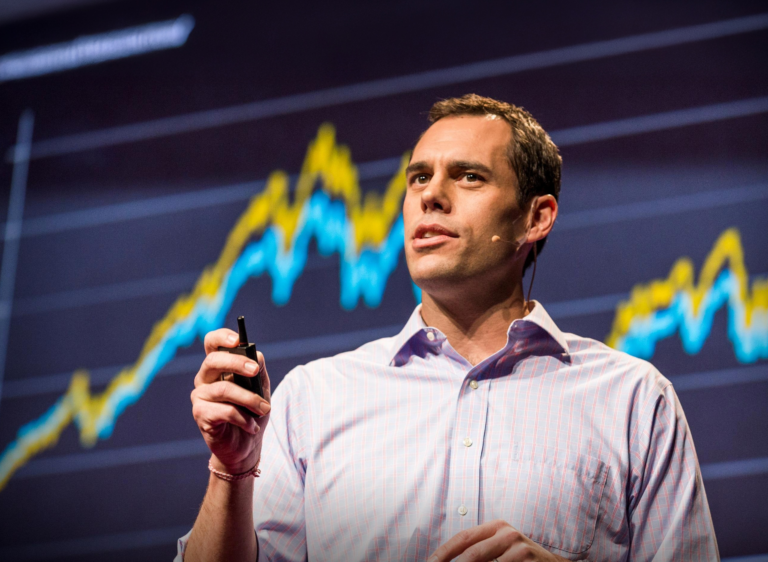
In 2013, I gave a TED Talk on The Investment Logic for Sustainability.
At the time, I was the Vice President & Head of ESG at State Street Global Advisors, but ESG investing was still a very niche topic. It was mostly associated with values-based investing by foundations or religious institutions, not mainstream finance. I was trying to push the idea that sustainability factors weren’t just about values. They were relevant to value creation and risk mitigation. I’m most proud of the talk because it still holds up today.
What makes it even more meaningful is that I didn’t really want to do it. I was essentially a team of one at the time, and I worried about the time commitment. I was also unsure whether people would actually care about what I had to say. A colleague encouraged me to apply. He told me that, whenever I gave updates in meetings, my section of the meeting was the only part he found interesting. That was incredibly empowering and I’m now really glad that I listened to him.
TED ended up choosing my talk to be the global TED Talk of the Day. That changed the game for me professionally, for many years afterward.
How has your Aspen experience shaped your view of the world?
Before I became a First Mover Fellow in 2009, I thought fellowship was just a word, and I didn’t understand the value of it. But now I feel like I have people—not just my own class, but the broader First Movers community. I know I could pick up the phone and call any other Fellow and they would help me out. That kind of fellowship is invaluable.
In these hyper-polarized times for sustainability professionals, being part of the Aspen community has also helped me stay grounded. Earlier in my career, the biggest obstacle was benign neglect. People just didn’t really think much about sustainability issues. Then ESG moved from the sidelines to the main stage, and now there’s active hostility around it.
I’m able to stay the course because of the tools I learned through the Fellowship, the ongoing touchpoints with the Aspen community, and the sense of belonging Aspen has given me. Even with a business degree, a TED Talk, and all those tangible accomplishments, I still experience imposter syndrome from time to time. Knowing that Aspen sees me as worthy helps carry me through the periodic lulls that so many of us face.
What was the impact of your Fellowship experience?
At the time of the Fellowship, I was the only ESG-focused person working at State Street Global Advisors. As a result, the work around ESG was very fragmented and bespoke to individual clients. The goal of my Fellowship project was to create a firm-wide organizing framework for ESG considerations in investment decisions. I wanted to help marshal the firm’s resources more strategically around a shared set of principles.
That didn’t fully happen during the Fellowship, but I was able to establish pieces of it that were eventually tied together into a broader top-of-house perspective after I left.
Beyond the project itself, the Fellowship gave me an internal energy source that I still draw on today. The seminars also gave me practical tools that I still use constantly: reframing problems, appreciating the power of small wins, asking better questions, and mapping decision-making ecosystems inside organizations. One question from the Fellowship that I still use all the time is: “What would have to be true?” It’s so powerful because it shifts people out of immediate skepticism and into problem-solving mode. It encourages them to thoughtfully step into your perspective and think collaboratively, instead of dismissing an idea outright.
What keeps you grounded?
When things get really frenetic at work, I focus my energy on supporting my team. How I serve them reminds me who I am, and that keeps me grounded. I also try to appreciate that practice makes progress. This is something I tell my kids all the time. Perfection doesn’t need to be the goal and, in many cases, it shouldn’t be. Small wins and steady progress matter.
I also rely a lot on micro-breaks. I rarely take a full lunch break, but I do take several short walks throughout the day. Just getting outside and seeing the sky, clouds, or trees is really restorative for me, even in an urban setting.
Want more insights like these? Sign up to receive thought leadership and updates from the Business & Society Program each month!

Anyone weighing debt settlement wants to know what the fees will be, and a 2026 study from EY (Ernst &...
Economic development strengthens economies by creating resilient, and vibrant communities. From closing gaps and increasing access, to sharing and deploying...
Archives The McNulty Foundation is seeking individuals who are fearlessly pursuing solutions through their organizations, and showing a commitment to...