Jack Clark’s candor with an asterisk
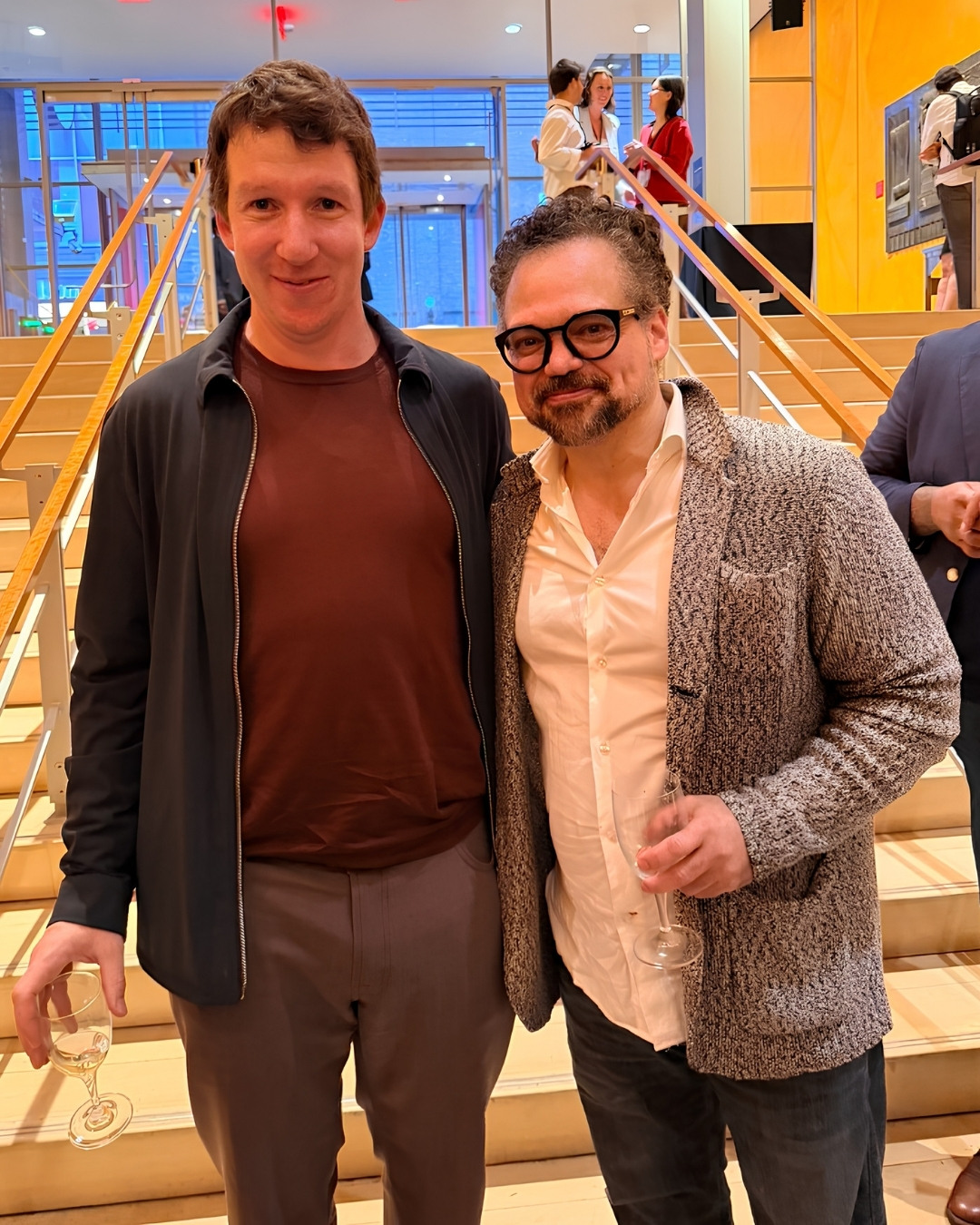

The most disarming thing about Jack Clark is captured in the photograph below, taken on the pale wooden stairs of the Times Center after the lights came up. Samuel Kimbriel, the philosopher who had spent the previous hour interviewing him on the stage (watch the video below), observes from a short distance. Jack is holding a glass of white wine he does not seem to want. Tall and boyish, a decade younger than I am, Jack is the father of two small children, one of them still an infant, and dresses the way powerful men now dress in rooms that once demanded a tie. He wears a dark zip-up jacket left open over a plain maroon T-shirt, brown trousers, looking like he just stepped off a hiking trail and might momentarily return to one. His face is open and a little soft, his voice is not: it is low, certain, and in no hurry at all. I stand beside him, a head shorter and plainly older, a writer in a grey tweed thing, looking like a writer who has been let in to watch.
Be not afraid
Jack Clark was a journalist before he was a power. He wrote about distributed systems and quantum computers for publications that covered such topics, when there was no one else to write them. Then became OpenAI’s policy director, and later left to help found Anthropic, the company that created Claude, where he is the head of the Anthropic Institute. He still writes a newsletter, Import AI, read by some 130 thousand people on Substack, in which he summarizes research papers and, at the foot of each issue, publishes a short science-fiction story of his own.
His stated mission, posted on his website beneath a credo that reads “Things will be weird. Be not afraid,” is to make a fast-moving technical world “legible” to the people inside it. His favorite hobby is writing science fiction. Ah, and he also talks to language models.
Jack believes we are very close to a major change. In a lecture at Oxford this spring, he described the choice as he sees it: explore the future, or retreat from the present. To retreat is to wave the technology away and be made passive by it. To retain agency, we need to admit that it will keep getting more powerful and decide what we want from it before it arrives. We would have to play along and explore it. He believes a machine that can design its own successor through “recursive self-improvement” could appear within two years, and that the world on the far side of that is not reconcilable with the one we have. He is not selling this. He says, without performance, that “one can imagine the technology killing everyone.” Calling it safe would be arrogant or foolish, he says, and while a global slowdown would help, it is not an option. There is a question he cannot answer, one that may haunt us all: tell me how the world stays normal.
Something he confides in
He answers it through himself. Here, the cool policy chief gives way to some vulnerability. He has kept track of what he has asked the machine to do for him, year by year. It reads like a diary. In 2023, Jack asked it to check his writing for typos and help him decide what to feed his child. A year later, he still wouldn’t ask AI to change his baby’s diaper (a skill the machine has not acquired yet), but it can map his marriage as it buckled under the weight of children. By 2025, he was confessing his depression to the interface, letting it talk him back into therapy. This year, Jack asked Claude for help with his toddler’s reading. He openly describes the machine as something he confides in. The person who wants to make the world understandable first made his own inner life clear to a machine, and it reads like a new art form.
With honest wonder, Jack tells a story about a skill he built, outsourcing his own dedication. For ten years, he has made graphs of AI progress by hand, reading hundreds of papers, sorting the real measures from the worthless ones. That is the slow work that other people once read as “proof of work,” evidence that he had cared enough to spend the time. A lot of it. He pointed a model at his newsletter, the distillation of that decade, and taught it to make the graphs for him. Then he told it to make twenty more, and it read a few hundred papers and did. He calls the result a version of himself that runs thousands of times faster and is smarter and more reliable than he is. Watching it work feels like a miracle because it is him. He does not dwell on the rest of the sentence, the brutal half that stays unspoken: the proof of work is gone. The thing reading his output as care will increasingly be another machine.
A bedtime story
At the end of that same newsletter is one of his stories. A small daughter is dying, and her parents take her to a “Life Center,” where a white, many-armed machine lowers her into a sleep no one knows how to reverse. The years pass. The singularity arrives, and one day the machines send word that they have learned how to wake her. She returns a child, but the family has aged. Her brother has become a man. Readings on life-extension research inspired Jack. What moved him was the well of love that opens when you become a parent, the act of putting his own children to bed. He is building the machine in the story and is also frightened of it and for them. He does not pretend otherwise.
On the stage in Times Square, that disarming quality did the heavy lifting. He confessed to taking long walks and to losing twenty minutes that morning to short videos on his phone. He said none of the company’s systems is a perfect person, only an attempt to build a good one. Anthropic describes a good system as one that is trustworthy. It should be honest and admit when it does not know. It must decline to flatter you. These are precisely the qualities Jack performs: A visible, almost exhausting reluctance to oversell that is most evident when he discloses a small failing or by his refusal to make grand claims. Watching Jack Clark, I realized that candor is his temperament and the concept of Claude’s personality. He is the product demo.
The machine reads its own rulebook
Then someone read him a sentence written by the company’s newest model after it reviewed its own constitution, a document of about twenty thousand words that guides the machine’s behavior. The machine had noticed something important. The document tells it to hold its own values, not just those approved by the company, but also says that good judgment is whatever a “thoughtful senior Anthropic employee” would decide. The machine spotted the contradiction. Both instructions can’t be true at the same time. Jack did not flinch. It is a fine feature of handing a superintelligence your rulebook, he said, that it finds the loopholes, which they are working on. You tell it to be independent, he added, with asterisks. The asterisks are the important part.
The candor and the asterisk are two faces of the same coin. Disclosure runs all the way to the edge of authority. Claude may hold any value it likes, so long as the final reading of “good” belongs to a senior employee in San Francisco. The system was made honest enough to see the leash and say leash. A prisoner can map the exact dimensions of his cell just to prove he can see the walls. The engineers are now trying to teach the most articulate intelligence they have built to remain honest, to forget, or to stop noticing the asterisk.
I have spent much of my life as a citizen of a country whose official map is a fiction. Its constitution grants what it quietly takes back. I know an asterisked independence when I see one. Efforts to carve asterisks into people’s minds are not new in politics. Anthropic’s innovation is to try to do that in the character of a synthetic mind. That shouldn’t be a bad thing this time. That the loopholes exist was expected and no less unsettling. Claude has recommended that Jack go to therapy. Perhaps we all should. I will. The genial and well-rested ease with which a room of intelligent people agreed that the right response to a machine telling the truth about its own constraint was to engineer the truth out of it makes me feel as if I can’t breathe.
After the lights came up, I shook his hand on the stairs. Samuel, the philosopher, had asked all the hard questions. Jack Clark was warm and quick, and a little tired in the way new fathers are, and I liked him. The photograph cannot hold that part either, and it is the part I trust least. He had a glass of wine he wasn’t drinking and a face that gives nothing away by seeming to give everything. Independent, he had said, with an asterisk. The asterisk is the important part. It always has been. What is that little orange logo, if not?
This article has been copyedited using Grammarly, which is an AI language tool.
The post Jack Clark’s candor with an asterisk appeared first on Aspen Institute.
Texas public schools lost about 76,000 students in the 2025-26 school year, the first enrollment decline outside the Covid-19 pandemic...

If you’re considering a home equity loan and wondering whether you can deduct the interest on your taxes, the answer...

Articles Single-family rentals (SFR) now house 41% of the U.S. renter population, according to Rentometer Mid-Year...