Industry, workforce, and education advance together to strengthen West Texas’s manufacturing sector

By Jennie Blizzard
Community partners in the Big Country area of West Central Texas are working towards a big, bold goal: create 450 new high-wage manufacturing jobs in the region by 2030. How? Through the Big Country Manufacturing Alliance (BCMA). The group focuses on collaboration among manufacturing companies, school districts, colleges, universities, workforce and economic development groups, and governmental organizations to strengthen the industry in the region.
“It’s been great to work with industry and education partners to identify how we can make a broader impact on our talent pipelines in our rural communities and support the manufacturing industry, which is important to West Central Texas’ economy,” said Amelia Reeves, CEO of Workforce Solutions of West Central Texas. Her agency strengthens businesses with human resource expertise, workplace training and education, and support to build a skilled workforce.
The Big Country consists of a 19-county region, including Abilene, and has a population of more than 325,000. While data has shown declines in the manufacturing industry, the sector—along with education and healthcare—still has an important place in the state’s economy.
“It’s been great to work with industry and education partners to identify how we can make a broader impact on our talent pipelines in our rural communities and support the manufacturing industry, which is important to West Central Texas’ economy.”
– Amelia Reeves, CEO of Workforce Solutions of West Central Texas
In 2018, the BCMA was formed when a group of manufacturers and workforce and economic development leaders wanted to solve a challenge. They were working individually to address how to impact the workforce talent pipeline. The group had ideas but wasn’t sure how to coordinate efforts into success.
“We knew we had an initiative, but we didn’t know exactly how we were going to manage it and do what was needed to achieve it,” said Marissa Ransted, program manager at RAM, Inc. Located in Cisco, Texas, RAM, Inc. specializes in high-precision manufacturing and is an active partner in the BCMA. Ransted was involved at the start of the BCMA as a workforce development representative for Abilene’s economic development organization. She now serves as an industry representative.
As the BCMA navigated growing pains, they heard about the Federal Reserve Bank of Dallas’ Advance Together (AT) initiative. AT is a place-based initiative (PBI) that supports community partnerships addressing education and employment challenges to connect Texans with quality jobs. PBIs involve partners coming together to drive change through shared vision, goals, and data to put resources and efforts toward achieving a common goal. For over four years, AT participants receive training, coaching, and funding from philanthropic partners to help implement their plans and increase the impact of their programs (the Federal Reserve does not provide any funding). BCMA applied and was selected to participate in AT’s first cohort in 2020. They were awarded a $300,000 grant from public, private, and philanthropic investors to maximize the efforts of their work.
“BCMA has done great work in bringing local partners together- inclusive of public, private, and nonprofit partners- to make progress towards ambitious workforce development goals for their region.”
– Jane Santa Cruz, senior advisor with the Federal Reserve Bank of Dallas
“BCMA has done great work in bringing local partners together- inclusive of public, private, and nonprofit partners- to make progress towards ambitious workforce development goals for their region,” said Jane Santa Cruz, senior advisor with the Federal Reserve Bank of Dallas and one of the coordinators of the AT initiative.
Ransted adds “Advance Together helped us focus on how to work together as partners on systems change instead of making a one-time one impact. The opportunity to participate and the relationship with the Dallas Fed really helped equip us to catalyze those conversations so we could identify what we could achieve by working collectively instead of individually,” she said. “We were able to gain the momentum to move forward more rapidly around a common goal.”
Companies in Abilene, like Hartmann, Inc., a precision manufacturing and engineering business, invest in the talent pipeline through student internships and collaboration with other industry manufacturers. Jacob Dendinger, right, participated in an internship with Hartmann and is now a full-time employee.
Built to Succeed
BCMA drives toward achieving their bold goal in several ways. Manufacturing businesses regularly talk and connect with each other. “It’s good to see what started out as a group of competitors [manufacturers] come together on the industry side and build relationships with each other,” said Reeves. “We have employers partnering with each other and having conversations together about how they’re overcoming issues. Just seeing the collective growth and that shift in mindset in real time is a huge highlight.”
“Before the BCMA, industry, education, and workforce development were very siloed. There was very little collaboration. Through the BCMA, we’ve been able to connect education to industry and industry to education.”
– Vicki Hayhurst, career and technical education (CTE) specialist at Region 14 Education Service Center
Connecting with education to increase the talent pipeline for manufacturing jobs is crucial. “Before the BCMA, industry, education, and workforce development were very siloed,” said Vicki Hayhurst, a career and technical education (CTE) specialist at Region 14 Education Service Center based in Abilene, Texas. The state has 20 service centers and each of them has a number of school districts assigned to their region. “There was very little collaboration. Through the BCMA, we’ve been able to connect education to industry and industry to education,” she said.
Hayhurst says through BCMA, she’s been able to educate manufacturing industries on how they can better understand how to leverage for work-based learning opportunities and the existing manufacturing workforce.
One of BCMA’s outreach efforts is exposing college and high school students to manufacturing career opportunities. They actively participate at college and high school career fairs, conduct facility and plant tours, and provide awareness about manufacturing career opportunities across the Big Country.
Luke Schonerstedt, a senior at Wylie High School in Abilene participated in BCMA’s World of Work (WOW). At WOW, different manufacturing industries in the region come together to talk about different career paths available in manufacturing. “I want to be an engineer but events like WOW helped me learn how important manufacturing is to engineering work.”
Qualitative and quantitative data guide how BCMA measures progress. They look at specific job growth data in the industry but also ask what that growth can be attributed to. “We’ve seen an increase in new employers coming into town,” Reeves said. “We look at how many manufacturing jobs there are in the region versus the potential of how many jobs we’ll have tomorrow. This can indicate that we’re changing the system. We’re using those kinds of data points to look at what is the growth and why it is happening.”
BCMA also looks at K-12 education data. The number of CTE programs offered and aligned with manufacturing have increased significantly. The group focuses on connecting younger students in the beginning of the talent pipeline.
BCMA credits building trust and deep relationships to its progress, and the process takes time and is foundational to PBI work. “Relationships and trust are really the foundation of this work,” said Hayhurst. “It’s not a quick process and can take a couple of years.”
“I think BCMA’s tagline ‘Made in the Big Country’ is very true. As an industry leader you want to say that your product was made in the Big Country, but you take pride in saying that your initiatives and talent pipeline come from there too.”
– Marissa Ransted, program manager at RAM
Reeves notes their AT training allowed them to reassess relationships and think through who needs to be at the table in this work. She said, “You can get complacent and comfortable with the group you have. You have to always think about who else needs to be represented and have voice in this work.”
BCMA continues to evolve and strategize to be a part of a unified manufacturing voice in the region. “I think BCMA’s tagline ‘Made in the Big Country’ is very true,” said Ransted. “As an industry leader you want to say that your product was made in the Big Country, but you take pride in saying that your initiatives and talent pipeline come from there too.”
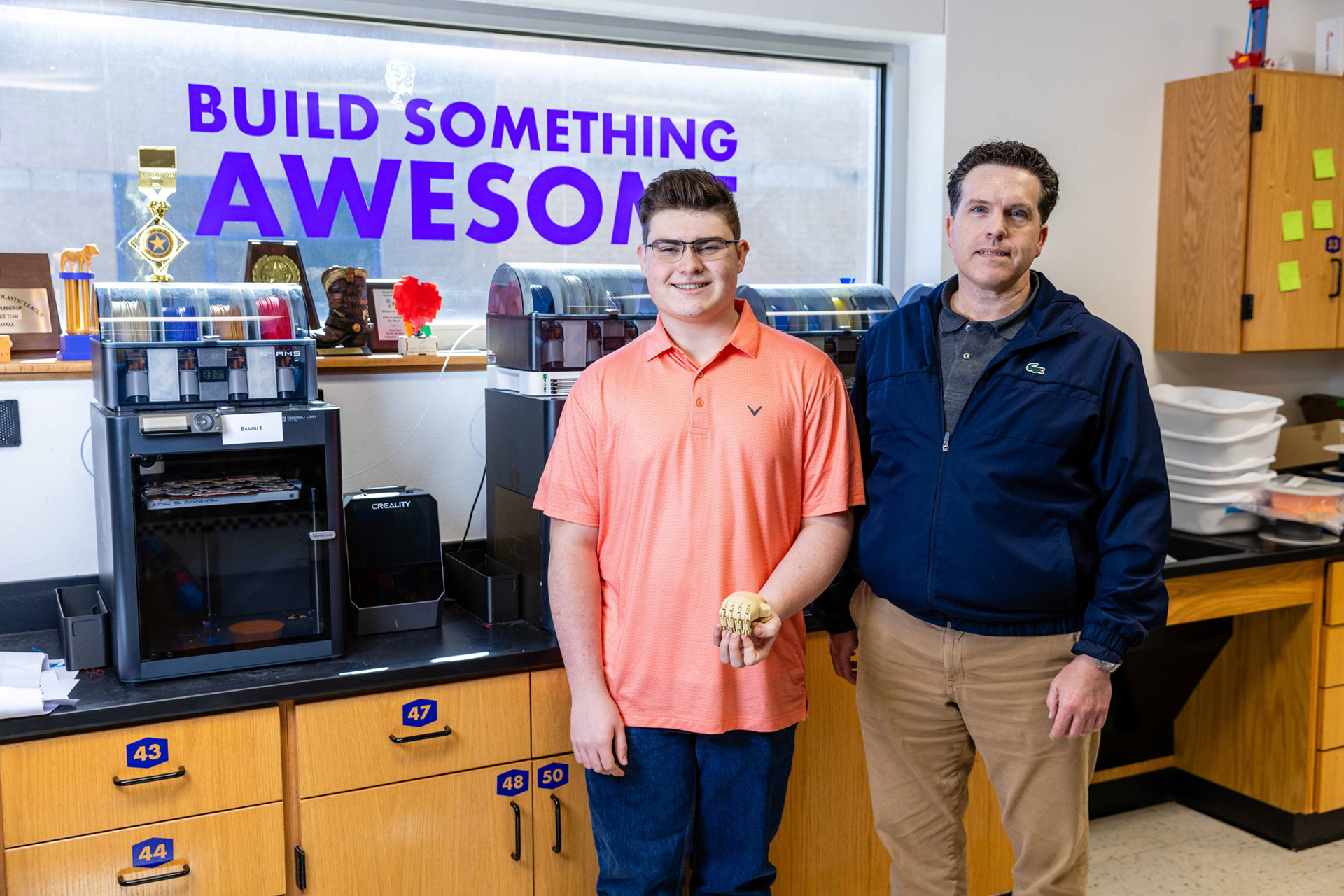
In high school, Luke Schonerstedt has gained extensive exposure to the manufacturing and engineer fields. He looks forward to one day leveraging the manufacturing industry to advance the production of his concept that has the ability to change the functionality of prosthetics for limbs.
Luke’s Engineering Story
Luke Schonerstedt, a senior at Wylie High School in Abilene, Texas, said he’s always loved math and science. He wants to become a biomechanical engineer. “Throughout high school, I’ve been pursuing academic courses and opportunities to prepare,” he said.
Luke realizes that manufacturing will play an important part in reaching that goal and he’s grateful for the exposure the Big Country Manufacturing Alliance (BCMA) has given him to the manufacturing industry.
In his robotics and engineering class, Luke said his exposure to BCMA through its WOW initiative opened his eyes about how vast the manufacturing industry can be and how engineering and manufacturing work together. At WOW, manufacturers in the area share information about the work they do, and students tour facilities. “It was cool seeing all of the different industries and all of the different careers that you could choose from,” he said. “WOW helped me see when you design something, manufacturing is really the way you get it out to others.”
His mother, Sevie Schonerstedt, said she’s witnessed how groups like BCMA helped her son fully understand that you need diverse skill sets in manufacturing. “It takes all levels of education to do this work,” she said. “And I think this is something he’s witnessed through WOW tours. He’s learned that engineers may be doing the design, but the people putting designs together are the manufacturers.”
For Luke’s engineering class, he’s developing a 3D prototype of a prosthetic hand for a year-long project. Often, prosthetics require robotic parts for functions like opening and closing fingers and toes. But Luke’s design focuses on not needing those mechanisms. “I want to design things that are going to help people,” he said. “And impact the world.”
Special thanks to Adam Koudaih at the Federal Reserve Bank of Dallas for photography and Natalie Karrs at the Federal Reserve Bank of Cleveland for production assistance.

As an example of what I mean, think back to the most enjoyable vacation you ever took. When it was...

Investment Arbor Realty Trust and Chandan Economics’ latest Special Report leverages industry-leading data analysis to interpret...

Military aid societies are some of the most powerful – and least understood – tools in the military community. Organizations like NavyMarine Corps Relief...