From numbers to narratives: Why Native voices matter in data
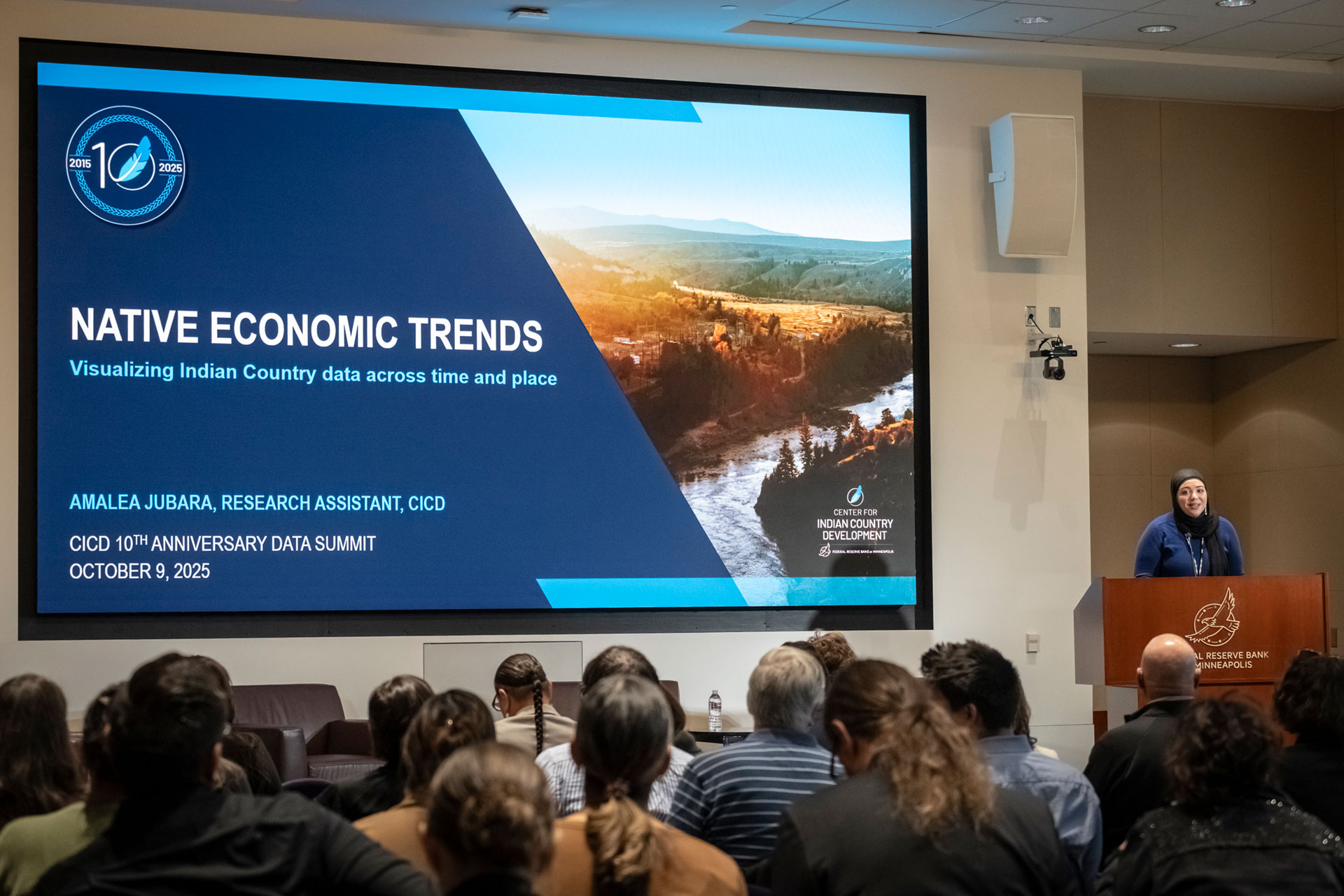

CICD Research Assistant Amalea Jubara provides an overview of the Native Economic Trends tool at the CICD 10th Anniversary and Data Summit, which took place October 8–9, 2025, at the Federal Reserve Bank of Minneapolis. Photo by Caroline Yang.
Leaders from across Indian Country and the Federal Reserve System gathered in early October for the Center for Indian Country Development’s (CICD) tenth anniversary and fifth-annual data summit. Housed at the Federal Reserve Bank of Minneapolis, CICD is a national research and policy institute that works in close collaboration with tribal leaders, Native organizations, and economic development practitioners across Indian Country to produce research that can advance understanding of Native economies and their relationship to the overall economy.
“The aim of CICD’s research and data products is simple. We make information available and easier to find and use for economic decisions in Indian Country,” said Amalea Jubara, a CICD research assistant, in a session at the recent data summit.
CICD is part of the Federal Reserve’s community development function, which focuses in part on thoroughly understanding barriers to economic participation. The Fed’s community development work sheds light on opportunities to strengthen financial outcomes so that people in every community may participate and prosper in the economy.
One of the ways CICD has expanded access to data is through the development of a suite of interactive tools. At the October event, CICD launched its newest tool: Native Economic Trends, which brings together decades of data to visualize socioeconomic change over time for individual Native places and Indian Country as a whole. The tool is a companion to the Native Community Data Profiles tool, which launched in 2023.
With its ongoing data initiative, CICD offers Native community members, tribal leaders, and economic development practitioners a rich suite of resources to help fill persistent data gaps and better inform economic policy in Indian Country.
CICD Senior Policy Analyst Phil Gover announces the national launch of the Survey of Native Nations at the CICD 10th Anniversary and Data Summit, which took place October 8–9, 2025, at the Federal Reserve Bank of Minneapolis. Photo by Caroline Yang.
One of CICD’s flagship tools, Native Community Data Profiles harmonizes data from more than a dozen public sources in one place. The comprehensive data available through the tool supports Native nations and individuals in sharing their communities’ stories.
“You can think about it as providing a broad snapshot of a particular geography,” said Vanessa Palmer, CICD’s data director.
Users can access the tool’s searchable map to choose a Native geography to explore. For each Native geography, users can view robust data across eight topic areas, including education, healthcare, and housing. For example, users interested in healthcare infrastructure in Native communities can see data on how access to hospital facilities and medical professionals in a specific Native community compares to access across the United States as a whole.
The Native Community Data Profiles tool plays an important role in filling data gaps on Native communities. CICD was motivated to create the tool after speaking with tribal leaders about their desire for data reflecting the stories of their people and geographies, said Phil Gover, senior policy analyst at CICD.
A recent Brookings Institution report highlighted challenges with data about tribes and Native American people, including that existing data does not always reflect the needs of tribal leaders.
“Federal datasets collect data based on federal law and regulations. What that means is in many cases, data collected in those surveys don’t align with what tribal priorities might be,” said Robert Maxim, one of the authors of the report, in a fireside chat during the recent CICD Data Summit.
Rebecca Naragon, a citizen of the Poarch Band of Creek Indians, is the economic development director for United South and Eastern Tribes, Inc. (USET), a nonprofit intertribal organization that provides technical assistance services to 33 tribal nations in the eastern and southern United States.
A past member of the CICD Leadership Council, Naragon frequently engages with CICD in her work to support tribal nations in pursuing their economic development goals. She uses CICD data tools to communicate information about the economic conditions and opportunities of the tribal nations she works with, and to equip USET’s member nations with information useful in telling their own data stories.
“Data is important in not only the daily work that my team and I perform, but it is vitally important for the tribal nations that we serve, and for the community programs, visions, and goals that they have.”
– Rebecca Naragon, economic development director, United South and Eastern Tribes, Inc. (USET)
“What we do in the Office of Economic Development is provide technical assistance in what we refer to as three baskets,” she said. Those three areas of focus include education and training, resource brokering, and evaluation.
“Data is important in not only the daily work that my team and I perform, but it is vitally important for the tribal nations that we serve, and for the community programs, visions, and goals that they have,” she said.
Naragon finds Native Community Data Profiles helpful in her work, especially when she’s interacting with new external resource partners working in Indian Country for the first time. She explained that she often will pull up the tool to help these new partners get to know tribal nations in the region they serve. The data help make clear that each Native community is unique and the stories of each individual community are important, she said.
“It’s an important visible part of the narrative change that each Native community is different,” Naragon said. She emphasized that Native Community Data Profiles helps make clear that Indian Country is not one-size-fits-all and that the stories of each individual community are important.
Conversations with tribal leaders and economic development practitioners about their experiences with tools such as Native Community Data Profiles are essential to CICD’s work.
“All of our products are living tools,” said Palmer. “We’re taking feedback all the time from the individuals we speak with in our work.”
Since Native Community Data Profiles was launched in 2023, CICD’s staff engaged in dialogue with community members, tribal leaders, and practitioners about the tool.
“The feedback that we have heard consistently since Native Community Data Profiles was launched is that people wanted to be able to see trends over time,” said Palmer. Users also told CICD staff they were interested in having more flexibility to look at data for multiple areas or to make comparisons between areas.
Inspired by these conversations, CICD developed an interactive companion tool to Native Community Data Profiles, called Native Economic Trends. Launched at the October data summit, the tool allows users to explore data on how conditions in Native communities have shifted since 1990. Data are organized into four domains: people, infrastructure, education, and economy.
Rebecca presents to attendees on Opportunities and Financial Resources for Native Entrepreneurs at the 2023 Entrepreneurship Symposium hosted by the Mashantucket Pequot Tribal Nation at the Pequot Museum & Research Center.
Users can choose between two modes of the tool: Compare mode and Combine mode.
Conversations with tribal leaders and practitioners were key to the development of the Native Economic Trends tool. “The tool is very much informed by what features people told us they would like. We had a number of cycles of iterative feedback, including a focus group,” said Palmer.
The focus group brought together community members and experts like Naragon to discuss a prototype of the tool and potential design changes for the final version. One feature of the final tool, informed by the focus group’s feedback, is an option to filter by both Native geography type and by state in Combine mode.
“The goal was to make it easy for users to come up with various combinations of pre-aggregated geographies,” said Palmer.
Naragon explained that she expects the tool to be helpful as her team at USET prepares for economic cluster-specific conversations in the coming year.
“I think it’s going to be a really important tool and resource to economic developers within tribal nations,” she said.
“The tool is very much informed by what features people told us they would like. We had a number of cycles of iterative feedback, including a focus group.”
– Vanessa Palmer, director, Center for Indian Country Development (CICD)
In conversations with CICD, tribal leaders and community members often note the limitations of publicly available data about Native communities.
Both Native Community Data Profiles and Native Economic Trends draw on publicly available data from the Decennial Census and the American Community Survey.
“Public data is not always accurate, and gets less accurate the smaller tribes are,” said Gover. “We often have conversations with tribal leaders digging into why some of this data might not be accurate.”
The Native Economic Trends tool has special data notes making users aware of limitations to the data they are exploring. For example, data notes flag methodological changes in census question formatting over time that might affect a user’s ability to make accurate comparisons.
Palmer explained that CICD’s tools use census data because it is a source of publicly available data across all geographies, but tribes sometimes collect their own more accurate data. In the future, CICD hopes to explore potentially building partnerships with tribes to share their self-collected aggregate data, with consent, in CICD’s tools.
Singer Crow Bellecourt listens as Sharon Day, an Ojibwe elder, leads an invocation at the CICD 10th Anniversary and Data Summit. Photo by Caroline Yang.
Indigenous data sovereignty is the concept that Native nations and Indigenous communities have the inherent right to govern the access, storage, and use of their data. Conversations about data sovereignty are also central to CICD’s work. Palmer and Gover emphasized the importance of partnerships with tribal leaders and Native organizations to further Indigenous data sovereignty.
“Working in partnership with tribal leaders is the key to progress towards a better data culture.”
– Phil Gover, senior policy analyst, Center for Indian Country Development (CICD)
“Working in partnership with tribal leaders is the key to progress towards a better data culture,” Gover said. He noted that historical data collection practices involving information about Native communities often are viewed as extractive and harmful, because the data collection and use did not benefit tribes.
Naragon emphasized how important CICD’s commitment to Indigenous data sovereignty is to tribal nations in light of the trauma past extractive practices caused.
“It’s not only important to have team members in CICD to help build data systems or data tools, but also to be a resource because they understand that trauma,” she said. “Data is an important tool not only for narrative change. Data is important for tribal leaders to make the best-informed decisions for their communities as they see fit.”
At the CICD Data Summit, Kitcki Carroll, the executive director of USET, also emphasized how critical data are to tribal sovereignty.
“What sovereignty really is about is tribal policy. That’s where data becomes so critical and important for our communities to make these decisions,” he said. “[Not having data] costs us the strength of our people and our communities. Data is part of everything that we do.”
Together, the Native Community Data Profiles and Native Economic Trends tools make data on Native communities more accessible and interactive. These tools empower tribal leaders and practitioners to make data-informed decisions about their communities and to tell their own stories through data. CICD invites ongoing feedback to inform the tools’ regular updates and ensure they continue to best serve community members and leaders.
Check out Native Community Data Profiles, Native Economic Trends, and CICD’s entire suite of data tools and resources to explore data on Native communities firsthand. If you have any feedback or questions about these tools, CICD encourages you to reach out to a member of the CICD team.
To access more data tools available from across the Federal Reserve System, try our Fed Communities Community Development Data & Tools Explorer.
The Survey of Native Nations is a collaboration between CICD and tribal governments across the United States to equip tribes with high-quality public finance data. The survey provides participating tribal governments with customized data reports to inform their decision-making—and enables CICD to provide research-based insights that advance understanding of tribal economies.
The Survey of Native Nations is now open to all tribes across the country. There is no monetary cost to participating in the survey; the primary cost is staff time to prepare responses.

Sixty-eight percent of affluent investors were willing to pay for financial advice in 2025, up 10 percentage points from 2024...

The federal government is making moves that will reshape how colleges operate and how families pay for school. This week,...

Publications Archives UnfavoriteFavorite April 9, 2026 UpSkill America, and Economic Opportunities Program Chelsea Miller Associate Director For the working adult...