From Norway to the American Way
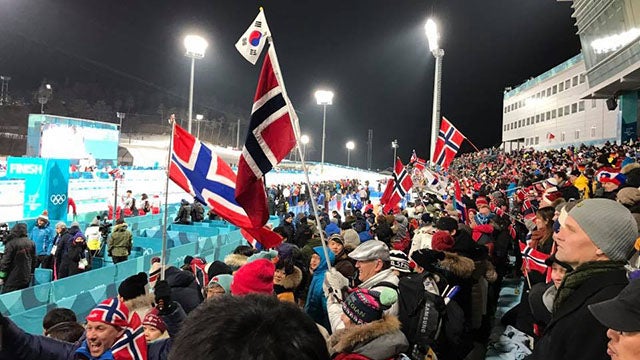

Eight years ago, I learned about the Holy Grail of Sports on a snow-covered hill in South Korea. Just above the biathlon course at the 2018 Winter Olympics in PyeongChang, to be exact.
There, I met Inge Anderson, former chief of Norway’s confederation of sports, while creating a podcast for NBC Sports about the country’s sudden rise to the top of the medal count. Norway was on its way to winning a then-record 39 medals, not bad for a nation the size of Minnesota. The U.S. would finish with 28 medals, fourth in the overall count.
I needed to understand how this could happen. I mean, Norway has lots of snow, mountains and citizens moving about on skis – but the U.S. has more. Lots more.
Norway is one of the world’s wealthiest countries, flush with oil money. But we have more.
The U.S. Olympic & Paralympic Committee pays athletes $37,500 for winning a gold medal. Were Norway’s financial incentives greater? Nope. Norway pays zero.
Were they just better cheaters than the suspended Russians? They may not be saints, but doping there is almost unheard of.
Anderson was a cross-country skier back in the day, but he looks like a retired defensive lineman — tall and thick, with an easy smile that reminded me of NFL legend Merlin Olsen. When I asked him to spill his nation’s secret, he flashed that knowing grin and explained that Norway’s dominance begins with what it does right at the other end of the pipeline, where 9 out of 10 kids grow up playing sports.
It’s a framework that Norway first developed in the 1990s, drawn from universally accepted human rights principles, to champion and safeguard Children’s Rights in Sports. Their rights to safety, mastery, and agency. To friendship and enjoyment, freedom of choice, and developmentally appropriate play. And the right of all to play. The vision: “Joy of Sport for All.”
From that values-based charter, adopted by the array of sport stakeholders from the Olympic committee to regional governing bodies to volunteer-driven community clubs, Norway was able to introduce a set of aligned policies that helped build athletes for life.
No travel teams that sort the weak from the strong before children grew into their bodies, minds and true interests. No early specialization. No scores recorded or standings kept until age 13. No national championships until adolescence. Norway prioritized the needs of children over those of their snowplow parents and built a protected zone around kids.
This wasn’t nostalgia at work. It was science, aligned with athletic development literature. And it was faith, that from systems excellence would emerge Olympic excellence.
I had to see this model with my own eyes, as this was long before journalists had begun to study Norway’s formula. I flew to Oslo. Visited with athletes and experts in Bergen. Took a plane, car then ferry, until finally, perched on the side of a frigid fjord, I found myself in a tiny village that was the home of the world’s top male player in, of all sports, beach volleyball. Here it was: the Holy Grail of Sports.
I came back and shared what I learned in a well-read essay for the New York Times.
Proof of concept has only grown since then. Yesterday in Italy, the Winter Olympics closed with Norway out-performing every country for the third consecutive time, with 18 gold and 41 overall medals, both all-time records. That’s with one-sixtieth the population of the U.S., which was next in the medal count. That’s not to diminish the accomplishments of Team USA, which with 12 golds had its best performance ever. Jordan Stolz was amazing. Elana Meyers Taylor was inspiring. Alysa Liu was transcendent. Our hockey teams dominated. But U.S. athletes won one medal for every 10 million citizens. Norway won one for every 140,000.
And as we turn our attention to warm-weather sports at LA28, Norway is also now producing world-class talent. Among them: soccer (Erling Haaland, Martin Ødegaard, Ada Hegerberg), tennis (Casper Ruud), golf (Victor Hovland), triathlon (Kristian Blummenfeldt, Casper Stornes), and as noted, beach volleyball (Anders Mol and Christian Sørum). At the Paris Olympics, Norway won gold medals in middle-distance track, decathlon, weightlifting and team handball. More importantly, the sporty lifestyles of its citizens has helped make Norway one of the world’s happiest and healthiest countries, with a sturdy democracy made possible in part, no doubt, by all the societal trust created through sport clubs.
The Holy Grail, courtesy of one of the least religious nations in the world. The proven, disruptive model we want stakeholders to mull as our Project Play initiative develops ideas and opportunities to build healthy communities through sports.
Many are mulling now. Unlike after PyeongChang, the “Nor-way” went mainstream at Milan-Cortina, from big-budget broadcasters to independent YouTubers, tech bloggers to authors. We’ve seen an uptick in traffic on our website to our research on the World’s Leading Sport Systems that found Norway’s model delivers the best results for its society.
So, the inevitable next question: Could the “Nor-way” become the American way?
The short answer is — yes, with some caveats and courage.
Here’s what needs to happen:
Joy was the hallmark of perhaps the most compelling Team USA athlete in Milan, figure skater Alysa Liu, who grinned her way to gold in women’s singles (the first American to do so since 2002). She moved with effervescence. But her story is instructive: The spirit that powered her flowed not from the system that groomed her, but from her ability to survive it.
She had quit the sport at 16, burned out from consuming too much of one thing too soon. Hers was an increasingly common decision among teenage athletes across many sports, where early talent is often squandered by over-eager parents and coaches who seek some downstream return on investment, whether an athletic scholarship or Olympic medal.
“I didn’t like skating anymore,” Liu told NBC Sports. “I didn’t have too much freedom. I was set on a schedule that someone created for me. My whole life was skating and I didn’t get any satisfaction from the sport anymore. I knew that retirement was the only way for me to get out in the world and do more.”
Liu found her way back to the ice only after exploring other interests and finding herself as a person. That she won in Milan should cause sport leaders to rethink competition structures and development models anchored in the joy of sport. We must disrupt the prevailing model that guides many sports: throw eggs against a wall and see which ones don’t break.
The success of the USA hockey teams offers an opening. Those two goals that beat Canada in the men’s hockey final? Both were scored by 24-year-olds, Matt Boldy and Jack Hughes, who were eight years old when USA Hockey launched the American Development Model (ADM), the first comprehensive attempt by a National Governing Body overseen by the USOPC to reorganize its sport, from the grassroots up, in a manner that aligns with best practices in long-term athlete development.
They were among the millions of children who benefited from this pioneering framework which aimed to reduce injuries and early attrition while promoting skill development. ADM was used to lift standards for coaching education, introduce cross-ice hockey at the entry level, get more kids on the ice, encourage more puck touches, educate parents and rink operators, and ban body checking in games through the peewee level. For a while, ADM even led to USA Hockey to stop hosting peewee national championships.
The U.S. is now producing many more top NHL scorers than it did before ADM. And it’s helped guide the rapid growth of girls’ hockey which led to gold as well in Milan.
Back in 2013 for ESPN, I wrote about ADM in a piece called, “Miracle on Ice.” In Milan, we saw full articulation of the vision unfold. Now it’s time to embed ADM principles fully in other sports by giving NGBs the incentives and authority to implement them in local clubs.
Could the “Nor-way” become the American way? The short answer is — yes, with some caveats and courage.
Inspired by Norway, our Project Play team convened experts in 2021 to draft a framework to mobilize stakeholders in the U.S. around minimum expectations of providers. Aligned with the principles reflected in the 1989 United Nations Convention on the Rights of the Child, the Children’s Bill of Rights in Sports (CBRS) recognizes that all children have the right to play sports and to be treated with care by the adults guiding them in organized programs.
The USOPC, a member of our 63X30 national roundtable that aims to help the nation meet the federal target of 63% youth sports participation by 2030, was the first organization to endorse the framework. Now, U.S. Soccer, the U.S. Tennis Association and most NGBs have done the same, as have most of the largest professional leagues, industry leaders like ESPN and Dick’s Sporting Goods Foundation, dozens of community recreation and coaching groups — more than 500 organizations and elite athletes to date.
Shared principles are needed more than ever. Private equity, NIL, youth sport tourism, and advances in technology that turn kids into content are reshaping the experience. Without guardrails, youth sport could move from the transformational to the transactional. And more kids from lower-income homes could be left out as money chases money.
The lesson of Norway is that system design matters, that the best way to address issues of access, safety and quality is to not have a system that creates gaps in the first place. The CBRS creates the common language among stakeholders to move forward, together.
Next step? Get more organizations to embrace policies and practices that align with the bill of rights, and to encourage more cities and schools to use the power of the permit to drive compliance among the providers that rent their facilities. The endorsement by the U.S. Conference of Mayors of the bill of rights last year will help us create a runway.
Take a look at the way the U.S. sports sector is organized. It’s a hot mess. We have the largest sports marketplace in the world with families alone spending $40 billion a year on their children’s activities, but no mechanism at the federal level to coordinate sport development. Congress outsourced that responsibility in 1978 to the Olympic committee through the Amateur Sports Act but gave the USOPC and its affiliated NGBs no money and limited authority to do the job. As a result, USOPC’s focus narrowed to primarily supporting high-performance athletes at the tippy-top of the pyramid via sponsorships.
Many of the problems plaguing youth sports today – untrained coaches, abuse in various forms, insufficient program standards and financial transparency – can be traced to a lack of governance. Parents often have no clue if the coaches even passed background checks.
Now take a look at the way Norway’s sports sector is organized. There’s a formal venue, the confederation of sports that Anderson once led, to balance competing interests. The table includes 55 sports federations, 19 regional confederations, 370 sports councils, the Olympic Committee, Paralympic Committee, and Special Olympics. The confederation equally represents the mass sport movement and the elite sport structure, with both stakeholder groups possessing 75 votes at the biennial General Assembly. Sport clubs are recognized as the backbone of Norwegian sport, with more than 12,000 across the country.
Democracy in action. That’s how Norway rallied its ecosystem, from treetops to grassroots, behind their world-beating, socially beneficial youth sports model.
Congress should create a commission to explore options to better coordinate sport development across the silos. At a minimum, we need to register all youth sports organizations. We started down this path in 2017 by requiring any member of an NGB to get their coaches and staff trained in abuse prevention through the U.S. Center for Safe Sport, which also ensures they pass criminal background checks. But with the USOPC’s limited scope and authority, NGB members are a small fraction of providers in this space.
Registration should promise carrots, not sticks. For example, Congress could cover providers’ costs for background checks and abuse prevention training. And pay for it all by redirecting some of the sports betting revenue that currently flows into the federal budget from excise taxes, as the government allows in other cases (e.g. transportation). Right now, that’s a pot of more than $400 million a year.
That’s an idea I floated when Congress asked me to testify in December in its first-ever hearing on youth sports. I also called for a review of federal investment criteria for youth sports, and the collection of more localized data on sport participation down so communities can set and track progress against local goals. I think there’s an appetite an Capitol Hill to move on some of these ideas, though reform will be an incremental process.
Any state could act as well to improve youth sports. Maybe start with California, home to the 2028 Olympics and Paralympics and other mega-events in the coming years. (After all, it was the 1994 Lillehammer Games that spurred Norway’s development of the Children’s Rights in Sports framework.) Wherever you live, and from whatever sector you come from, ask policymakers what they are doing to better organize the largest and most important layer of our sport ecosystem, youth sports.
The goal needs to be coherence, not control. We need a values-based model that puts children first – and trusts excellence to emerge. One that treats Olympic success as evidence of system health, not system purpose. I think most Americans are ready for that.
After all, we like to win.
Tom Farrey is executive director of the Aspen Institute’s Sports & Society Program and author of Game On: The All-American Race to Make Champions of our Children. He can be reached at [email protected].
The post From Norway to the American Way appeared first on Aspen Institute.

Trump Accounts are also known as 530(a) accounts. Don’t let the political name prevent you from taking advantage of the...
For many adults, the trade-off of working for a steady paycheck is that you become dependent on that steady paycheck....

Multifamily financing is where most apartment deals are won or lost. It happens in the capital structure, not in talks...