Can You Use a Bitcoin Miner to Heat Your Home?
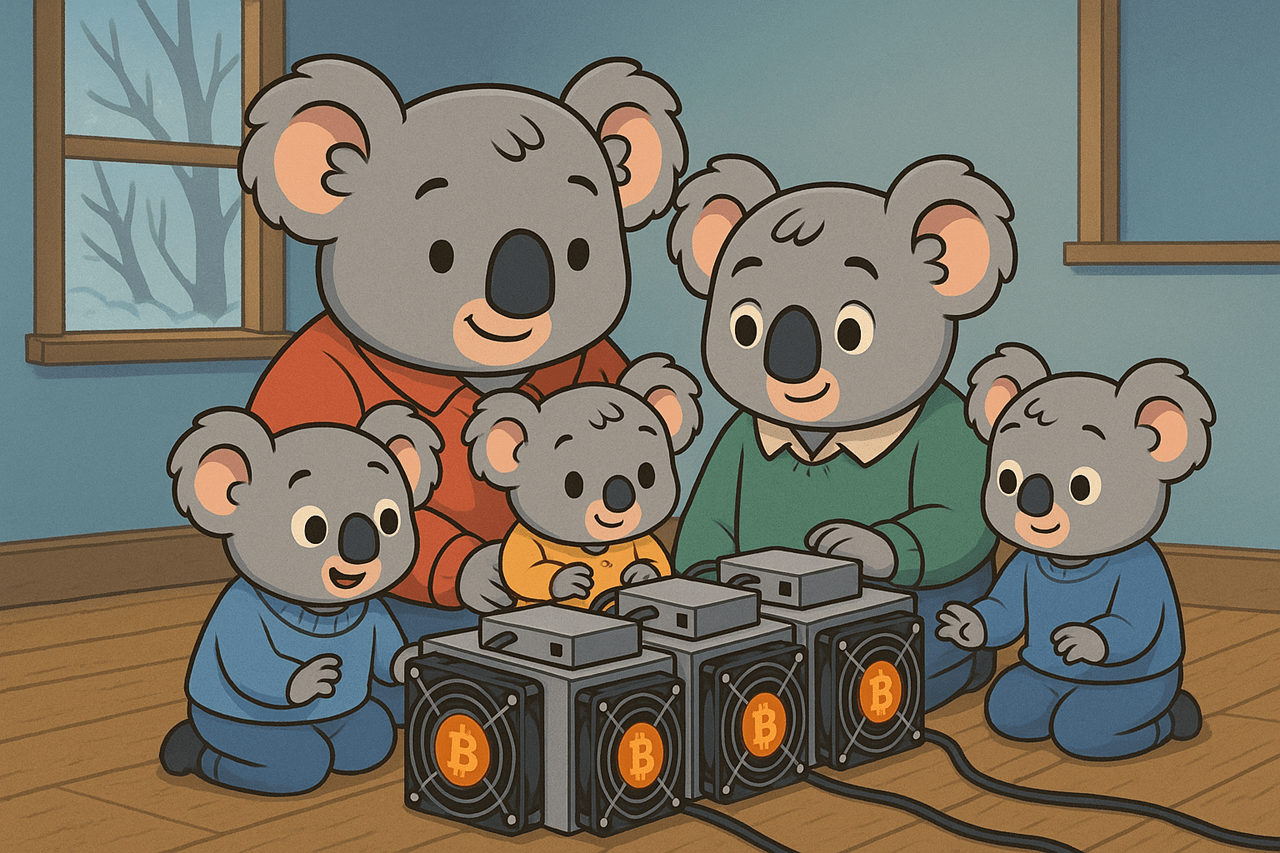

Summary: Yes but it’s only a replacement for space heaters and can never replace an electric heat pump because they are far more efficient. If you can tolerate the extra work, noise, and hassle, a bitcoin miner may be a fun way to generate heat and bitcoin as a small rebate.
Every winter, I see tons of Facebook ads for bitcoin miners that can double as space heaters.
But, much like solar panels, everything they claim is legitimate but the question is whether it’s worth it for the upfront cost and hassle.
I’d love to get solar panels but we live in a house surrounded by trees. Whenever I’ve asked solar panel companies (I’ve only done it twice so it’s a small sample size), they’ve had to stifle their laughter when they looked at the maps of our house.
If you’re seeing the ads, you may be wondering, is it worth it?
A bitcoin miner is a space heater that generates a little bit of bitcoin. Almost all the electricity that goes through a bitcoin miner is generated as heat so it’s as efficient as a space heater for generating heat.
When you’re thinking about the type of heat you’re getting, it has all the benefits and drawbacks of a space heater. Good localized heat, noisy, and far less efficient than a heat pump.
Space heaters have a coefficient of performance (COP) of 1. One unit of electricity generates one unit of heat.
Modern heat pumps have a COP greater than 1 so they’re as much as 3.5x more efficient depending on the outside temperature (which is where it draws heat):
When you run a bitcoin miner, you’re only getting 1 COP. You’re better off running the heat pump than the bitcoin miner at almost every temperature outside, especially above 20°F.
Takeaway: Bitcoin miner is a space heater and those are almost always less efficient than a heat pump, but they do offer localized heating. So if you’re only going to heat a small area, a bitcoin miner may be a good alternative.
Let’s say you buy a Heatbit Trio miner, you can expect a hashrate of 10 TH/s. The Trio gives you 400W of mining heat and 1100W of regular resistive heat (it’s also air purifier too). I am a novice when it comes to bitcoin miners but according to Minerstat, 10 TH/s nets you about 38 cents a day.
If you run it 24/7 and it’s a 1500 Watt device, we’re talking 36 kWh/day which in Maryland will cost me around ~$8.07 (yes, we pay 22.4 cents a kWh all in ). The bitcoin makes 38 cents, thus reducing the cost by around 4.7% for just the one miner.
At the time of this writing, bitcoin was $89,027.55 a coin (and mining difficulty was near cycle highs).
From an ROI perspective, we’re talking $139 a year on a $999 device, so a return of 13.9% which, to be honest, isn’t that bad for a mining rig, heater, and air purifier. It does assume that you would’ve paid for electric resistance heat anyway though and isn’t a standalone return.
And if you really want to pursue it, you can buy the same computing power for less. Heatbit packages it up nicely for end consumers but you can get a higher ROI by building one yourself.
Takeaway: At current prices, which you can monitor via Minerstat for each device, a bitcoin miner with 400W of mining heat will get you 38 cents a day. If you pay $999 for a device, it’s a 13.9% ROI plus 1500W of heat.
Bitcoin miners are loud because they have fans cooling the processors – which is where you get your heat. Space heaters are loud too though.
The Heatbit Trio claims it’s about 40 dB, which puts it as loud as a refrigerator. It’s loud enough for you to notice but steady enough (no revving up) that you can have it blend in as background noise. You can mitigate some of the noise by putting it on a vibration dampening mat or putting the machine elsewhere and directing the heat to where you are located through piping, but the noise will still be an issue.
I have a small Lasko space heater underneath my desk and a decibel monitoring app tells me it’s around 40 dB about three feet away. The Heatbit Trio is just about as loud as your average small space heater.
More powerful miners, like some iPollo or Antminer, are significantly louder. The iPollo V2 version is around 75 dB, which is similar to a loud vacuum. The home miner version, iPollo V2, is around 50 dB which is similar to rain or a home refrigerator.
Since noise is a big issue, there are miners that are designed to be like baseboard heaters such as the Canaan Avalon Mini3. Here’s a video reviewing it.
The short answer is that it’s 800W of mining power for 37.5 TH/s that gets you around $1.30-$1.60 a day (if you run it 24 hours) before the cost of electricity. It’s never profitable, but like Heatbit or others, it subsidizes your electricity with bitcoin. It’s also around $900.
If you like the idea but don’t want to spend $1,000, you can build your own.
The most comparable method is go buy a used Antminer S9k where 1300-1400W of power goes entirely to mining. This gets you 13-14 TH/s which is good for ~50 cents a day. It’s loud though, 75 dB, so similar to a vacuum cleaner.
But instead of paying $1,000, you can buy a used one on eBay for less than $250.
Then, spend a few more bucks to buy Antminer silencer or dampening kits to lessen the noise. You should be able to get it to around 50 dB, which makes it comparable to the Heatbit Trio. All for less than $300 or so.
That said, remember that an ASIC miner is NOT a UL-listed space heater. You need to think about safety, especially circuit capacity, ventilation, and fire safety that you wouldn’t with a consumer space heater.
So you could get three Antminers for the price of one Heatbit. You just need to figure out how to set it up and hook it up to generate bitcoin.
To be honest, when I realized that these heater / home bitcoin miners were only generating like 30 cents a day, I lost interest.
That level of ROI isn’t really worth the hassle. You have the up-front cost plus the noise pollution of the miner itself. Even if you went homebrew and purchased Antminers, you’re increasing the ROI but still have to deal with the noise.
And when the summer rolls around, you have to decide whether you need to add ducting to pump the heat out of the home or shut off the devices.
For me, the novelty isn’t quite enough to justify the up-front cost, noise, and complexity… but I can see why it could scratch that itch for those of you who like to tinker.

Sixty-eight percent of affluent investors were willing to pay for financial advice in 2025, up 10 percentage points from 2024...

The federal government is making moves that will reshape how colleges operate and how families pay for school. This week,...

Publications Archives UnfavoriteFavorite April 9, 2026 UpSkill America, and Economic Opportunities Program Chelsea Miller Associate Director For the working adult...