Building Awareness, One Family at a Time: How two Michigan children’s savings account programs are strengthening community visibility

Many factors determine the effectiveness of a children’s savings account (CSA) program. But first, the community needs to know it exists. For newer programs, and those that rely on parents and guardians taking active steps to unlock the full benefit, building that awareness can matter as much as the dollars deposited into students’ accounts.
With support from an Innovation & Sustainability Grant administered by CEDAM and funded by the Michigan Department of Labor and Economic Opportunity, two Michigan CSA programs took different approaches to that knowledge gap. The Storrs Family CSA Program and My Future Fund in Washtenaw County utilized this grant funding to make their programs more visible, approachable, and impactful for their communities.
Storrs Family CSA Program: Making connections at Grandparents Day
Opening accounts for an entire student body at once is a major logistical lift, but building widespread awareness and community trust presents an even greater hurdle. The Storrs Family CSA Program faced a unique version of this challenge when it launched in early 2025 through a partnership between the Huron County Community Foundation (HCCF) and Harbor Beach Community Schools. Unlike traditional models that build community momentum over time before raising funds, this program was established almost overnight with funding already in hand. That meant the team had to secure local buy-in quickly, educate families on how CSAs work, and earn the region’s trust.
With grant support, the Storrs Family CSA Program developed a dedicated website, outreach materials, and event displays to connect directly with families. One of their most impactful opportunities came at Harbor Beach Elementary’s Grandparents Day. Setting up an information and deposit table allowed program leaders to introduce the initiative to extended family members who play key roles in supporting their students’ futures. The strategy paid off: the event generated deposits across 62 unique accounts—the program’s highest single-day total to date and a 51 percent increase over the previous record.
“Nearly every elementary student welcomed a grandparent or grandparent figure to the building during that event,” said Mackenzie Price, HCCF executive director. “Partnering with the school to host a deposit and information table during this event allowed us to reach brand new family members and community members who had never heard of the program.”
Beyond schools, the Storrs Family CSA Program has expanded its reach onto the airwaves. After learning about the program through local events, a local radio host invited Price to discuss the program during a live broadcast at the Harbor Beach Maritime Festival.
“This is just one example of how, especially in rural communities, word-of-mouth advertising is a strong strategy for growing awareness and excitement,” said Price.
Establishing a graduation toolkit
The Storrs Family CSA Program also aimed to address another practical gap. Because the program launched only five months before its first batch of students graduated in 2025, many families didn’t know how to access their funds or what they could use them for. To clarify this, the program used grant funds to create a Graduation Toolkit, which included an online intake form and FAQ document. HCCF distributed the toolkit online and through school communication channels ahead of the 2026 graduating class.
“Parents in particular appreciated the toolkit,” Price said. “While the messaging was aimed at students, parents appreciated a better understanding of how to support their students [in] accessing and utilizing the dollars.”
After more than a year on the books, the Storrs Family CSA Program has reinforced the value of meeting families in familiar spaces and letting awareness grow through trusted relationships—especially in rural communities. When a program is still getting off the ground, Price said it is essential to stay persistent in finding what works.
“Recognize that your CSA is always evolving,” Price recommended. “Not every event or idea will be a smashing success when you first start. That doesn’t minimize the impact of the work or the value of the activity to the students and the program. Continue to take feedback and improve as you go.”
My Future Fund: Turning awareness into action
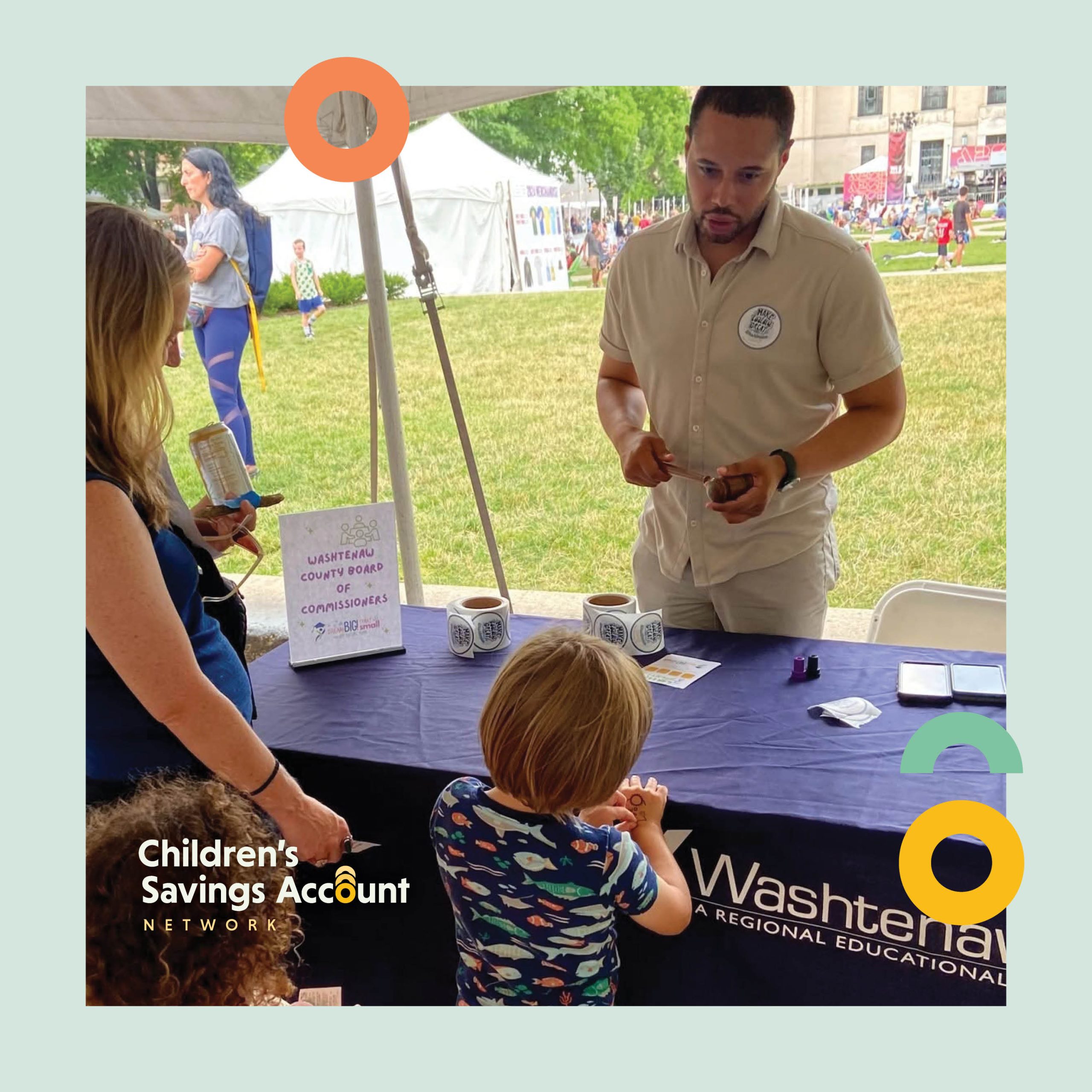
In Washtenaw County, My Future Fund faced a different awareness challenge. Established through Washtenaw Intermediate School District in collaboration with Washtenaw County government, the program already served tens of thousands of students. Still, many families had not completed an essential permission form required to unlock additional benefits, including a potential $475 bonus.
As part of its commitment to equity, the Washtenaw County Board of Commissioners designated additional My Future Fund allocations for students from low-income families, determined by students’ Supplemental Nutrition Eligibility (free and reduced lunch) status. However, to determine eligibility, the My Future Fund program requires parents and guardians to complete a permission form. The program has faced some barriers in communicating this process to families.
“Although the form only requires some basic information, it is still another thing parents and guardians have to do,” said Sara Saylor, CSA coordinator at My Future Fund. “Families are sometimes confused as to what it is, and many have legitimate reasons for being skeptical. We want to help them understand what the form is about, and how it can help their students.”
Trusted ambassadors and community events
With grant funding, My Future Fund addressed this challenge by galvanizing a team of parents and guardians already trusted in the community. The program expanded its ambassador team from two to four, adding trusted community messengers who could connect with families at school and community events. Between January and August 2026, ambassadors supported 54 events, using branded materials, giveaways, and casual conversations to introduce families to the program and the form, helping them take the next step.
“Having ambassadors has allowed us to expand our reach significantly,” Saylor said. “People already know who they are, and trust them. This continued presence humanizes [the program] for families.”
The program also brought awareness directly into schools by sponsoring 10 eighth-grade promotion ceremonies. At these events, students received personalized certificates and information about their accounts, along with a $20.30 bonus recognizing the Class of 2030.
“It was impactful for the program to be present at events that families would already attend anyway, like the ceremonies,” said Saylor. “These are positive, celebratory environments and trusted settings. There’s inherent credibility in that.”
These efforts helped My Future Fund collect 2,054 new form submissions during the grant period, increasing overall completion to 59% across active accounts. After submitting the forms, an additional 480 students became eligible for the $475 bonus, unlocking $228,000 in additional investments in students’ futures.
“The [Innovation & Sustainability] funding has allowed us to scale these incentives in a way that we haven’t been able to before. This has translated to real results for students,” Saylor said.
To build on the awareness raised during the ceremonies, and give families ample opportunity to secure the $475 bonus, My Future Fund also introduced a login incentive tied to its online portal, where students and their families can watch their savings grow. During a special bonus window, families who logged in could receive an additional $25, creating another low‑barrier opportunity to engage with the program. The strategy worked: 803 students had a family member log in during the incentive period. This simple touchpoint helped reinforce the importance of the permission form while meeting families where they already were.
Putting awareness at the foundation
Although the Storrs Family CSA Program and My Future Fund started from different places and points in their program history, their experiences point to the power of community awareness and how it is built through consistent, personal connections over time. Whether introducing a brand-new initiative to a rural community or helping thousands of families better understand the existing account structure, both programs demonstrate the value of meeting people where they are.
Storrs Family CSA Program and My Future Fund are among 18 programs currently enrolling students in the Michigan CSA Network, a statewide initiative led by CEDAM. The Network supports community-based CSA programs through coalition building, technical assistance, and shared resources. In 2025, CEDAM and the Michigan Department of Labor and Economic Opportunity awarded Innovation & Sustainability Grants to 10 organizations across the state.
To learn more, visit the Michigan CSA Network webpage or email CEDAM’s director of economic initiatives, Madeleine March-Meenagh, at [email protected].
Many factors determine the effectiveness of a children’s savings account (CSA) program. But first, the community needs to know it...

As artificial intelligence juggernaut Anthropic prepares to go public, financial advisors have similar advice for clients as they did for...

For most people, the answer to “do I have to pay back grants?” is no. Federal Student Aid describes a...