Program Champions: Lansing SAVE uses Innovation & Sustainability Grant to expand youth intern program

What happens when students are given a real seat at the table to shape the programs designed for them? You unlock a powerful model for youth leadership and community-driven success.
Lansing SAVE, a children’s savings account (CSA) program managed by the City of Lansing’s Office of Financial Empowerment, provides local students with a foundation for long-term education and financial success. To deepen student engagement and build youth leadership from within the schools, the program applied for and received an Innovation & Sustainability Grant administered by CEDAM and funded by the Michigan Department of Labor and Economic Opportunity. With this funding, Lansing SAVE successfully expanded its youth intern program and put students at the center of its financial empowerment work.
Cutting through administrative tape
Before launching the youth intern program, the Lansing SAVE team struggled to gain traction. Standard outreach methods weren’t working; scheduling meetings with busy administrators was tough, and connecting directly with students was even harder. To break through these barriers, Lansing SAVE used an initial Innovation & Sustainability grant to pilot a student intern position at Everett High School during the 2024-25 school year.
“It was really challenging because administrators were really excited about the idea and then we would try to schedule meetings and get the ball rolling, and we just kept hitting roadblocks,” said Tiffany Lemieux-McKissic, director of the Lansing SAVE CSA program and the City of Lansing’s Office of Financial Empowerment. “When we hired Xavier, he was able to just cut through that administrative tape, and within two weeks he had everything scheduled that we needed to hold an informational meeting and establish a schedule for deposit days.”
Xavier, the program’s first student intern, also brought fresh ideas for boosting student engagement. Lansing SAVE staff regularly sat in the cafeteria at Everett High School to collect survey responses from students about the CSA program, connecting with only 10 to 11 students per visit. When the team asked Xavier how to get his peers talking to them, his answer was simple: Put hot chips on the table.
“We were like, ‘OK, all right, we’ll try it,’ and then we were blown away by the results,” Lemieux-McKissic recalled. Paired with a little swag and a deposit incentive, offering students bags of spicy chips drew lines that wrapped around the cafeteria. The hot-chip strategy, combined with swag and incentive giveaways at cohort assemblies, resulted in more than 1,500 student surveys collected during the 2025-26 academic year—including nearly 600 in a single day. The results proved just how powerful student-generated ideas can be.
Expanding reach across Lansing high schools
Building on the Everett pilot, the Innovation & Sustainability Grant enabled Lansing SAVE to scale its youth intern model across the district. In 2025-26, the program expanded to Eastern High School with intern Nautikah, and Sexton High School with intern Kayana. Looking ahead to 2026-27, it will expand to Lansing Tech, a trade high school where students learn technical and career skills.
To secure school cooperation and give interns the flexibility they need during the school day, Lansing SAVE provided $2,500 capacity-building grants directly to each high school—Sexton, Everett, Eastern, and Lansing Tech—for a total of $10,000. Schools could use these funds to cover staff time, logistics, communications & outreach, and school-based project coordination needed to implement engagement activities and sustain youth board efforts. This targeted support not only strengthened cooperation between the schools and Lansing SAVE, but enabled the youth engagement model to expand from a pilot to a districtwide approach, ensuring each high school had the resources to participate equitably.
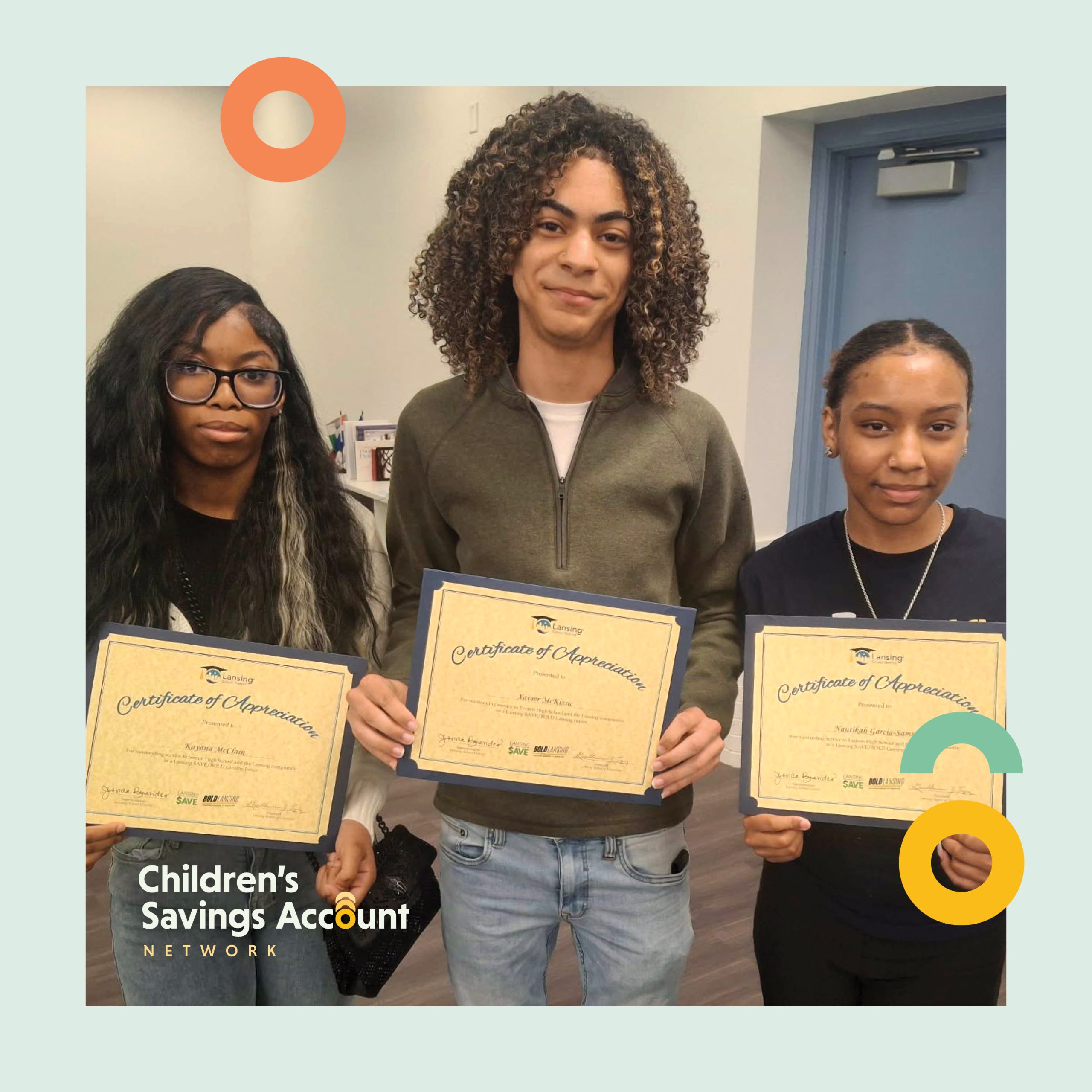
To recognize this partnership, administrators from all four high schools received the capacity-building grant checks at a Lansing School Board meeting. The Lansing Deputy Superintendent also honored the three youth interns with certificates of appreciation for their dedication and leadership. This public celebration not only spotlighted the powerful, unified partnership between Lansing SAVE and the school district, but it also provided a meaningful platform to elevate and celebrate the students’ hard work in front of their community.
As a result of these student-led initiatives, student participation surged at every high school using the model. Everett saw a 40% increase in student deposits, Eastern increased by 32%, and Sexton by 29%. This further underscores the importance of peer-driven engagement strategies.
Peer-driven engagement
In addition to the student interns, each high school established its own Youth Board of 10 to 15 students to deepen peer leadership. “The youth boards are really awesome because not only were the kids coming up with ideas for events and marketing and student engagement, but they also were focus groups for us,” Lemieux-McKissic explained.
Board members and paid interns earned deposits of $10 to $50 each for attending meetings and volunteering. Meetings included catered lunches, a simple gesture that made board members feel appreciated and encouraged other students to get involved. Students also led student-facing social media and peer-to-peer outreach that vastly outperformed the program staff’s previous efforts.
Equitable incentives for every student
Lansing SAVE’s strategy centers on an equity-first incentive model. Standard matched savings can disadvantage families with fewer financial resources, so the program did something different: any student who deposited as little as a penny received a $25 deposit incentive in their account. By rewarding participation rather than specific dollar amounts, the program encourages the foundational habit of saving—demonstrating that even small amounts saved over time can make a transformative difference. Over the grant period, Lansing SAVE distributed $37,000 in direct incentives to high schoolers.
Student interns helped that model work in practice. At one deposit day event, unprompted by program staff, an intern brought in a jar of coins from home so classmates without cash on hand could still make a deposit and receive the incentive.
“These kids are amazing. Bringing their own change from home for other students’ deposits? That wasn’t even something we anticipated. No one should be concerned about this generation of kids coming up because they are brilliant and capable thought leaders,” shared Lemieux-McKissic.
Students continued to show up in unanticipated ways. At Eastern High School, students set a new program record with 65 deposits in a single day, shattering the previous record of 17, set just one day earlier at Everett. These back-to-back milestones offered another powerful example of how students enthusiastically participate when their peers lead the charge.
Youth leaders take the stage
The student-led model’s impact extends beyond savings balances. Interns have presented to the Lansing school board, spoken at community lunch-and-learns, and participated in regional conferences. Eastern High School intern Nautikah co-led a workshop at the Midwest CSA Consortium, sharing Lansing SAVE’s youth leadership framework with leaders across the region.
When asked why she thinks student-driven leadership resonates so strongly with high schoolers, Lemieux-McKissic pointed to something Nautikah says: “There’s a lot of programming for them, but not by them. Having youth voice and representation changes how a program operates.” Lemieux-McKissic added, “And that’s true; that insight has changed everything for us about how we operate.”
By placing trust, resources, and decision-making power in young people’s hands, Lansing SAVE transformed how its CSA program engaged high school students. Through its student intern program, Lansing SAVE has empowered students to lead financial education in their own schools and built a culture of saving and peer support.

Learning how to cancel a timeshare can feel urgent when fees rise, trips go unused, or the sale no longer...
What happens when students are given a real seat at the table to shape the programs designed for them? You...

LISTEN TO THE PODCAST Opportunity Zones (OZs) open the door to billions of dollars in potential investment for community‑driven projects...