Initiatives and people boost rural opportunities
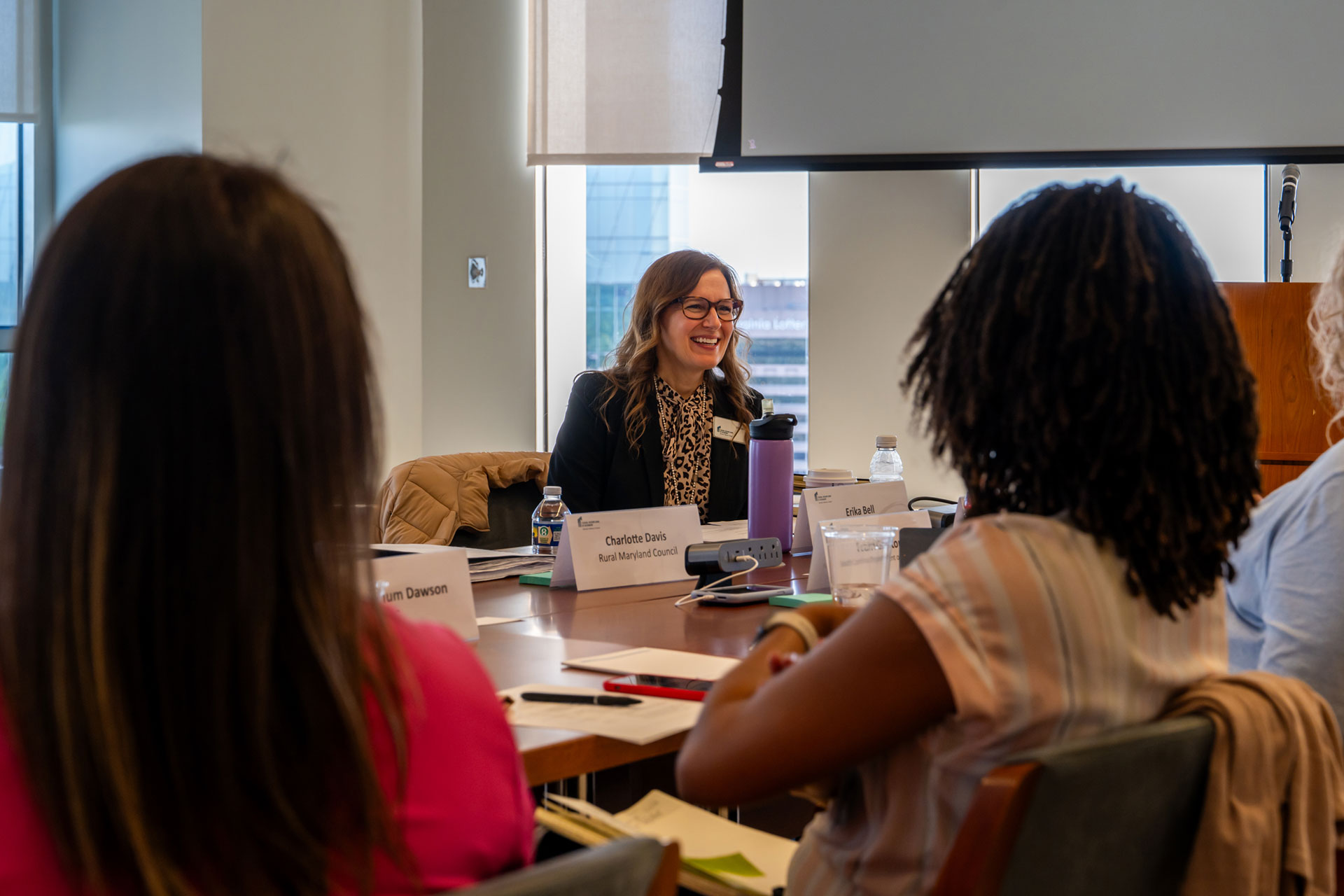

Erika Bell participates in a discussion with Rural Investment Collaborative Steering Group members.
While Federal Reserve employees have different backgrounds, some working on its rural initiatives have important ties to rural communities. That helps drive the work of Erika Bell, community development regional manager at the Federal Reserve Bank of Richmond (Richmond Fed). Erika has leveraged her personal and professional experiences to impact the Richmond Fed’s rural work including the Investing in Rural America Conference, Investing in Rural America Webinar Series, and Rural Investment Collaborative, which are housed in the Center for Rural Economies.
Erika grew up on a family farm in a tight-knit community. In her family since the 1880s, the land has 300 acres of pastures and woodlands. On the edge of York County, South Carolina, which is now a Charlotte, North Carolina suburb, back then it felt like her village.
How she describes her childhood sounds like our daydreams about a rural upbringing: playing barefoot on a dirt road on many acres of land. Life revolved around the rhythms of the land, and family. As beef cattle farmers, it was “all hands on deck” for picking up hay bales twice a year. Erika’s parents planted a cutting garden to adorn tables and homes.
Erika lived within walking distance to her grandparents, aunts, and uncles. Several generations attended Winthrop College, later Winthrop University, to stay close to home. Even Erika’s grandfather trained as an airman on the campus when it was still an all-female school.
With the farm just outside the Rock Hill city limits and the interstate nearby, the family gave a conservation easement to Nation Ford Land Trust in 2001 to preserve the open land for generations to come.
We know why rural places are critical to our economy when we think about where so much of our food, lumber and forest products, energy, entrepreneurs, and business owners come from. Rural-area success is tied to the surrounding urban areas, each doing better if the other functions well.
The Richmond Fed’s District includes South Carolina, North Carolina, Virginia, West Virginia, Maryland, and the District of Columbia. Rural areas and small towns make up nearly one quarter of this District’s economy and have deep economic ties with neighboring cities. That’s why the Richmond Fed focuses on them.
Understanding rural employment, business health, and financial resources is essential for the Richmond Fed. This helps fulfill its mission of supporting broad economic growth and informing monetary policy to align with the Federal Reserve’s dual mandate: maximum employment and stable prices.
Looking back on the foundation laid for her by community members—from family to teachers to shopkeepers—Erika sees that everyone plays a key role in their communities. “Every day after school my mother took me to the thrift bread store—where they sold day-old bread for a discount,” describes Erika. “And every day I’d be greeted by the lady behind the counter. She’d ask me about school, grades, friends, and family. I always felt like she cared and I belonged. Now I wonder if she ever knew what impact she had on me. I wonder if people know the impact they have on other people.”
The Investing in Rural America Conference is a flagship event for the Richmond Fed’s Center for Rural Economies. It began in 2019 as a one-day event in Harrisonburg, Virginia. Now nationwide and over several days, the 2026 conference is focused on economic development, small business development, financial inclusion, and workforce pathways in rural communities. The conference provides spaces for people dedicated to seeing rural communities and small towns thrive to connect, learn, and exchange ideas.
The Richmond Fed introduced the Investing in Rural America Webinar Series in October 2025. In these sessions, folks working with rural and small towns across the nation share practical insights and real-world examples. They explore how rural communities thrive, giving participants ideas to apply in their own communities.
“This experience deepened my understanding of capital pathways, community development finance, and the innovative solutions required to address barriers in small towns and rural areas.”
Erika Bell
Federal Reserve Bank of Richmond
Growing up, Erika saw the hard work of both her father and brother who started their own electrical business. During the 10 years she worked with her family, their commercial electrical contracting company doubled in size, and it continues to grow today. With her family, Erika learned the importance of small business development, a skilled labor force, and workforce development.
Erika worked for 18 years with a nonprofit organization, serving three counties, two of which are rural. This gave her a deep dive into community development and access to capital and credit. Erika recalls the impact of co-authoring a US Department of Agriculture (USDA) Rural Development funding proposal that helped secure $35 million for a community wellness center, serving historically underserved rural populations. “This experience deepened my understanding of capital pathways, community development finance, and the innovative solutions required to address barriers in small towns and rural areas,” she said. “I spent so many hours and sweat and tears on that project.”
Through outreach, the Richmond Fed community development teams see rural leaders transforming their communities: breaking ground; revitalizing historic buildings into thriving community centers; creating jobs; securing funding; and showing what small towns can do with the right tools and support.
Seeing a way to amplify these opportunities, they launched the Rural Investment Collaborative in 2022. The Collaborative brings together leaders of rural-serving organizations and communities. They connect to training, resources, and networks to turn ideas into investment-ready projects. Through its Community Investment Training program, local champions build financial and strategic skills to compete for capital and drive sustainable economic development in their towns. Sixty-three rural community leaders engaged in this training since 2024. (Learn more in the 2025 Annual Report.)
When the Richmond Fed’s Investing in Rural America Conference went virtual with the pandemic in 2020, Erika naturally jumped in to lead a session on rural disaster recovery and resilience, “Hurricanes, Fires, Pandemics, Oh My!” Co-leading the event for the next two years, she brought it back from the virtual stage to in-person. Research staff now lead this impactful annual event. But Erika remains involved: at the most recent conference, she moderated “Banking on Community: How Community Reinvestment Act (CRA) Funding Can Help Strengthen Small Towns and Rural Places.”
To shine a light on those making a difference in their own small towns, regions, and rural communities, Erika leads the Investing in Rural America Webinar Series. Also supporting the Richmond Fed’s Rural Investment Collaborative, Erika notes that, “With my nonprofit and small business development experience, I can perfectly relate to our Community Investment Training participants.”
Having grown up in a rural community around small businesses and rural-serving non-profits, she can better understand the people, and their needs, fears, and grit. She knows firsthand the impact that individuals and programs can have in rural communities. In the roles of convener, educator, and collaborator, the Richmond Fed and staff such as Erika Bell are helping to build economic opportunity, one rural community at a time.

Graduation is a big milestone. You’ve put in the work and now you’re ready to move forward. But for many...
Erika Bell participates in a discussion with Rural Investment Collaborative Steering Group members. While Federal Reserve employees have different backgrounds,...
Blog Posts Archives Part one of a series highlighting Newport Festivals Foundation’s internship program and broader Creative Youth Development work...