Make Your Values Mean Something

Senior Director of Organic Recycling, Waste Management
Lessons in Leadership with Eric Myers
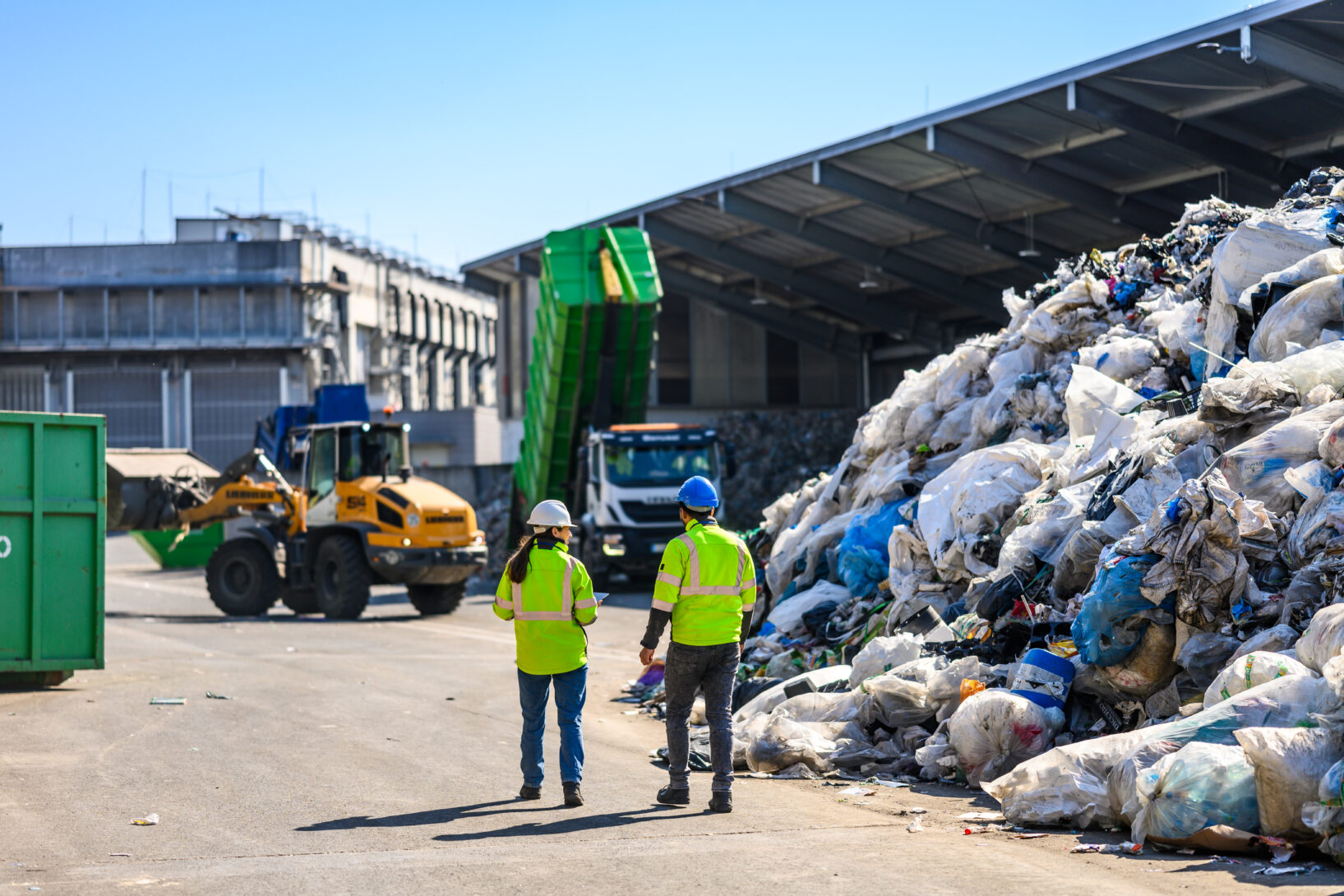
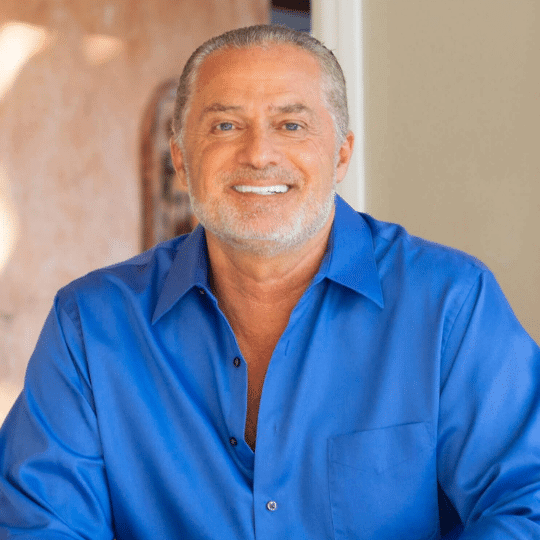
Eric Myers is the Senior Director of Organic Recycling at Waste Management, where he leads development of current and next-generation beneficial use solutions to create higher value products from the organic portion of the waste stream. Eric joined Waste Management in June 2010 and has over 30 years of experience in the recycling and organics residuals management industry. He has bachelor’s degrees in both Forest Engineering and Wildlife Management from the University of Maine, has served on several industry boards, and is an Aspen First Mover Fellow.
What early professional experience shaped your approach to leadership?
I’ve been fortunate to work with some really great companies. People always say that, but it’s especially true for me, and it’s kind of hard to pick just one. But I’ll tell you the first thing that came to mind.
Right after college, I worked for the company Patagonia. A lot of us rode our bikes to work or went running during the lunch hour, and we were lucky because we had an employee shower. Patagonia was relatively small at the time, so they didn’t have cleaning staff. Our team had to clean the office.
Over time, with everyone using the shower, it was a mess. One morning, everyone came in, and the shower and the bathroom were totally spotless. Nobody knew who had cleaned it. Eventually, we figured out it was the manager of the whole operation. She didn’t assign the task, she didn’t complain, she just quietly did it herself. That had a huge impact on me. It was my first real lesson in servant leadership.
What I learned was that leadership isn’t about asking people to do things you wouldn’t do yourself. It’s about modeling the behavior you expect from others. I’ve tried to carry that through my career, and I’ve never asked someone to do something I wasn’t willing to do myself.
What professional advice do you wish you’d received earlier in your career?
Seek first to understand, then to be understood.
It’s challenging for me, because I naturally like to think out loud and talk through problems. Over time, I’ve learned that asking thoughtful, open-ended questions is almost always more valuable than offering quick answers.
One technique I like is asking the Five Whys, where you keep asking some version of why to move past the first answer and gain deeper understanding. It helps me understand what is driving someone’s thinking, and when you truly understand someone’s fears, motivations, goals, and perspectives, collaboration and alignment become a lot easier. And it helps you think through how to solve problems that often seem impossible.
What makes it possible for a person to lead with courage and conviction?
Knowing your values and having a clear North Star.
There was a point in my career when I worked for a different company, and I was dealing with a really difficult situation with a customer. We were under a lot of pressure to do something that didn’t align with my personal values, and I suspected it didn’t align with the company values. In situations like this, I use something that I call the ‘rocking chair test’, which is when I ask myself: when I’m retired and sitting in my rocking chair, how am I going to feel about this decision?
When I looked at it from that perspective, I realized how important this was to me. I decided to go to our leadership and tell them that I didn’t think it was aligned with our values or appropriate for us to do. Initially there was some pushback, but it became clear that we needed to stand on our principles, even if it meant losing a customer—which it was happened.
Over time, word spread that we had stood on our principles, and we found new customers who respected this. Even some of our employees told us that they really appreciated the integrity it took to stick to our values, and they appreciated that distinction with our company. That really reinforced something I believe: values may cost you something in the short term, but integrity pays dividends in the long run.
There’s a great book called The Razor’s Edge by W. Somerset Maugham, and one of my favorite quotes is, “It’s easy to be a holy man on a mountain.” It’s easy to have morals and values until they’re tested and they mean something. It’s easy to have those values when you’re not penalized. When you lose a customer, or you lose a job, or there’s some impact, that’s when you know where your values really are.
What professional accomplishment are you most proud of?
I’m incredibly proud of the work my team has done to advance organics recycling. We’ve developed and patented new technologies. We’ve commercialized new approaches. During my time at WM, we’ve grown organics recycling from under a million tons to almost 4 million tons annually. It’s incredibly rewarding, and this work proves that doing what’s good for the environment can also be good for business. But, honestly, when I think about what I’m most proud of, it isn’t any of those things.
People build the business. I have an awesome team of really smart, talented, thoughtful employees, and they are the best part of this work. Trying to figure out what makes them tick and how to motivate them in a way that’s meaningful to them and to the organization—those are the things I love.
Years ago, I had an employee who worked on a sorting line removing contamination from recycling. He’s a bright, hard-working guy, but he didn’t see himself as someone who could take on more responsibility. I saw something in him and I encouraged him to take another step and become an equipment operator, even when he believed he wasn’t capable. Fast forward to now: he manages that entire facility. He has several lines of business and oversees 125 people.
I didn’t accomplish that; he did. But I’d like to think that I helped him see something in himself that he couldn’t before. If 10 years from now, people remember me for how I helped others grow into something more than they thought they could be, that would mean a lot to me—more than any patent or business milestone.
How has your Aspen experience shaped your view of the world?
The work that the Aspen community does is hard work. Whether it’s sustainability or social impact or systems change, it’s hard work. And one of the greatest benefits of the First Movers Fellowship was that it helped me realize that I’m not doing this work alone.
I’m now part of this Aspen community. We’re all trying to create meaningful environmental and social change from within organizations that know they need to do something but have a tremendous amount of inertia. The ability to have a cohort where you share failures and successes and strategy and encourage each other has been one of the biggest benefits for me.
The other benefit of this network is that it makes you realize that it is possible to make meaningful change happen. If you add up all of these really bright people working diligently—not perfectly—you realize that together we can accomplish a lot.
What was the impact of your Fellowship experience?
My project was to try and ingrain organics recycling as a core part of WM’s business. After 16 years, we’re finally starting to get there.
The two most powerful tools I learned from the Fellowship were storytelling and problem reframing. These tools gave me the courage to do and say things that I ordinarily might not have. Storytelling in particular was totally foreign to me at the time.
I had a really big meeting with the entire C-suite of our company where they were asking me what my strategy was and where the organics business would be in five years. I’m an engineer, so my default approach would be to go into this meeting with data and statistics. But, because of what I’d learned in my Fellowship, I instead went in with this mindset of, “What really appeals to the CEO? I’m going to try to appeal to what I think works for him.”
So, in this meeting, I said to the CEO, “You hired a guy before me. He came in and told you all these things that were going to happen, and a lot of that didn’t happen, and it didn’t really work. One thing I can tell you is that organics is a big area of focus in the waste stream. It’s very dynamic, and it’s hard to predict. So the only thing I can tell you about five years from now is, if I give you a number, it’s going to be wrong.”
He said, “Okay, but you’re responsible for this. What’s your strategy? You’ve got all these people. How are we going to grow this business?”
I paused for a moment, and then told him, we’re going to grow by using the coyote strategy. Our CEO had a playful side, so he said, okay, I’m biting, what’s the coyote strategy? I explained that if you study coyotes, you learn that they’re extremely adaptable. They can survive in rural, suburban, or urban environments—they’re even in New York City. It’s a very successful species. Sometimes they eat mice or rabbits, or they’ll work together to take down a deer. But sometimes they have to eat blueberries just to survive. The point is: they know how to sniff around to find food.
We’ve assembled the most talented group of people in the industry. I know this industry; I’ve been in it my whole career. We know how to sniff around. We’re going to tell you when we can catch a rabbit, take down a deer, or when we just have to eat blueberries.
Honestly, that probably bought me like three years. The executive team was basically like, “Okay, they’re smart people. They haven’t screwed up. They seem to know what they’re talking about. Let’s let them go for a while.” In those three years, we worked our tails off and were able to get some patents and commercialize some approaches, which built our credibility. I wouldn’t have had the confidence to do that if I hadn’t done the Fellowship.
What keeps you grounded?
First, my wife. We’ve been married a long time, and she knows me well enough to know when I’m missing something or when I’m taking things too seriously.
Second, spending time outside. It’s what motivates me. I surf all year round in New Hampshire. I get up into the mountains. We skied in Chamonix last year. Even just working in the garden is awesome. I grow a whole bunch of vegetables. We, of course, make our own compost. Nature has a way of putting everything into perspective for me. It reminds me of why the work I’m doing matters.
I also have lots of little rituals that I do. I like to research what successful people do and shamelessly copy their habits. For example, every morning, I write down what’s on my mind, just to get it out from my head onto a piece of paper. Then I write down three things that I’m grateful for. A lot of the time, I am grateful for little things, like, “I saw a beautiful sunflower yesterday,” or, “I really like this pen.” Lastly, I write down three things that I’m in control of that would make today great, and I try and work toward those three things.
The Business & Society Inside View
Want more insights like these? Sign up to receive thought leadership and updates from the Business & Society Program each month!
The post Make Your Values Mean Something appeared first on Aspen Institute.
Blog Posts Archives UnfavoriteFavorite August 27, 2026 Business & Society Program Eric Myers Senior Director of Organic Recycling, Waste Management...
Author Rod Khleif: Top Multifamily Real Estate Mentor, Best Selling Author & Host of Top Real Estate Investing Podcast Multifamily...

In nearly all cases, you can’t close a bank account with a negative balance until you’ve paid back what you...