A secret prison group transformed a prison yard and now teaches the outside world how to connect

This story was originally published on Weave’s newsletter. Every week, you’ll get resources on how to weave our communities and restore social trust.
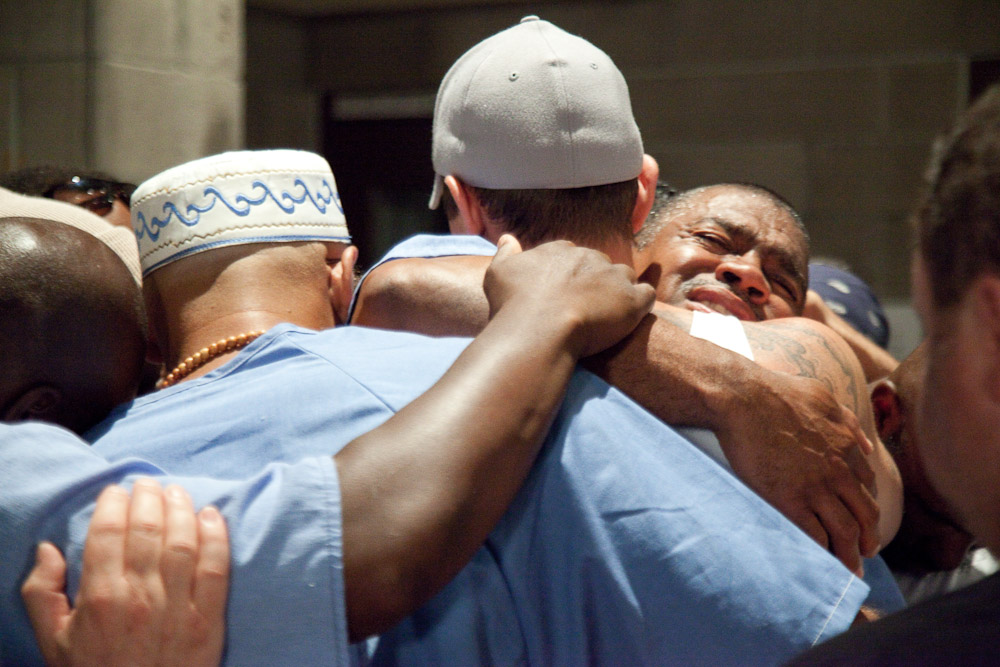
In 1997, in the wake of a massive riot at New Folsom Prison in Sacramento, Calif., something remarkable happened: groups of inmates started gathering each week to talk, share their stories, and seek personal healing inside the prison walls.
The sessions, which were the vision of an inmate named Patrick Nolan, eventually grew into a program called Inside Circle. Nolan had grown “sick and tired of watching us kill one another over skin color, rag color, being from Northern or Southern California or just plain breathing in the wrong direction on a windy day,” says Eldra Jackson III, Inside Circle’s executive director.
Jackson was invited to join Inside Circle in 2004, 14 years into a life sentence in New Folsom. Sitting in Circle saved his life, Jackson says. “I remember being asked who I was and I didn’t have an answer — at least not one that felt honest in a room full of men who were seeking truth.”
Inside Circle was built on the belief that healing a community requires first healing oneself: when individuals heal and change, they bring a transformational energy back to their groups and it spreads to the rest of the culture. At times, Circle resembled an “exorcism,” Jackson says. “There was an extraction of old, diseased ways of thinking, being and reacting, and an infusion of purpose.”
Because Circle was held in the Catholic chapel, prison officials assumed it was a religious program and didn’t monitor it — which was good, Jackson says, because “we were breaking pretty much every rule in the book.” Sessions often became physical, as inmates struggled with overwhelming emotions. But while prison officials didn’t understand what was going on, they saw a “tremendous positive impact on the yard,” Jackson says. “More importantly, their staff, the guards, felt safer. That’s why they allowed it to go on without knowledge of what was actually happening.”
The type and frequency of violence dropped because Circle had “created new lines of communication for folks from different groups, different cultures, and different backgrounds,” Jackson explains.
“When conflicts arose out on the yard, you could go and talk to somebody, and it was more like ‘I’m talking to my brother,’ versus ‘I’m talking to a white guy’ or ‘I’m talking to a Chicano guy’ or ‘I’m talking to a black guy.’ Now I’m talking to somebody who I have an affinity for, who I love, who I’ve sat with and shared tears with.”
Hundreds of paroled men who have participated in Circle, including Jackson, now bring their desire to cultivate trust and healing into their homes, neighborhoods, and workplaces. They maintain close contact, creating a vast support network. “Everywhere someone goes who has ever sat in Circle, a circle is there,” Jackson says.
This network of care has allowed Inside Circle to expand its work into cities and neighborhoods across the country. Programs like Outside Circle bring young people and other community members into Circle with formerly incarcerated leaders, helping them learn that they have choices in life.
“As soon as they recognize that they have more choices, as soon as they recognize that the world is bigger than their own household or the four square blocks they live in, you can see the light bulb go off,” Jackson says. “You can see that revelation and the realization that anything is possible.”
If you are inspired to deepen your understanding of yourself and others in the community, Jackson offers this: Talk to people who don’t look, talk, or dress like you; listen without passing judgment, giving advice, or trying to fix the other person; move past small talk and ask deeper questions about family, safety, love, and fears.
“You’ll see how similar you are, just hearing them talk about those sorts of things,” Jackson says. “You’ll be shocked and amazed. We’re all the same. There is no difference.”
The post A secret prison group transformed a prison yard and now teaches the outside world how to connect appeared first on Aspen Institute.
Texas public schools lost about 76,000 students in the 2025-26 school year, the first enrollment decline outside the Covid-19 pandemic...

If you’re considering a home equity loan and wondering whether you can deduct the interest on your taxes, the answer...

Articles Single-family rentals (SFR) now house 41% of the U.S. renter population, according to Rentometer Mid-Year...