Community Work Is the Best Work: From the Block to the Boardroom

How One Man’s Journey From Prison to Purpose Is Rewriting the Rules of Re-Entry
by Marquan E. Jones
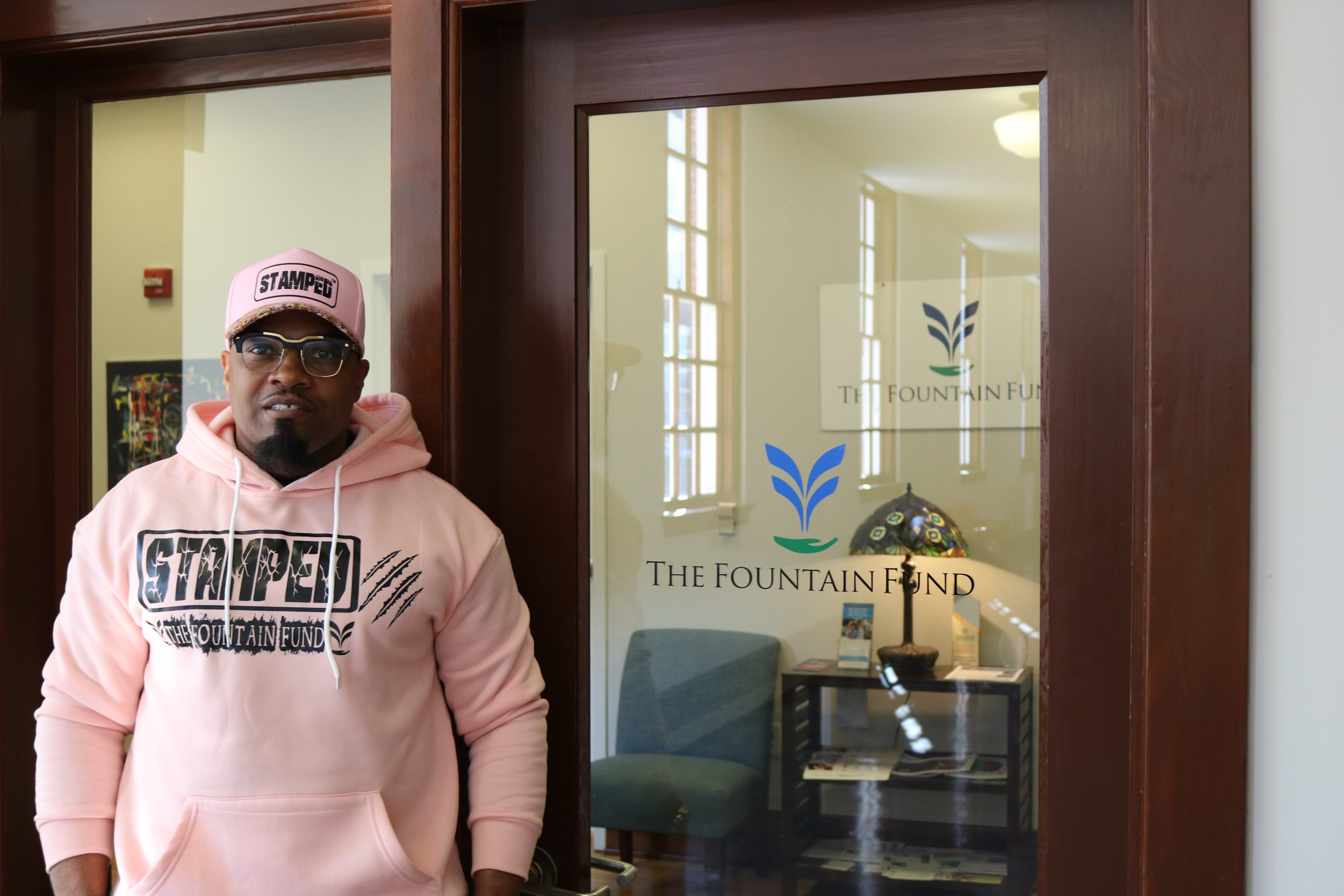
The yellow legal pads are stacked in neat columns on Martize “Tez” Tolbert’s desk at the Fountain Fund offices in Charlottesville. Each one represents a person. A story. A second chance—or a third, or a fifth. Names fill the pages, along with development plans Tez has crafted to help formerly incarcerated people navigate their way back to society. Not just to survive, but to thrive.
“We don’t say no to people,” Tez explains, running his hand over one of the notepads. “We just say, ‘You’re not ready yet. But here’s the steps it takes to get ready.’ Then we give them the support they need so when they do come back, they’re blown ready.”
It’s a philosophy born from lived experience. Tez knows what it’s like to need that fifth chance because he was the one who needed it himself.
Detroit to Charlottesville. Three prison bids totaling ten years. A mother lost. A family exhausted by broken promises. By the time Tez walked through the doors of the Fountain Fund in the early 2010s, he was drowning in debt, behind on rent, an absent father, and carrying the weight of a community that had given up on him—and rightfully so.
“I created that false sense of hope,” he says now, his voice steady but reflective. “My family, my friends—they loved me, but when it came time for me to be serious, they really had doubts. Because I created that. The first two times I went to prison, I said, ‘I’m gonna get it right this time.’ And they were like, ‘What happened the last two times?’”
What happened was Eddie Harris.
Harris, the late founder of Vinegar Hill Magazine and a pillar of the Charlottesville community, had been watching Tez for years. He’d show up on the block where Tez was hustling, never judging, never pushing. Just present. “Whenever you’re ready,” he’d say. “I got the tools whenever you’re ready.”
Eddie was the only person Tez and his crew had ever seen navigate himself out of similar circumstances. He’d been through the same hardships so they wouldn’t have to, but they were too young, too trapped in the survival mentality of the late ’90s and early 2000s to understand what Eddie was offering.
Then Tez’s mother died. His heartbeat. His first love. His doctor, his lawyer. The one constant that had kept him tethered to something better.
“I knew I didn’t want to return back to the streets,” Tez recalls. “I knew the streets were done for me. And I didn’t want her to look down on me still doing the same effed up stuff that I was doing when she was here.”
So he walked into the Fountain Fund. It was Black History Month. And for the first time in his life, someone outside of his family and neighborhood believed in him enough to shake his hand and hand him a check to pay his fines and fees.
“Tez, you take a lot of risks. You took a lot of risks in your life. I’m asking you now to take more healthier risks.”
Eddie Harris said those words to Tez that day, and they’ve lived with him ever since. In fact, Tez says if he ever gets a tattoo—and he has none—it would be those three words: “Take healthy risks.”
“I didn’t know nothing about no Fountain Fund. I didn’t know nothing about repaying a loan. I didn’t know nothing about interest rates,” Tez says. “Eddie just said, ‘That’s all gonna come in time. Just let them people support you.’”
And it changed his life.
The story of the Fountain Fund itself is almost too cinematic to believe.
Tim Heaphy, a former federal prosecutor, walked into a U-Haul rental shop on Rell Road in Charlottesville one day. Behind the counter was a man named Walt. They locked eyes, and there was a moment of recognition.
“You don’t remember me, do you?” Walt asked.
Heaphy did remember. He had prosecuted Walt on a RICO charge years earlier and sent him to prison.
Tez always asks Tim the same question about that moment: “Was you scared? Was you nervous?”
Tim’s answer: “Yeah.”
But what happened next changed both men’s perspectives forever. They ended up in the cab of that U-Haul truck, having a conversation about how they could invest in each other. Tim asked Walt a simple question: “If there’s one thing right now that could support you and help you through all these barriers, what would it be?”
Walt’s answer was immediate: “To be honest with you, get my driver’s license back.
Because if I got my driver’s license back, I could do more things. I could be more mobile instead of driving around without a license, risking my freedom.”
Heaphy, a UVA graduate and attorney, went back to the university’s law school. He researched the barriers facing formerly incarcerated people. And in 2017, the Fountain Fund was born—initially focused solely on helping people get their driver’s licenses back.
The irony isn’t lost on Tez. The man who founded the organization that would eventually employ him as national director had prosecuted his own brother. Some of the men Tez grew up with in the Charlottesville projects, guys he sold drugs alongside, were sent away by Tim Heaphy. Now they’re clients of the Fountain Fund.
“Tim is a hell of a white man,” Tez says with a laugh, then catches himself. “I mean, the dude is… Bro. But it’s not just the way he thinks—it’s the way he puts it into action.”
Today, the Fountain Fund has expanded far beyond driver’s licenses. They provide loans for housing, transportation, entrepreneurship, fines and fees—whatever their “client partners” (never just “clients”) need to build stable, self-sufficient lives.
The model is deceptively simple but revolutionary in its execution. When a client partner receives a loan, the repayment amount is determined not by some arbitrary formula but by what they can actually afford after paying their monthly bills. The Fountain Fund is the only
micro-lender in the country doing this.
“We’re not just making up random numbers,” Tez explains. “We go through a thorough budgeting worksheet—this is what you make a month, this is your bills for the month, and what’s left over is a fraction of what your repayment’s gonna be. And we let them know, whatever that payment is, it goes into a loan fund that helps the next person get the loan. And we’re gonna report to all three credit bureaus.”
It’s a self-sustaining cycle of mutual investment. Each one, teach one. Each one, support one. Peer-to-peer.
Since 2017, the Fountain Fund has disbursed $5.5 million in loans, with $2.5 million already recycled back into the fund. Nearly 1,000 loans have been distributed across five markets: Charlottesville, Richmond, New Orleans, Philadelphia, and Boston.
But the numbers that truly matter to Tez are these: 97% of client partners weren’t incarcerated in 2024. 95% say their experience transformed their entire life for the better. 97% feel supported by the staff.
“It’s not about the interest rates, it’s not about the loans, it’s not about the repayment. It’s about building somebody else up and building them back better.”
“We’re like a bank with a heart,” Tez says. “It’s not all transactional. It’s relationship-based.”
On the morning of our interview, Tez had already conducted three intakes. Three different people with three different dreams.
One man wanted to expand his event space business. The Fountain Fund helped him access capital to grow what he’d already built.
Another man, a registered sex offender, needed to pay court fines to get his license so he could work toward getting his CDL and earn a raise at his job. The Fountain Fund partnered with Network to Work to create a pathway: they’d help him get his license, and their community partner would provide free CDL classes.
A young woman with a newborn baby had mold in her apartment. She wanted to move across the street to a better, bigger unit for just $150 more per month. The Fountain Fund helped make that elevation possible.
“These are all folks coming in with their own self-determined goals,” Tez says. “We don’t set terms of what the loan looks like or what they’re coming for. They come in letting us know what their self-determined goals are. We’re here to match that energy and walk them through the whole journey.”
It’s the opposite of the traditional nonprofit model, where organizations decide what people need. At the Fountain Fund, the client partners are in the driver’s seat. The staff is there to remove barriers and open doors.
“We wanted to dignify people,” Tez explains. “One of our missions is to treat people with honesty, dignity, and respect. Calling them ‘client partners’ instead of participants or clients or job seekers—it reminds everyone that they’re investing in us as much as we’re investing in them. It’s like, ‘I got your back, bro or sis. And I want you to bring some skin in the game, and we’ll match that same energy to get you to that finish line.’”
What sets the Fountain Fund apart isn’t just the loans—it’s the holistic, wraparound support that comes with them. Tez calls it “the warm handoff.”
“We don’t just say, ‘Go to the DMV,’” he explains. “We call it a warm handoff. We say, ‘Hey, go check out my guy Brandon at the DMV. He knows about the Fountain Fund. He’s our
point person there. He can get you squared away. Just let him know you’re a client partner of the Fountain Fund.’ That’s letting that person know we are walking alongside you with this.”
The Fountain Fund has built relationships with community partners across every sector: mental health services, healthcare providers, employment programs, apprenticeships, legal aid. If a client partner needs help restoring their voting rights, connecting with a therapist, finding better employment, or learning to be a better parent, the Fountain Fund knows exactly who to call.
“Sometimes I become… I have a kinship with our client partners,” Tez says. “They’ll tell me, ‘Look, Tez, I wanna be a better dad. How can I be a better dad, man?’ That’s got nothing to do with the loan. But we provide those services through our partnerships and through my own personal lived experience, because that was a journey I was once on.”
And if someone isn’t ready for a loan yet? They’re not turned away.
“We don’t say no to them. We just say, ‘You’re not ready. But these are the steps it takes to get ready. Go see one of my community partners. They’ll set you up with employment or better employment. They’ll set you up with housing. And then once you’re ready, they’ll boomerang you back to us.’ That’s what we call a warm handoff. We’re not telling them no. We’re just telling them not right now.”
Those yellow legal pads on Tez’s desk? They’re full of development plans for people who aren’t ready yet. He works with them, builds them up, prepares them. “If you do one, two, and three,” he tells them, “we can help you with five, six, and seven on the back end.”
Rico Hearns embodies what’s possible when the Fountain Fund model works as intended.
Tez and Rico have known each other since 2015, first as friends, then as professional colleagues. When Tez joined the Fountain Fund, Rico was one of his first client partners. He came in for housing assistance. Paid the loan off. Came back for transportation. Paid that off. Came back for fines and fees. Paid that off. By now, Rico is on his fifth loan with the Fountain Fund—covering everything from better employment to an improved housing situation.
But here’s what matters most: Rico saw his credit score climb with each loan. Instead of going elsewhere for help, he stuck with the people who stuck with him. He saw the benefit of the relationship, the credit building, the wraparound services that connected him to resources across the community.
Now, Rico is one of the Fountain Fund’s biggest volunteers and community advocates.
He tells everyone he works with—guys on the street, people in the re-entry system—about what the Fountain Fund did for him and what it can do for them. He’s referred dozens of people to the organization.
“He knows everything about what the Fountain Fund does, how we support, how we show up for our client partners,” Tez says with obvious pride. “So he tells everybody what the Fountain Fund had done for him and what they can do for you.”
It’s the virtuous cycle the Fountain Fund was designed to create: transformed lives creating more transformed lives.
Four years ago, Tez created something that had never existed in Charlottesville: the One Stop Shop.
It’s a bi-monthly gathering at the Carver Recreation Center that brings together every re-entry and community resource in the area under one roof. DMV representatives.
Apprenticeship programs. Job training. Mental health services. Rights restoration. All with a caterer (shout-out to Chef G) and a DJ (Nicholas Feggans, aka DJ Runaway) to create a welcoming atmosphere.
“We call it a mall of re-entry,” Tez explains. “Everybody’s been to a mall—Sears, JC Penney’s, Foot Locker. Why not have the same setup for folks returning home to our communities? They can get connected to the same things like you can get connected to when you go shopping. Everything will be right then and there.”
The One Stop Shop is free and open to the entire community, not just the re-entry population. Because as Tez points out, “We’re only in a community of 50,000. My brothers and sisters are your brothers and sisters. It’s not just the re-entry population. It’s not just the unhoused population. It’s not the mental health population. We all one population.”
The next One Stop Shops are scheduled for February 24th from 12PM to 3PM and April during Tom Tom Festival—another collaboration Tez helped birth into existence.
Four years ago, Tom Tom Festival founder Paul Byers reached out to Tez. He’d heard about the work happening at the Fountain Fund and wanted to diversify the festival, which had historically catered to a predominantly white, affluent crowd. But Byers was smart enough to know what he didn’t know—and smart enough to bring in people who did.
“He wanted to face more into our community, but he didn’t know our community like the leaders in our community do,” Tez says. “So he’s smart enough to know what he know, and he’s smart enough to know what he don’t know. And he’s smart enough to get the people that do know to come on in.”
Together, they created the Tom Tom Block Party—an event that has become one of the most successful examples of true community integration in Charlottesville’s recent history.
“People look at that as a convergence from all walks of life,” Tez says. “Black, Brown, white, Middle Eastern—it doesn’t matter. From eight to 80. You see people dancing, laughing, congregating, having a good time for two days in a row on the downtown mall. That’s something people have told me they have never seen—that many waves of people in Charlottesville, ever, on the downtown mall.”
And perhaps most remarkably: “Nothing happened at that block party. Nothing happened. Four years going and running, nothing, ever nothing.”
It’s a point Tez emphasizes because he knows what people assume when they hear about a block party in a diverse urban setting. But the Tom Tom Block Party has proven that when you center community voices in the planning, when you treat people with dignity and create space for authentic joy, magic happens.
Now, the Block Party has grown beyond Tez. He’s brought in local DJs—Flatline and DJ Double U (Reggie and Devin)—to lead the way. “It’s not about me no more,” he says. “It’s about we. Now it’s a collaborative, supportive group effort because those guys know best. Those are local DJs, local young guys in our community. It’s about giving them the opportunity to bring in their expertise. That’s how we grow and go.”
Five million formerly incarcerated people live in the United States. Most people understand they face challenges finding employment and housing. But the barriers go far deeper than that.
“We call them a second sentence and invisible cuffs,” Tez explains. “Even though they’re returning to the community, they still have challenges, barriers, and things that are holding them like shackles that they might not even know they have to overcome.”
Court debt accumulation. Suspended licenses. Lack of access to capital. And perhaps most painful of all: rebuilding trust with family and community.
“I did collectively 10 years, but I did three different bids,” Tez says. “So my community, my family, my friends—they all were like, ‘Man, when you gonna get it?’ They loved me, but when it came time to me being serious, they really had doubts. Because I created that.”
This is why the Fountain Fund’s model of long-term, relationship-based support is so crucial. One loan isn’t enough. One intervention isn’t enough. People need consistent presence, patient guidance, and someone who believes in them even when they stumble.
“I wouldn’t be sitting in front of you if somebody didn’t give me that fifth chance. That’s when somebody really believed in me, that fifth time around when I didn’t even believe in myself.”
When asked about the Fountain Fund’s remarkable 97% non-incarceration rate, Tez pushes back gently on the question itself.
“Recidivism is a hard one to talk about because they still can’t calculate what causes people this. Everybody’s got speculations. But from my experience, it’s nonlinear. It’s like climbing a ladder. Sometimes when you climb that ladder, it might be sunny outside and you’re getting good momentum. Then sometimes it could be raining and storming where you might slip and fall down three rungs on that ladder.”
“One thing about the Fountain Fund is we are that ladder. We’re not going nowhere. We’re gonna be a constant. So our client partners, sometimes they’re very successful, sometimes they’re not. They go through ups and downs. We’re here to be that support whenever they do stumble, but not fall.”
It’s this philosophy—staying with people, never giving up, offering second and third and fifth chances—that accounts for the success rate. Not because the Fountain Fund has figured out some magic formula, but because they’ve committed to treating people like human beings who deserve dignity and support through the messy, nonlinear process of rebuilding a life.
“We have an open and honest communication with them, but also that skin in the game,” Tez says. “Letting them know we’re gonna be right there with you through the good, the bad, or the ugly.”
Every market leader at the Fountain Fund has been behind that wall at some point in their life. Every member of the Loan Review Committee includes formerly incarcerated individuals alongside bankers, nonprofit leaders, and community stakeholders. Even the underwriting team has lived experience.
This isn’t tokenism. It’s intentional design.
“Who else better can help shape these problems and challenges than the folks that were in close proximity to this?” Tez asks. “The ones that navigated their way out? I feel like it’s a must that we put more folks with lived experience in leadership and positions of power so we could be the ones to kind of shape and help folks. Meeting them where they’re at because we’ve been there.”
When Tez’s executive director came on board years ago, she made it a priority to have the Loan Review Committee and board reflect the population they serve. “I will say today, 2026, she’s done that and more,” Tez says. “Now, every part, every stage and process through the Fountain Fund, from doing an intake to doing a closing, would all be somebody of some type of lived experience.”
This matters in tangible ways. When a client partner walks through the door, they’re not just seen—they’re understood. The person across the desk has been where they are. They know the invisible cuffs. They know what it’s like to have a community doubt you. They know the weight of that fifth chance.
Tez has been instrumental in shaping Virginia policy around fines and fees. He helped inspire Virginia HB 1895, which eliminates fees and interest accumulation during incarceration.
But he’s not done. Not even close.
“I would love to be at a table with other leaders in our communities, as well as leaders of DOC, just so we can come together to talk about what change looks like,” he says. “Hearing from all different accounts and having that qualitative data from folks that lived that and now are working in that space to try to give them ways to support that population.”
His vision is for a comprehensive 12-month re-entry program that begins before people are released. “Their last 12 months, they know what’s coming. They have people come in to let them know and help them shape and build out a home plan, an action plan. It’s very interactive. Very hands-on.”
He wants people to leave prison with all their documents—birth certificates, Social Security cards, resource lists for whatever area they’re going home to. He wants simulations and scenarios that prepare them for the realities they’ll face.
“The most important time of a newly released individual is that first 72 hours to that first year,” Tez explains. “They’re gonna need that walking alongside them. They’re gonna need that guidance. If that’s not in place, recidivism is gonna remain high, and folks will remain hopeless, without resources, without that connectivity.”
And he wants policymakers to understand something crucial: “The most motivated, the most ready-to-go, that’s plug-and-play, is individuals that’s coming home. Because they know they have lost a lot of time from their family, friends, and they’re ready to get to it. They just need that support to get them there.”
The Fountain Fund is fielding calls monthly from different cities asking why they’re not in their area or how they can come. The model is proven. The need is everywhere. And the organization knows it’s scalable.
But they’re being intentional about expansion.
“For one, it’s gonna take a need,” Tez explains. “Two, we’re gonna have to be invited into that area. It’s not about us just slamming down an office or the Fountain Fund in somebody’s community. It’s about building a relationship. The same way we do with our client partners, we
do the same with our community partners. So there’s gotta be a need. There’s gotta be a buy-in. And then it has to come with funding.”
Tim Heaphy, the chairman, has a vision: he wants the Fountain Fund on every corner like the Boys & Girls Club. “He sees the need just like folks see the need in having a Boys & Girls Club,” Tez says.
But they’re not rushing. “We wanna pause and do it the right way,” Tez says. “We wanna do it methodically. We wanna do it impactfully. And we wanna do it with the support of that community.”
In five years, Tez has a personal dream: to bring the Fountain Fund to his hometown of Detroit, Michigan, and lead that site himself. “I know the need there,” he says simply.
On hard days—and there are hard days—Tez thinks about loan closings.
“When we have clients come in to do their closing, and they’re bringing in their kids, or they’re bringing in their dad, and they’re smiling for the first time because it wasn’t like that when we did the intake,” he says. “Either they were in crisis or looking for stabilization or going through some barriers. But at loan closings, you can see the shoulders are kind of now going down. Smiles are brought back on their faces. And they’re bringing other people around them that they love to this closing.”
He thinks about those impact survey numbers in the highest 90th percentile year after year. “The guy who does that says that’s almost next to impossible,” Tez notes. “But somehow we reach that number every year because we bring that human element back. We bring that dignified folks back. And we wanted to show them something differently that somebody didn’t show them earlier.”
He thinks about Eddie Harris, who passed away recently but whose lessons live on through every person Tez mentors, every life he touches, every chance he gives.
“To keep what I have, I gotta give it away every day. That’s how I keep it. By walking alongside others and sharing lessons and guiding them.”
If there’s one thing Tez wants people to understand about the Fountain Fund, it’s this: “It’s more than just loans. The Fountain Fund is about giving hope and opportunity and trust. From the gate, they already know it’s an investment. We’re investing in people, not just paperwork.”
He quotes Eddie Harris one more time, a lesson that’s become his north star: “Mentorship is the bridge between potential and opportunity.”
For Tez, Black History Month isn’t just February. It’s a daily commitment to honor the work, the testimonies, the stories, and the vision of those who came before—people like Eddie Harris who believed in him when he didn’t believe in himself.
The yellow legal pads on his desk will continue to fill with names. Development plans.
Dreams deferred and then realized. People who walked in believing they were broken and walked out knowing they were just human.
That’s what healthy risks look like. That’s what dignity sounds like.
That’s what transformation feels like when someone finally, finally believes you’re worth the investment.
The Fountain Fund: Visit fountainfund.org to learn more about becoming a client partner or supporting the organization’s work.
The One Stop Shop: Visit onestopshop.org for information about upcoming events. Next event: February 24th from 12PM to 3PM and April 2026 during Tom Tom Festival.
Texas public schools lost about 76,000 students in the 2025-26 school year, the first enrollment decline outside the Covid-19 pandemic...

If you’re considering a home equity loan and wondering whether you can deduct the interest on your taxes, the answer...

Articles Single-family rentals (SFR) now house 41% of the U.S. renter population, according to Rentometer Mid-Year...