Understanding Reach and Impact: OYF Collaboratives are Serving Youth at Scale
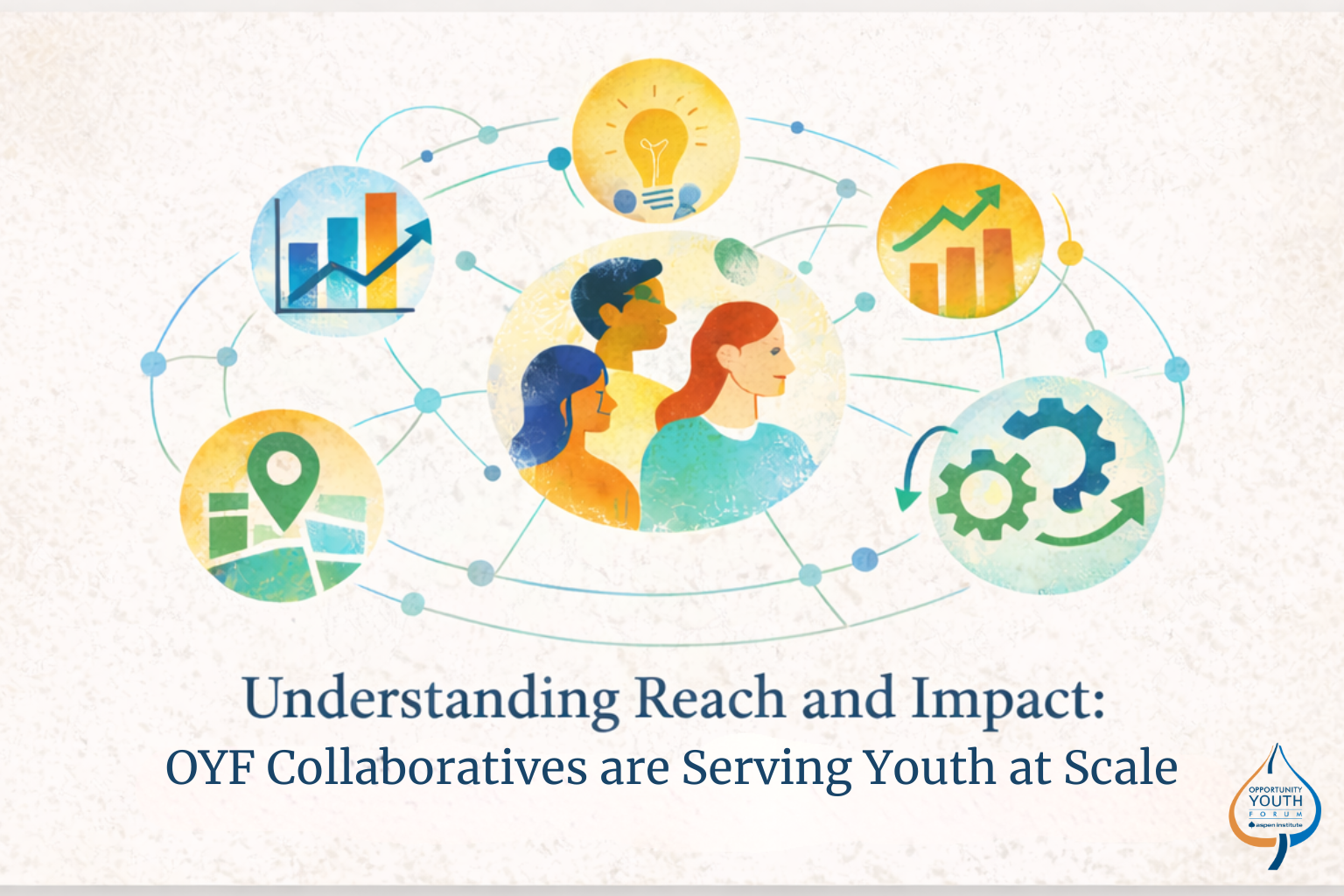

Opportunity youth – young people ages 16 to 24 who are not employed or enrolled in school – represent a population that desire and deserve the support needed to participate in school and the workforce. Across the Opportunity Youth Forum (OYF), over 40 collaboratives are working to reconnect young people to pathways that lead to education and employment, and ultimately, economic mobility. Rigorously tracking the progress of youth served and their outcomes is vital to the network’s goal: achieving 500,000 fewer opportunity youth in OYF communities by 2033.
In 2025, the network updated the process of collecting important youth outcomes data, through a new OYF Collaborative Partner Youth Data reporting tool. This information not only quantifies the scale of local program services, but also highlights the significant youth outcomes achieved in education and employment, which underscores the network’s ongoing commitment to building a robust, long-term outcomes reporting tracking system.
The results from our most recent year of data collection offer new insights, providing the clearest picture to-date of the reach and impact of our network. In 2024, the OYF network collectively served 231,086 youth through prevention and re-engagement programs.
But success didn’t stop at simply reaching young people (a necessary first step); the data also revealed the following key youth outcomes of high school credential attainment, postsecondary credential attainment, and employment: collaboratives across the network reported 23,725 such major youth outcomes among all youth in 2024. These outcomes put young people on a path to social and economic mobility.
Achieving these outcomes is noteworthy, but so is reporting them – these outcomes are notoriously difficult to capture because they are lagging data points that depend on strong follow-up systems and deep relationships with young people. As we continue to better understand the total impact of the OYF network, we anticipate the reported outcome numbers will increase. In part, this is because collaboratives and service providers have traditionally found it simpler to track service provision vs. youth outcomes, and OYF is currently engaged in improving youth outcomes tracking across the network. Additionally, attainment of youth outcomes may take more than a single year. For example, reconnecting a young person to high school does not necessarily result in a high school diploma (a measured outcome) within a reporting year; this outcome (and others) takes time and capacity to track. Additionally, we recognize that the network is serving over 200,000 young people and many of these youth are in services that maintain existing connections (i.e. these are prevention of disconnection approaches), which in many cases are likely to be multi-year interventions that do not get captured in a single year’s outcomes reporting.
This 2024 outcomes reporting reflects not only program success, but also the network’s ongoing work to strengthen outcomes tracking systems.
As we head into 2026, collaboratives will continue to refine systems, build partnerships, and focus on outcomes that change lives. We’re closing 2025 with two promising reflections:
Data collection is a critical part of OYF’s work, providing a window into what’s happening, where there’s momentum, and where additional support is needed. Yet unlike students enrolled in a single school system or those at work, opportunity youth – by definition – are disconnected from a single system that provides clean, reliable data. Many interact with fragmented programs and systems that do not share or maintain robust data, while others have no touchpoints with providers at all, resulting in an incomplete picture of their experiences. Complete, quality data is necessary to identify who opportunity youth are, understand what supports they need to be successful, and determine which pathways and interventions are working.
This challenge of collecting data on youth who are not participating in work or education is one reason why the OYF invests deeply in collaborative data collection across its network of over 40 collaboratives. Building on a rich history of supporting data capacity building, the OYF launched several efforts in 2024 aimed at addressing the unique challenges of capturing data about young people – those at risk of disconnection and those who are disconnected.

The National Student Clearinghouse Research Center released its 14th annual High School Benchmarks report on September 17, 2026, tracking where...

If you’re overwhelmed by education debt, you may be asking, “Can I file bankruptcy on student loans?” The answer is...
A dividend is a cash payment a company sends to shareholders, quarterly for most U.S. stocks. Reinvested dividends account for...